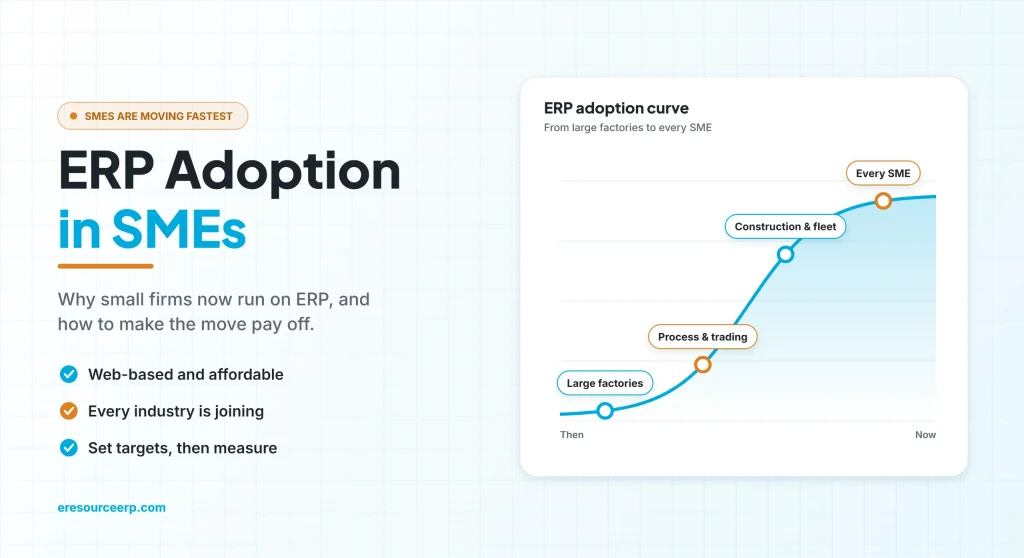
ERP adoption in SMEs has grown faster than in any other segment, because affordable web-based systems now give small firms the same control that once only large companies could buy. Not long ago, ERP was a tool for big factories with big IT budgets. Today, however, small and medium businesses in manufacturing, construction, trading and logistics run their daily work on it. In fact, about 60 per cent of companies on the eresource client list are SMEs. So this guide explains why ERP adoption in SMEs keeps rising, which industries lead, and how to make sure your own rollout pays off.
Key takeaways
- ERP is no longer only for large firms: web-based, flat-fee systems put it within reach of SMEs.
- Every industry is joining: process, construction, trading, fleet and food businesses also use ERP now.
- Compliance is a big push: GST and e-invoicing rules are easier to meet on one system.
- Measure to succeed: set clear targets before go-live, then track them after.
What is ERP adoption in SMEs?
In simple terms, ERP adoption in SMEs means small and medium businesses moving from spreadsheets and separate tools to one integrated system. As a result, finance, stock, sales, purchase, production and HR share the same data.
Of course, the term small and medium-sized enterprises covers a wide range of firms. Still, most share the same goal: grow without adding chaos or a large back office.
How ERP adoption has changed over the years
At first, mainly manufacturing companies used ERP, and mostly for finance, sales and purchase. Later, they added plant maintenance, HR, transport and service modules. Today, in contrast, almost every industry looks for an ERP to run its business smoothly. Overall, the table below shows the shift:
| Area | Early ERP | ERP for SMEs today |
|---|---|---|
| Who used it | Large manufacturers | Firms of every size and industry |
| Setup | Own servers and IT team | Web-based, ready in weeks |
| Cost | High license and per-user fees | Affordable packages, flat fee |
| Modules | Finance, sales and purchase | Production, HR, projects, fleet and more |
| Access | Office desktops only | Browser and mobile, anywhere |
| Changes | Custom code by consultants | No-code setup by your own team |
Why ERP adoption in SMEs keeps growing
Several forces push small firms toward ERP at the same time. Below, then, are the main ones.
1. Lower cost of entry
First, web-based ERP removes the need for servers and large IT teams. Moreover, flat-fee licensing means SMEs do not pay more each time they hire.
2. Faster go-live
Next, ready industry processes let a small firm go live in weeks, not months. So the business sees value quickly.
3. Compliance pressure
Also, tax rules keep getting stricter. For example, GST e-invoicing in India, ZATCA in Saudi Arabia and the UAE’s phased e-invoicing rollout are all easier to handle on one system.
4. Customer expectations
In addition, buyers now expect fast quotes, accurate delivery dates and full traceability. Therefore, SMEs need live data to compete with larger rivals.
5. Mobile and AI tools
Meanwhile, owners and managers want answers on their phones. So modern ERP adds mobile apps, dashboards and AI insights that small teams can use without analysts.
6. Growth across locations
Finally, many SMEs open new branches, sites or warehouses. One ERP then keeps every location on the same numbers.
Industries leading ERP adoption in SMEs
Like manufacturing, the process industry has also gained a lot from ERP. Today, however, the list is much longer:
- Manufacturing and process: discrete, chemical, plastics, pharma and food plants.
- Construction and projects: contractors and project companies that track cost by site.
- Trading and distribution: multi-branch traders that need live stock and pricing.
- Fleet and logistics: transport firms that manage trips, vehicles and billing.
- Automotive suppliers: component makers that must meet strict customer schedules.
- Cement, power and food: sectors with heavy inventory and compliance needs.
Benefits SMEs see after ERP adoption
Once the system is live, most SMEs then report gains in a few clear areas:
- Smoother inventory: stock levels stay accurate across stores and sites, so fewer orders slip.
- Better scheduling: production and shipments follow a clear, timely plan.
- Easier HR: attendance, leave and payroll also run from the same records.
- Faster information sharing: teams, branches and partners see the same data online.
- Softer gains: more transparency, better planning and less stress at work.
Some of these gains, especially the soft ones, are hard to put a number on. That is why measurement matters so much.
How to make ERP adoption in SMEs succeed
To get the real effect of ERP, set your goals before go-live and measure them afterwards. So here is a simple path:
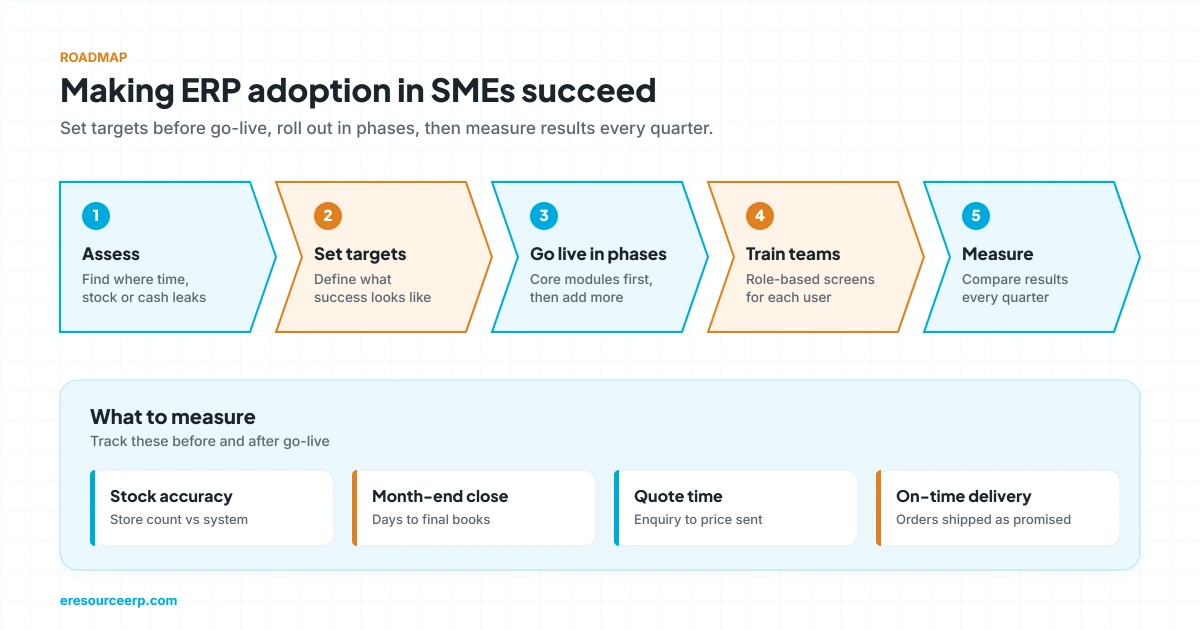
- Assess: first, list where time, stock or cash is lost today.
- Set targets: next, write down what success looks like, such as faster month-end or fewer stock errors.
- Go live in phases: then start with core modules and add more once teams are comfortable.
- Train by role: after that, show each person the screens they use every day.
- Measure and improve: finally, compare results with your targets every quarter.
For more on the payback side, also read about ERP ROI for SMEs.
Common barriers to ERP adoption in SMEs
- Fear of cost: compare total cost over five years, such as per-user fees and servers.
- No time to switch: phase the rollout, so daily work never stops.
- Resistance to change: involve key users early, so they see what gets easier.
- Messy data: clean customer, supplier and item records before migration.
- Wrong fit: choose a system built for your industry instead of a generic tool.
Why SMEs choose eresource
eresource is a web-based, AI-powered and no-code ERP with 37 integrated modules on one platform. It has also served businesses for 20 years, with 3,000+ go-lives.
- Affordable packages: one flat license with unlimited users.
- Industry editions: ready processes for manufacturing, process, construction, trading and logistics.
- Quick go-live: start with core modules, then add more as you grow.
- No-code changes: adjust screens and workflows yourself instead of hiring a developer.
- Compliance built in: GST, ZATCA and e-invoicing from the same data.
- Anywhere access: browser and mobile, for office, plant and site teams.
To learn more, read how to choose the right ERP for SMEs, the key benefits of ERP for SMEs, and why a web-based ERP for SMEs makes sense. You can also see how ERP supports small business growth, read about UAE e-invoicing for SMEs, or explore ERP for manufacturing and construction ERP software.
Frequently asked questions
What is ERP adoption in SMEs?
Simply put, it is the move by small and medium businesses from spreadsheets and separate tools to one integrated ERP system.
Why are SMEs adopting ERP so quickly?
Mainly because web-based ERP is now affordable and quick to set up. In addition, compliance rules and customer demands push firms to use live data.
Which industries lead ERP adoption in SMEs?
Generally, manufacturing and process firms lead. However, construction, trading, logistics, automotive and food businesses are adopting fast too.
How long does ERP adoption take for an SME?
Of course, it depends on scope. Typically, a phased rollout of core modules takes a few weeks, and more modules follow later.
How can an SME measure ERP success?
Set targets before go-live, such as faster month-end or better stock accuracy. Then compare actual results every quarter.
Is eresource suitable for small companies?
Yes. In fact, about 60 per cent of eresource clients are SMEs, and the flat license includes unlimited users.
Planning ERP adoption for your business? Book a free demo, or start with a free ERP assessment.
Also Read – ERP Software for SMEs: Benefits for Indian Businesses