Skip to content


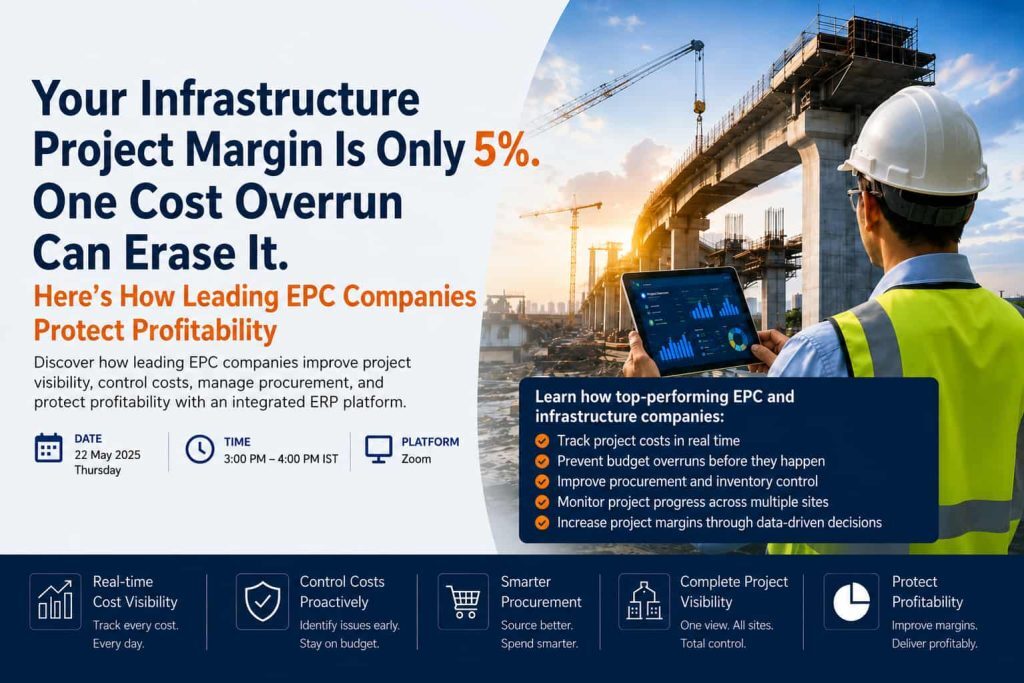
Table of Contents
Why Construction Project Margins Are Shrinking Across the EPC Industry
In today’s highly competitive infrastructure and EPC sector, profitability is under constant pressure. Material inflation, labor shortages, project delays, procurement inefficiencies, and subcontractor disputes can quickly turn a profitable project into a loss-making one.
Industry studies show that construction projects experience an average schedule overrun of nearly 37%, resulting in significant increases in overhead costs, delayed billing cycles, and reduced project profitability.
For most EPC companies, the issue isn’t just rising costs.
The real challenge is the lack of real-time visibility into where project money is being spent.
Many organizations still manage multi-crore infrastructure projects using spreadsheets, emails, WhatsApp approvals, and disconnected software systems. This creates delays in decision-making and allows small cost overruns to accumulate unnoticed.
When project margins average only 5-8%, even a minor deviation can eliminate profitability.
The Hidden Cost of Margin Erosion in Construction Projects
Most business leaders assume margin loss is caused by external factors such as:
- Material price increases
- Labor shortages
- Client-side delays
- Regulatory changes
While these challenges are real, the biggest cause of margin erosion is often poor project cost visibility.
Common Margin Leaks in EPC Projects
Manual BOQ Tracking
The Bill of Quantities (BOQ) is often prepared during estimation and rarely updated during project execution.
Without real-time BOQ tracking, project teams cannot identify cost variances early.
Uncontrolled Procurement Spending
Site teams frequently raise purchase requests without visibility into current budget consumption.
Small procurement overruns gradually become significant project losses.
Subcontractor Billing Variations
Many contractors approve invoices based on manual verification rather than system-controlled progress measurements.
This can lead to:
Overbilling
Duplicate claims
Payment disputes
Delayed project closure
Delayed Financial Reporting
By the time finance teams prepare project cost reports, the project may already be 40–50% complete.
At that stage, correcting the variance becomes extremely difficult.
Why Construction ERP Software Has Become Essential
The global construction ERP software market continues to grow as construction companies seek greater control over costs, procurement, resources, and project profitability.
Modern construction ERP software enables organizations to:
- Monitor project costs in real time
- Compare budget vs actual expenditure
- Track BOQ progress
- Manage procurement workflows
- Control subcontractor billing
- Improve project forecasting
- Monitor project profitability
Instead of reacting to cost overruns after they occur, companies gain the ability to identify risks before they impact margins.
Also Read: ERP for Construction Industry
How Construction ERP Software Helps Prevent Cost Overruns
1. BOQ-Level Cost Visibility
Every project activity can be monitored at the BOQ level.
Project teams can track:
- Material consumption
- Labor costs
- Equipment utilization
- Activity-wise profitability
This enables early detection of cost variances before they become major financial issues.
2. Accurate Project Estimation
Poor estimation is one of the leading causes of project losses.
Advanced ERP systems leverage:
- Historical project data
- Cost benchmarks
- AI-assisted forecasting
- Resource planning
This improves bid accuracy and protects project profitability from the beginning.
3. Real-Time Procurement Management
Construction procurement software integrated within ERP ensures:
- Budget validation before approval
- Automated approval workflows
- Vendor performance tracking
- Purchase order monitoring
This prevents unauthorized spending and procurement overruns.
4. Subcontractor Management
Construction ERP software enables organizations to:
- Match claims with completed work
- Validate milestone achievements
- Track subcontractor performance
- Automate billing approvals
This creates transparency and reduces financial leakage.
5. Mobile Site Reporting
Project managers and site engineers can update:
- Daily progress
- Labor attendance
- Material consumption
- Equipment utilization
directly from mobile devices.
Real-time synchronization helps finance and leadership teams make faster decisions.
Why Leading EPC Companies Choose eresource Nfra
Unlike generic ERP systems adapted for construction, eresource Nfra has been developed specifically for:
- Infrastructure Companies
- EPC Contractors
- Civil Construction Firms
- Industrial Projects
- Government Infrastructure Projects
Key capabilities include:
Construction-Specific Features
- BOQ Management
- Project Cost Control
- Procurement Management
- Equipment Management
- Subcontractor Billing
- Multi-Site Project Management
- Resource Planning
- Project Profitability Tracking
Faster Implementation
Organizations can typically go live within 8-12 weeks, significantly faster than traditional ERP deployments.
Multi-Project Visibility
Executives gain visibility across:
- Projects
- Sites
- Regions
- Business Units
from a single dashboard.
The Question Most Boards Ask Too Late: What Does It Cost to Put Everyone On It?
By this point the case is straightforward. Forensic visibility requires that every cost event enters the system where it happens — the PO at the site office, the material issue at the store, the subcontractor claim at the work face, the labour attendance at the gate.
Which raises the question that kills most ERP business cases: how many licences is that?
On per-user pricing, the answer is brutal. A ₹500 crore contractor running eight sites needs 150–250 people on the system to get real coverage. Priced per seat, that’s a number the CFO refuses — so the rollout gets trimmed to the finance team and two planners. Six months later, the same firm concludes “ERP didn’t work for us.” It did work. It was just only allowed to see 5% of the business.
eresource Nfra is licensed per business. One licence. Unlimited users.
Your site engineers, storekeepers, QS team, procurement, subcontracts, accounts, project directors — all on the same system, all on one licence. No seat maths before every rollout. No rationing logins to protect a budget. No choosing between visibility and cost control, which was always a false choice.
Most construction ERPs price per user, and the cost of visibility scales with the size of your organisation. We price per business, so it doesn’t.
That’s the difference between an ERP you deploy and an ERP you actually run.
Want the numbers on your own operation first? Book a free 30-minute Margin Analysis — we’ll run one of your live projects and show you where the leakage sits.
Also Read: UAE e-invoicing Software Solution
Frequently Asked Questions(FAQs)
Construction ERP software helps contractors, builders, and infrastructure companies manage project costs, procurement, resources, subcontractors, and profitability from a centralized platform.
ERP provides real-time visibility into project costs, procurement spending, BOQ tracking, and subcontractor billing, helping companies identify cost overruns before they impact margins.
Yes. EPC companies use ERP to manage engineering, procurement, construction activities, budgeting, project planning, and cost control.
Most modern cloud-based construction ERP implementations can be completed within 8–12 weeks depending on project complexity and business requirements.
Yes. ERP systems enforce budget controls, approval workflows, vendor management, and purchase tracking, helping organizations reduce procurement leakage and overspending.
eresource Nfra is designed for infrastructure, EPC, civil construction, industrial projects, contractors, builders, and engineering companies.