Table of Contents
Introduction
For many organizations, UAE e-invoicing is still viewed as an upcoming compliance requirement that businesses must prepare for before mandatory implementation. However, the reality is much bigger than simply meeting regulatory obligations.
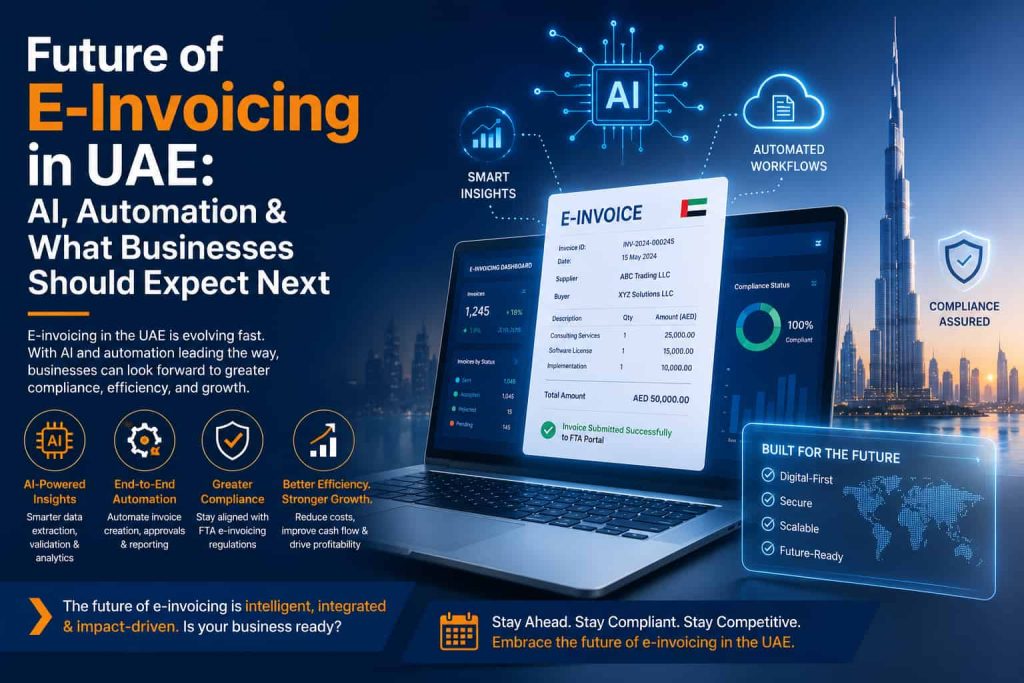
The future of e-invoicing in UAE is not just about replacing paper invoices with digital formats. It represents the foundation of a much broader transformation across finance, taxation, compliance, and business operations.
The UAE is steadily moving toward a digitally connected economy powered by:
- Real-time digital compliance
- Automated tax ecosystems
- AI-driven financial operations
- Intelligent ERP systems
- Connected business platforms
Businesses that recognize this shift early and invest in future-ready technology will gain a significant competitive advantage.
This article explores the future of UAE e-invoicing, how AI and automation are reshaping financial operations, and what businesses should start preparing for today.
UAE E-Invoicing Is the Beginning, Not the End
Many businesses currently approach UAE e-invoicing as:
- A compliance project
- A finance department initiative
- A mandatory technology upgrade
- A regulatory requirement
While these perspectives are valid, they only represent a small part of the bigger picture.
Globally, countries that have implemented structured e-invoicing systems have gradually evolved toward more advanced digital tax ecosystems that include:
- Continuous transaction monitoring
- Real-time tax reporting
- Automated compliance validation
- Intelligent audit systems
- Predictive compliance monitoring
The UAE e-invoicing framework is expected to become a key building block for similar advancements in the future.
Businesses that implement scalable systems today will be better positioned to adapt as regulations and technologies continue to evolve.
Why Governments Are Moving Towards Digital Invoicing
Governments worldwide are adopting electronic invoicing frameworks because they create greater transparency, efficiency, and accountability across economic systems.
Greater Transparency
Traditional invoicing processes often create reporting gaps and opportunities for discrepancies.
Structured electronic invoices create a digital audit trail that provides visibility into every transaction.
Benefits include:
- Reduced tax fraud
- Improved compliance monitoring
- Better transaction verification
- Enhanced financial transparency
Faster Tax Administration
Instead of relying solely on periodic reporting cycles, tax authorities can access validated transaction data much more efficiently.
This reduces:
- Processing delays
- Reporting errors
- Manual verification requirements
Better Economic Visibility
Digital invoicing enables governments to gain deeper insights into:
- Business activity
- Industry growth trends
- Tax collection performance
- Economic indicators
Digital Economy Growth
E-invoicing supports broader digital transformation initiatives by encouraging businesses to modernize systems and adopt automation technologies.
Also Read: ERP for Construction Industry
How the UAE Is Positioning Itself for the Future
The UAE has consistently demonstrated its commitment to becoming one of the world’s leading digital economies.
Government initiatives focused on:
- Artificial Intelligence
- Smart Governance
- Digital Taxation
- Cloud Technology
- Economic Innovation
all point toward a future where business processes become increasingly digital and interconnected.
The UAE e-invoicing initiative aligns perfectly with this vision.
Under the guidance of the Federal Tax Authority (FTA) and the Ministry of Finance (MoF), businesses are expected to adopt digital invoice exchange frameworks that support transparency, efficiency, and compliance.
For organizations operating in the UAE, this means preparing not just for compliance but for a broader digital transformation journey.
Future Trends Businesses Should Watch
As UAE e-invoicing evolves, several important trends are expected to shape the future of business operations.
AI-Powered Invoice Validation
Today, invoice validation focuses primarily on format compliance and structured data verification.
In the future, Artificial Intelligence will play a much larger role.
AI-powered validation systems may identify:
- Suspicious transactions
- Duplicate invoices
- Tax inconsistencies
- Fraud indicators
- Compliance anomalies
As machine learning models improve, invoice validation processes will become increasingly intelligent and proactive.
This represents one of the most significant developments in AI in e-invoicing.
Fully Automated Finance Operations
Manual finance processes are gradually disappearing.
Organizations are increasingly moving toward:
- Automated invoice generation
- Auto-validation workflows
- Automated reconciliation
- AI-assisted reporting
- Intelligent approval systems
Rather than spending time on repetitive administrative work, finance teams will focus on analysis, forecasting, and strategic planning.
This shift will accelerate as UAE e-invoicing automation becomes more widespread.
Real-Time Tax Reporting
Traditional reporting cycles often involve:
- Monthly reconciliations
- Manual tax submissions
- Delayed reporting processes
Future tax ecosystems are likely to become increasingly real-time.
This means businesses may eventually operate within environments where:
- Transactions are validated instantly
- Tax data is available continuously
- Reporting delays are minimized
- Compliance monitoring becomes automated
While this improves efficiency, it also increases expectations around data accuracy and system readiness.
ERP Systems Becoming Central Business Platforms
Historically, ERP systems were viewed as operational management tools.
That perception is changing rapidly.
Modern ERP platforms are becoming the central hub for:
- Compliance management
- Financial operations
- Business reporting
- Tax administration
- Automation workflows
As UAE e-invoicing requirements evolve, ERP systems will play an increasingly critical role in ensuring seamless compliance.
Businesses that continue relying on disconnected systems may face greater operational challenges in the future.
Predictive Compliance Systems
One of the most exciting developments in ERP automation UAE businesses can expect is predictive compliance.
Future AI-enabled ERP systems may be capable of identifying potential compliance risks before they become actual problems.
Examples include:
- Detecting invoice mismatches
- Identifying tax anomalies
- Highlighting unusual transaction patterns
- Monitoring regulatory changes
- Preventing reporting errors
This represents a shift from reactive compliance to proactive compliance management.
What This Means for SMEs
Many small and medium-sized businesses assume that advanced automation technologies are only relevant for large enterprises.
This is no longer true.
Cloud ERP platforms and automation technologies are making sophisticated capabilities accessible to businesses of all sizes.
As a result, SMEs can now:
- Improve operational efficiency
- Reduce administrative workloads
- Enhance compliance accuracy
- Scale operations more effectively
- Compete with larger organizations
Businesses that embrace automation early will benefit from greater flexibility and long-term growth opportunities.
Challenges Businesses Will Face in the Future
Digital transformation creates opportunities, but it also introduces new challenges.
Legacy Systems
Older software often lacks support for:
- Automation
- Real-time validation
- API integrations
- AI capabilities
Businesses may need to modernize technology infrastructure.
Data Quality Issues
AI systems rely heavily on accurate and structured data.
Poor data quality can lead to:
- Reporting errors
- Compliance issues
- Inefficient automation
Lack of Integration
Disconnected tools create operational inefficiencies and reduce visibility.
Resistance to Change
Many organizations hesitate to modernize established processes.
However, delaying digital transformation may become increasingly costly over time.
How eresource ERP Helps Businesses Prepare for the Future
Future-ready businesses require more than basic invoicing software.
They need a comprehensive platform capable of supporting automation, compliance, and operational efficiency.
eresource ERP helps organizations prepare for the future through:
Automated Invoicing Workflows
Reduce manual effort and improve invoice processing accuracy.
UAE Compliance-Ready Architecture
Support evolving regulatory requirements and digital tax initiatives.
Real-Time Reporting Capabilities
Access business insights instantly.
Integrated Business Operations
Connect finance, procurement, inventory, sales, and operations within a single platform.
Scalable ERP Infrastructure
Grow your business without worrying about technology limitations.
As the future of e-invoicing UAE continues to evolve, businesses using integrated ERP systems will be better positioned for success.
Real Business Impact of Automation
Before Automation
Businesses often experience:
- Manual invoicing processes
- Higher error rates
- Slow approval cycles
- Delayed reporting
- Limited visibility
After ERP Automation
Organizations benefit from:
- Faster invoice processing
- Improved compliance accuracy
- Better financial visibility
- Reduced manual workload
- Greater operational efficiency
The long-term benefits extend well beyond regulatory compliance.
The Future of Finance Teams
Finance departments are also undergoing transformation.
The future finance function will focus more on:
- Strategic planning
- Forecasting
- Data analysis
- Business intelligence
- Financial advisory
and less on:
- Manual processing
- Data entry
- Reconciliation work
- Administrative tasks
AI and automation will enable finance professionals to deliver greater business value while spending less time on routine activities.
Final Thoughts
The future of UAE e-invoicing extends far beyond invoice generation and compliance requirements.
It marks the beginning of a broader transformation powered by:
- Artificial Intelligence
- Automation
- Real-time compliance
- Connected ERP systems
- Digital business ecosystems
Organizations that prepare early will gain significant advantages through improved efficiency, better visibility, stronger compliance, and greater scalability.
Businesses that continue relying on outdated systems and manual processes may find future transitions increasingly difficult and expensive.
The smartest strategy is not simply preparing for compliance.
It is preparing for the future of business itself.
Build a Future-Ready Business with eresource ERP
As UAE e-invoicing automation continues to evolve, businesses need technology platforms capable of supporting growth, compliance, and innovation.
eresource ERP helps organizations build a strong foundation for digital transformation through intelligent automation, integrated operations, and future-ready ERP capabilities.
The future belongs to businesses that adapt early, automate intelligently, and embrace digital transformation with confidence.
Also Read: UAE e-invoicing Software Solution