Table of Contents
Introduction
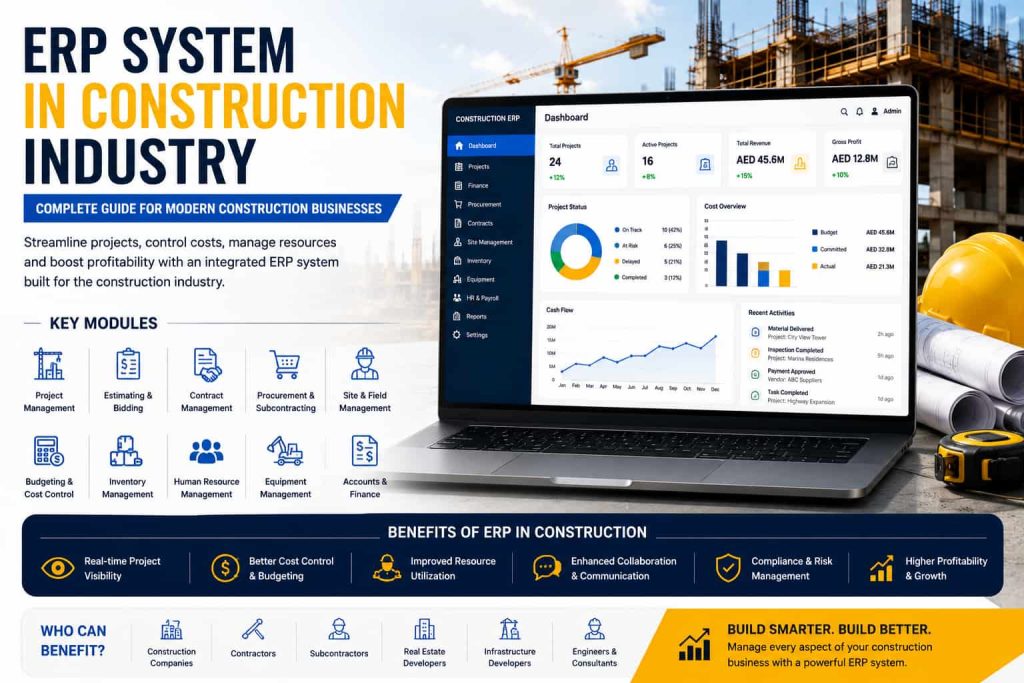
An ERP system in the construction industry is a specialized software solution designed to manage project planning, resource allocation, procurement, financials, and site operations in one integrated platform.
In simple terms, it helps construction companies track project progress, manage labor and materials, control budgets, automate billing, and improve decision-making, all in real time.
With increasing project complexity, tighter deadlines, and rising costs, ERP systems have become essential for construction companies aiming to improve efficiency, reduce risks, and ensure successful project delivery.
What is an ERP System in Construction Industry?
An ERP system in construction is tailored for project-based operations where every activity revolves around managing timelines, resources, and budgets.
It integrates:
- Project planning and scheduling
- Resource and labor management
- Procurement and inventory
- Contract and subcontractor management
- Financial accounting
- Billing and invoicing
- Reporting and analytics
Unlike traditional ERP systems, construction ERP focuses on project lifecycle management, cost tracking, and site coordination, making it highly suitable for construction businesses.
Why Construction Industry Needs ERP Systems
Construction companies face multiple operational challenges due to the nature of projects.
Key Challenges:
1. Project Delays
Poor coordination leads to missed deadlines.
2. Cost Overruns
Lack of real-time cost tracking increases expenses.
3. Resource Mismanagement
Managing labor, materials, and equipment across sites is complex.
4. Lack of Visibility
Limited insights into project progress.
5. Complex Billing
Handling milestone-based and contract billing.
An ERP system in construction industry helps solve these issues by centralizing operations and automating workflows.
Also Read: ERP for Construction Industry
How ERP System Works in Construction
Example Scenario:
- Project is created with budget and timeline
- Resources (labor, materials, equipment) are allocated
- Procurement orders are generated
- Tasks and milestones are tracked
- Expenses and time are recorded
- Project progress is monitored
- Billing is generated based on milestones
- Financial reports are updated
👉 This ensures efficient execution and cost control.
Core Features of ERP System in Construction Industry
1. Project Planning & Scheduling
Defines project timelines and milestones.
Benefits:
Better planning
On-time delivery
2. Resource & Labor Management
Manages workforce and equipment.
Benefits:
Efficient resource allocation
Reduced idle time
3. Procurement & Inventory Management
Tracks materials and purchases.
Benefits:
Avoid shortages
Efficient material planning
4. Contract & Subcontractor Management
Manages vendor contracts and agreements.
Benefits:
Better vendor coordination
Improved compliance
5. Budgeting & Cost Control
Tracks project expenses.
Benefits:
Prevents cost overruns
Improves profitability
6. Billing & Invoicing
Supports milestone and contract-based billing.
Benefits:
Accurate invoicing
Improved cash flow
7. Financial Management
Tracks financial performance.
Benefits:
Real-time insights
Better decision-making
8. Reporting & Analytics
Provides project insights.
Benefits:
Performance tracking
Data-driven decisions
Benefits of ERP System in Construction Industry
1. Improved Project Visibility
Track progress in real time.
2. Better Cost Control
Monitor expenses and budgets.
3. Increased Efficiency
Automates workflows.
4. Accurate Resource Management
Optimizes labor and materials.
5. Faster Decision-Making
Provides real-time data.
6. Enhanced Collaboration
Improves team communication.
7. Scalability
Supports multiple projects.
Real-Life Use Cases
1. Construction Company
Tracks project timelines and budgets.
2. Infrastructure Firm
Manages large-scale projects.
3. Real Estate Developer
Handles multiple projects and finances.
4. Contracting Business
Manages subcontractors and billing.
Common Mistakes Construction Companies Make
- Using manual systems
- Poor resource planning
- Lack of cost tracking
- Delayed reporting
- Choosing generic ERP instead of industry-specific
How to Choose the Best ERP System in Construction Industry
1. Project Management Capability
Must support planning and tracking.
2. Resource Management
Should handle labor and materials.
3. Financial Integration
Must track costs and profitability.
4. Scalability
Should support business growth.
5. Ease of Use
User-friendly interface is essential.
Why eresource ERP is a Strong Choice
For businesses searching for a reliable ERP system in construction industry, eresource ERP offers:
Key Strengths:
- Integrated project and financial management
- Real-time cost tracking and reporting
- Flexible deployment (cloud and on-premise)
- Customizable workflows
- Scalable for SMEs and enterprises
It focuses on delivering practical ERP solutions tailored to construction workflows.
ERP Trends in Construction Industry (2026)
1. Cloud ERP Adoption
Remote access to project data.
2. AI-Based Forecasting
Improves project planning.
3. Mobile ERP
Manage projects on-site.
4. Integration with BIM
Enhances project coordination.
Also Read: UAE e-invoicing Software Solution
Frequently Asked Questions(FAQs)
It is software that manages projects, resources, and financials in construction businesses.
ERP improves efficiency, tracks costs, and ensures timely project completion.
It should include project planning, resource management, and financial tracking.
Yes, ERP tracks expenses and profitability.
Yes, ERP systems are scalable.
Yes, ERP improves planning and execution.
Yes, it supports milestone-based and contract-based billing.