Table of Contents
Introduction
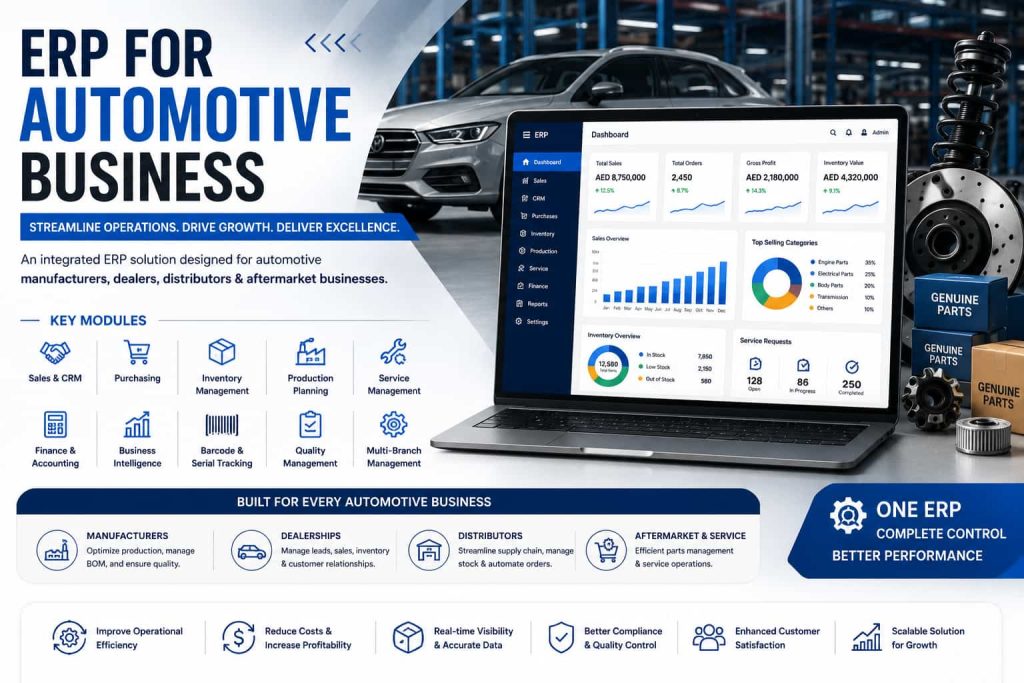
ERP software for automotive is a specialized system designed to manage manufacturing, inventory, supply chain, sales, and financial operations in automotive businesses.
In simple terms, it helps automotive companies track parts and components, manage production processes, optimize supply chains, ensure quality compliance, and improve operational efficiency, all within one integrated platform.
From vehicle manufacturing to auto parts trading and dealership management, ERP systems are essential for handling complex operations, reducing costs, and improving decision-making in the automotive industry.
What is ERP Software for Automotive?
ERP software for automotive is tailored to meet the needs of:
- Automotive manufacturers
- Auto parts suppliers
- Dealerships
- Service and maintenance businesses
It integrates:
- Production planning and scheduling
- Inventory and warehouse management
- Supply chain and procurement
- Quality control
- Sales and distribution
- Financial accounting
- Reporting and analytics
Unlike generic ERP systems, automotive ERP focuses on component tracking, production workflows, compliance standards, and supply chain efficiency.
Why Automotive Businesses Need ERP Software
The automotive industry involves complex processes and strict quality requirements.
Key Challenges:
1. Complex Supply Chain
Multiple suppliers and components must be coordinated.
2. Inventory Management
Tracking thousands of parts is difficult.
3. Production Complexity
Multi-stage manufacturing processes require precision.
4. Quality Compliance
Strict industry standards must be maintained.
5. Cost Control
Managing production costs and margins.
ERP software for automotive helps address these challenges through automation and integration.
How ERP Works in Automotive Businesses
Example Scenario:
- Raw materials and components are procured
- Inventory is updated in real time
- Production planning is created
- Manufacturing processes are executed
- Quality checks are performed
- Finished products are recorded
- Sales and distribution are managed
- Financial records are updated
👉 This ensures smooth operations and accurate tracking.
Core Features of ERP Software for Automotive
1. Production Planning & Scheduling
Manages manufacturing processes efficiently.
Benefits:
Reduced delays
Optimized production
2. Inventory & Parts Management
Tracks components and spare parts.
Benefits:
Accurate stock control
Reduced shortages
3. Supply Chain Management
Manages suppliers and logistics.
Benefits:
Better coordination
Cost optimization
4. Quality Control & Compliance
Ensures adherence to industry standards.
Benefits:
Improved product quality
Regulatory compliance
5. Sales & Distribution Management
Handles orders and deliveries.
Benefits:
Faster order processing
Improved customer satisfaction
6. Financial Management
Tracks costs, revenue, and profitability.
Benefits:
Real-time financial insights
Better decision-making
7. Service & Maintenance Management
Manages after-sales services.
Benefits:
Improved customer retention
Efficient service operations
8. Reporting & Analytics
Provides business insights.
Benefits:
Data-driven decisions
Performance tracking
Benefits of ERP Software for Automotive Industry
1. Improved Operational Efficiency
Automation reduces manual work.
2. Better Inventory Management
Tracks parts and components accurately.
3. Enhanced Supply Chain Visibility
Improves coordination with suppliers.
4. Improved Product Quality
Ensures compliance and consistency.
5. Cost Reduction
Optimizes production and logistics.
6. Real-Time Visibility
Provides instant insights into operations.
7. Scalability
Supports business growth.
Industries That Use Automotive ERP
- Automotive manufacturing
- Auto parts suppliers
- Dealership networks
- Service centers
- Logistics providers
Real-Life Use Cases
1. Automotive Manufacturer
Manages production lines and component tracking.
2. Auto Parts Supplier
Tracks inventory and supply chain.
3. Dealership
Handles sales, inventory, and customer data.
4. Service Center
Manages repairs and maintenance.
Common Mistakes Automotive Businesses Make
- Using generic ERP instead of industry-specific
- Poor inventory tracking
- Lack of supply chain visibility
- Ignoring compliance requirements
- Inefficient production planning
How to Choose the Best ERP Software for Automotive
1. Industry-Specific Features
Must support automotive workflows.
2. Scalability
Should grow with your business.
3. Integration Capability
Must integrate with existing systems.
4. Compliance Support
Should meet industry standards.
5. Ease of Use
User-friendly interface is essential.
Why eresource ERP is a Strong Choice
For businesses searching for reliable ERP software for automotive, eresource ERP offers:
Key Strengths:
- Automotive-specific modules
- Real-time inventory and production tracking
- Supply chain integration
- Flexible deployment (cloud and on-premise)
- Customizable workflows
- Scalable for SMEs and enterprises
It focuses on delivering practical ERP solutions tailored to automotive industry needs.
ERP Trends in Automotive Industry (2026)
1. Smart Manufacturing
Integration with IoT and automation.
2. AI-Based Forecasting
Improves demand planning.
3. Cloud ERP Adoption
Enhances flexibility.
4. Connected Supply Chains
Improves efficiency and visibility.
Also Read: ERP for Automotive Industry
Frequently Asked Questions(FAQs)
ERP software for automotive manages production, inventory, and operations in automotive businesses.
ERP improves efficiency, reduces costs, and ensures compliance.
It should include production planning, inventory management, and supply chain tracking.
Yes, ERP systems track parts and components accurately.
Yes, ERP systems are scalable.
Yes, ERP optimizes supplier coordination and logistics.
Yes, ERP ensures compliance with industry standards.