Table of Contents
Introduction
Most businesses in the UAE are focusing on what e-invoicing is.
Very few are asking a more important question:
👉 What happens if we are not ready?
Because here’s the truth.
UAE e-invoicing is not just a system upgrade.
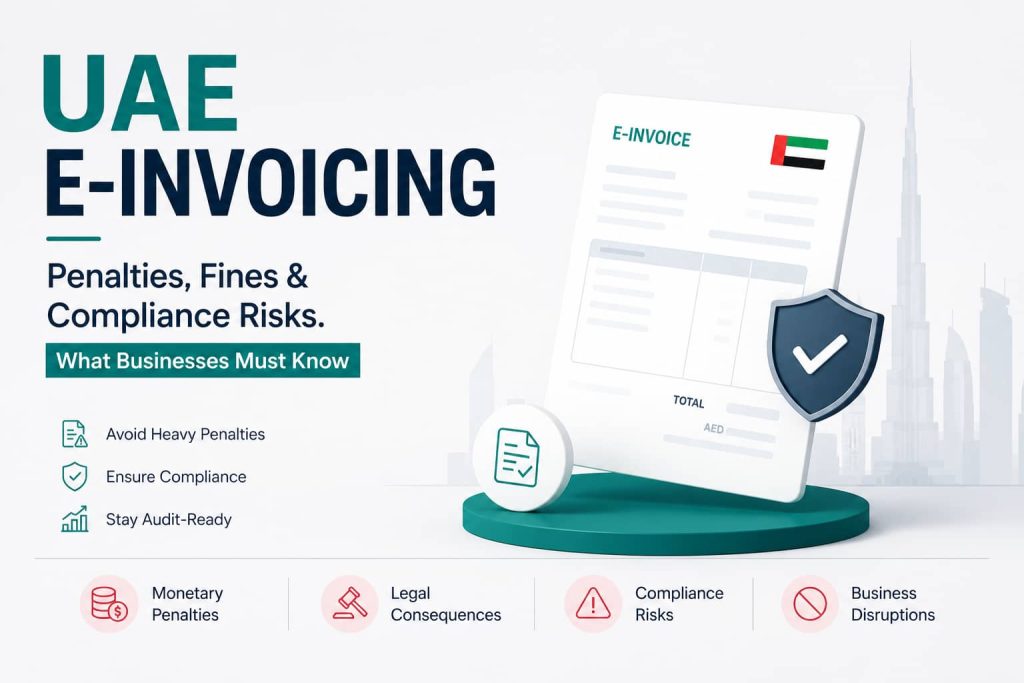
It is a regulated compliance framework.
And with compliance comes:
- Penalties
- Rejections
- Operational risks
If your business is not prepared, the impact will not be small. It will affect your cash flow, operations, and even your reputation.
Why Compliance Matters More Than Ever
Under traditional invoicing, errors were often overlooked or corrected later.
With e-invoicing, that changes completely.
Every invoice will be:
- Validated in real time
- Checked for compliance
- Approved or rejected instantly
This means errors are no longer “fix later”.
They are blocked immediately.
Who Regulates UAE E-Invoicing?
E-invoicing in the UAE is governed by the Federal Tax Authority along with the Ministry of Finance.
These authorities ensure:
- Standardized invoicing formats
- Real-time validation
- Compliance enforcement
And yes, penalties will follow for non-compliance.
Also Read: ERP for Construction Industry
Types of Compliance Risks Businesses Will Face
Let’s break this down practically.
1. Invoice Rejections
This will be the most immediate problem.
If your invoice:
Has incorrect format
Missing data
Wrong tax calculation
👉 It will be rejected instantly.
Impact:
Delayed payments
Disrupted business flow
2. Payment Delays
No valid invoice = no payment.
If invoices are rejected:
Customers cannot process payments
Cash flow gets affected
This becomes a serious issue for businesses with tight margins.
3. VAT Compliance Errors
Incorrect VAT handling can lead to:
Audit issues
Financial penalties
Legal complications
Even small calculation errors can create big problems.
4. Audit & Reporting Risks
E-invoicing creates a digital audit trail.
Authorities can:
Track every transaction
Identify discrepancies instantly
This increases accountability significantly.
5. System Failure Risks
If your system:
Cannot generate compliant invoices
Fails to integrate with ASP
Breaks during processing
👉 Your entire invoicing process stops.
Expected Penalties (What to Be Prepared For)
While detailed penalty structures may evolve, based on global implementations and VAT laws, businesses can expect:
Possible Penalties Include:
- Fines for non-compliant invoices
- Penalties for delayed reporting
- Additional charges for repeated violations
- Increased scrutiny during audits
👉 The cost is not just financial. It includes operational disruption.
Hidden Cost of Non-Compliance
Most businesses think penalties are the only risk.
They’re not.
Real Hidden Costs:
- Lost revenue due to delayed payments
- Increased operational workload
- Emergency system upgrades (higher cost)
- Damage to business credibility
Case Study. Non-Compliance Impact
Company: UAE SME
Situation:
Continued using manual invoicing
Delayed system upgrade
Problem:
Could not meet structured invoice requirements
Faced invoice rejections
Outcome:
Payment delays
Increased pressure on finance team
Urgent system migration (high cost)
Why Businesses Fail to Prepare
Let’s be honest.
Most businesses fail because they:
- Underestimate complexity
- Delay decision-making
- Look for quick fixes
- Ignore integration challenges
How to Avoid Penalties and Risks
Here’s what you should do.
✔ Automate Your Invoicing
Manual processes will fail.
✔ Ensure System Compliance
Your system must support:
Structured invoicing
Real-time validation
✔ Integrate with ASP
This is mandatory for transmission and validation.
✔ Test Before Implementation
Avoid surprises during live operations.
✔ Start Early
This is the most important step.
How eresource ERP Helps You Stay Compliant
eresource ERP is designed to reduce compliance risk by offering:
- UAE-compliant invoicing system
- Automated invoice generation
- Seamless ASP integration
- Real-time validation
- Centralized control
This helps businesses avoid penalties and operate smoothly.
Final Thoughts
UAE e-invoicing is not something you can ignore.
The risks are real.
The penalties are coming.
And the impact will go beyond compliance.
Businesses that prepare early will:
- Avoid disruptions
- Improve efficiency
- Stay ahead
Those who delay will face unnecessary challenges.
Also Read: UAE e-invoicing Software Solution