Table of Contents
Introduction
The UAE e-invoicing mandate is approaching fast.
Most businesses are aware of it.
Very few are actually prepared for what it will bring.
And here’s the reality.
The biggest problem is not compliance itself.
It’s the challenges that come with implementation.
From system limitations to integration issues, businesses will face multiple roadblocks.
If you are not prepared, these challenges can lead to:
- Invoice rejections
- Payment delays
- Compliance penalties
- Operational disruption
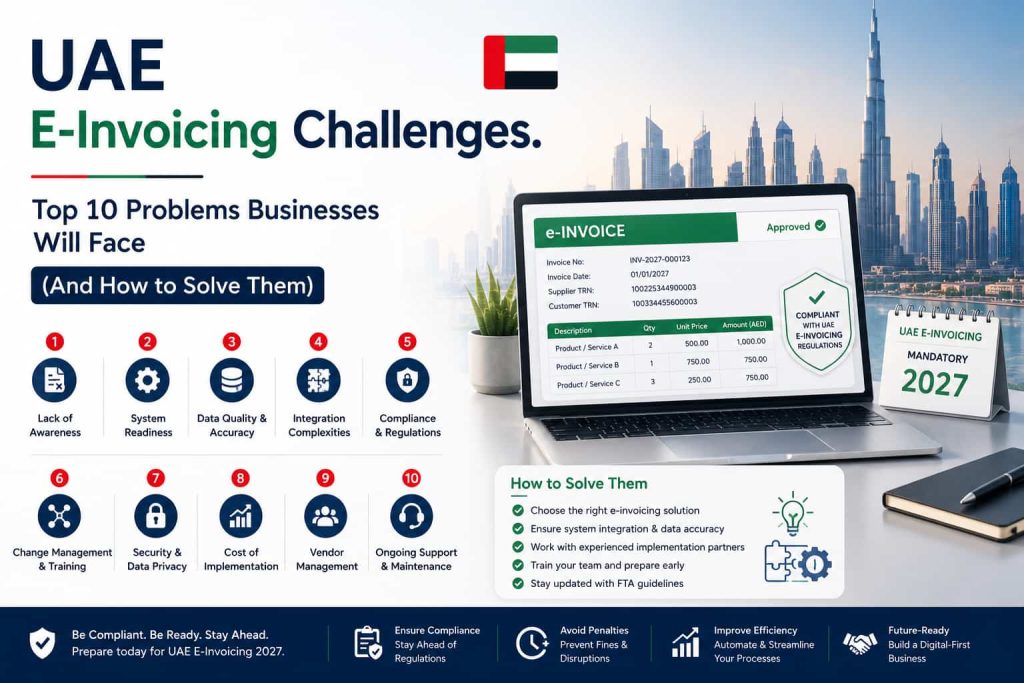
This blog breaks down the top 10 challenges businesses will face and how to solve them before it’s too late.
Challenge 1. Legacy Systems That Don’t Support E-Invoicing
Many businesses are still using outdated accounting systems.
These systems:
- Cannot generate structured invoices
- Do not support API integration
- Lack compliance features
Solution:
Upgrade to an ERP system that supports UAE e-invoicing requirements.
Solutions like eresource ERP are designed to handle structured invoicing and compliance seamlessly.
Challenge 2. Manual Invoicing Processes
If your team is still using Excel or PDFs, this will become a major problem.
Manual processes:
- Increase errors
- Slow down operations
- Do not meet compliance standards
Solution:
Automate invoicing through ERP systems that generate compliant invoices automatically.
Challenge 3. Lack of Understanding of PINT-AE Format
Structured invoicing is new for many businesses.
Without proper understanding:
- Invoices may be rejected
- Compliance risks increase
Solution:
Use systems that handle PINT-AE formatting automatically instead of relying on manual setup.
Challenge 4. Integration with Accredited Service Providers (ASP)
Connecting your system to ASP is not simple.
Common issues:
- API failures
- Data mismatches
- Transmission errors
Solution:
Choose ERP solutions that already support ASP integration, reducing technical complexity.
Challenge 5. Data Inconsistency Across Systems
Many businesses use multiple tools.
This creates:
- Data duplication
- Mismatched invoice details
- Increased errors
Solution:
Centralize operations in a single ERP system to ensure consistency.
Challenge 6. High Implementation Costs
Custom integrations can be expensive.
Businesses often underestimate:
- Development costs
- Maintenance costs
- Support costs
Solution:
Use pre-built ERP solutions instead of building everything from scratch.
Challenge 7. Employee Resistance to Change
New systems often face internal resistance.
Employees may:
- Avoid using new tools
- Make mistakes during transition
Solution:
Provide proper training and choose user-friendly systems.
Challenge 8. Compliance Risk Due to Errors
Even small mistakes can cause:
- Invoice rejection
- Penalties
- Audit issues
Solution:
Use systems with real-time validation to ensure compliance before submission.
Challenge 9. Scalability Issues
Many tools work for small volumes but fail as business grows.
Solution:
Choose scalable ERP solutions that grow with your business.
Challenge 10. Last-Minute Implementation Pressure
This is the most common mistake.
Waiting until deadlines leads to:
- Rushed decisions
- Poor system choices
- Higher costs
Solution:
Start early and plan implementation in phases.
Case Study. What Happens Without Preparation
Company: UAE Service Business
Situation:
- Manual invoicing system
- No ERP integration
Problem:
- Could not adapt quickly to structured invoicing
- Faced delays and errors
Outcome:
- Had to urgently switch systems
- Increased cost and operational disruption
Also Read: Construction ERP Software UAE
Case Study. Successful Transition
Company: UAE Trading Company
Approach:
- Early ERP adoption
- Automated invoicing
Results:
- Smooth compliance transition
- Faster invoicing
- Reduced manual workload
Why Businesses Are Moving Towards ERP Solutions
The pattern is clear.
Businesses are shifting from:
- Multiple tools
➡ To integrated systems
Because ERP solutions offer:
- Automation
- Compliance
- Integration
- Scalability
How eresource ERP Helps Solve These Challenges
Instead of tackling each problem separately, businesses are choosing integrated solutions.
eresource ERP provides:
- Built-in UAE e-invoicing compliance
- Automated invoice generation
- Seamless ASP integration
- Real-time validation
- Centralized system
This reduces complexity and ensures smoother implementation.
How to Prepare for These Challenges (Action Plan)
Step 1. Audit Your Current System
Identify gaps in your existing process.
Step 2. Define Requirements
Understand what your business needs.
Step 3. Choose the Right Solution
Focus on ERP-based systems.
Step 4. Start Implementation Early
Avoid last-minute pressure.
Step 5. Train Your Team
Ensure smooth adoption.
Final Thoughts
UAE e-invoicing is not just about compliance.
It is about transforming how your business operates.
The challenges are real.
But they are also avoidable.
Businesses that prepare early and choose the right system will:
- Reduce risk
- Improve efficiency
- Gain competitive advantage
Get Ahead Before It’s Too Late
If you want to avoid these challenges and ensure a smooth transition, explore how eresource ERP can help your business stay compliant and efficient.
👉 Start preparing today instead of fixing problems later.