Table of Contents
Introduction
If you’re running a small or medium-sized business in the UAE, you might still be thinking:
“E-invoicing sounds like something for big companies. Do I really need to worry about it?”
That assumption can cost you.
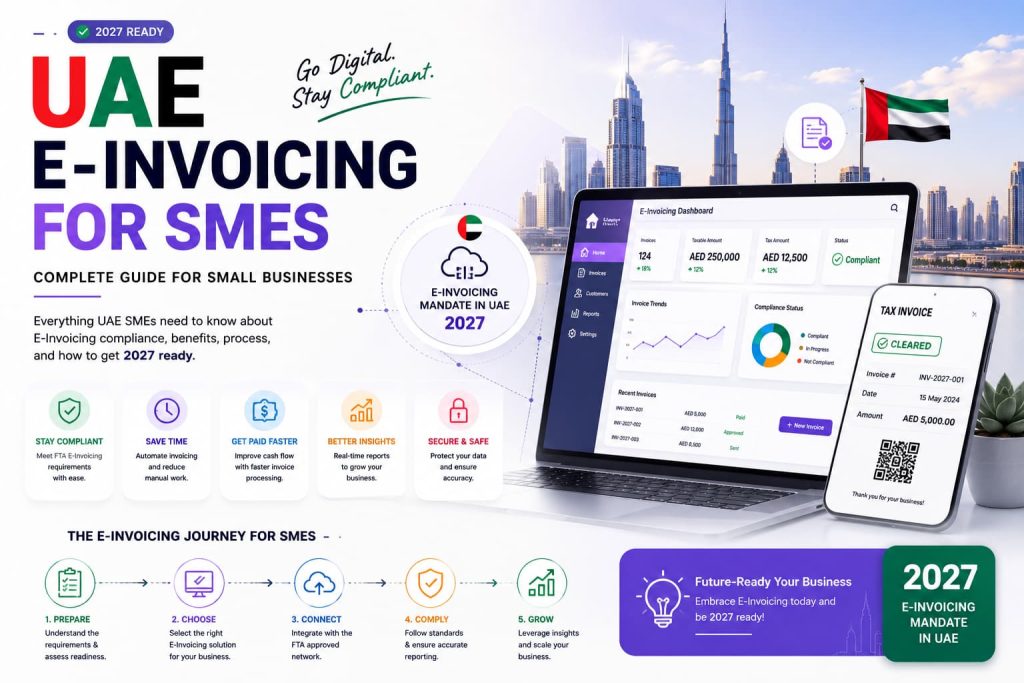
UAE e-invoicing is not limited to large enterprises. It is a nationwide shift that will impact every business that generates invoices, including SMEs.
In fact, SMEs are likely to face more challenges than large companies due to limited resources, manual systems, and lack of automation.
This guide will walk you through everything you need to know:
- What UAE e-invoicing means for SMEs
- What will change in your daily operations
- The biggest risks if you ignore it
- And how to prepare in a simple, cost-effective way
Will SMEs Be Affected by UAE E-Invoicing?
Yes. There is no escaping it.
The UAE e-invoicing framework applies broadly across businesses.
SMEs That Will Be Covered
- VAT-registered small businesses
- Trading and distribution companies
- Service-based businesses
- Consultants and freelancers (depending on activity)
If your business issues invoices, you will need to comply.
Why SMEs Are More Vulnerable Than Large Enterprises
Large companies have dedicated IT teams, finance departments, and bigger budgets.
SMEs usually operate differently.
Common SME Limitations
- Manual invoicing processes
- Heavy reliance on Excel or PDFs
- Limited system integration
- Smaller teams handling multiple roles
Because of this, SMEs often delay system upgrades. That delay becomes risky under e-invoicing regulations.
Also Read: ERP for Construction Industry
What Will Actually Change for SMEs?
This is where most confusion exists.
Let’s simplify it clearly.
Current SME Workflow
- Create invoice manually
- Share via email or WhatsApp
- Store copies in folders
- Fix errors later
Future E-Invoicing Workflow
- ERP system generates structured invoice
- Invoice is validated instantly
- Sent via Accredited Service Provider
- Recorded in compliance system
👉 No validation = No invoice = No payment
This is a major shift.
Key Compliance Requirements SMEs Must Meet
To comply with UAE e-invoicing, your system must support:
- Structured invoice format (XML / PINT-AE)
- Real-time validation
- Integration with Accredited Service Providers
- Accurate VAT reporting
These requirements are regulated by the Federal Tax Authority.
Biggest Challenges SMEs Will Face
Let’s talk about real problems.
1. Manual Systems Will Fail
Excel and PDF invoicing will not meet compliance requirements.
Impact:
Invoice rejection
Payment delays
2. Lack of Technical Knowledge
Most SMEs are unfamiliar with:
API integration
Structured data formats
Compliance systems
3. Budget Constraints
Many SMEs hesitate to invest in new systems.
But delaying often increases costs later.
4. Integration Complexity
Connecting your system with ASP providers requires technical setup.
5. Time Pressure
Late implementation leads to rushed decisions and poor system choices.
Common Mistakes SMEs Must Avoid
Let’s be direct here.
- Waiting until deadlines
- Choosing cheapest tools without compliance
- Ignoring integration requirements
- Assuming manual invoicing will still work
These mistakes lead to higher long-term costs.
What Are the Best Options for SMEs?
Let’s break this down practically.
Option 1. Standalone E-Invoicing Tools
Pros:
Low cost
Easy to start
Cons:
Limited features
No integration
Not scalable
👉 Short-term solution only
Option 2. Accounting Software Add-ons
Pros:
Moderate cost
Some automation
Cons:
Limited flexibility
Dependency on third-party modules
Option 3. ERP-Based Solutions (Best Choice)
Pros:
Full automation
Built-in compliance
Scalable
Integrated workflows
👉 Best long-term solution for SMEs
Why ERP is No Longer “Only for Big Companies”
This is an outdated belief.
Modern ERP systems are:
- Cloud-based
- Affordable
- Easy to implement
- Scalable
They are designed for SMEs as much as enterprises.
How eresource ERP Helps SMEs
Instead of dealing with multiple tools and integrations, SMEs can use a single system.
eresource ERP helps businesses:
- Generate compliant invoices automatically
- Integrate with ASP providers
- Automate VAT calculations
- Reduce manual errors
- Scale operations easily
This removes complexity and reduces dependency on technical expertise.
Final Thoughts
UAE e-invoicing may feel complex at first.
But for SMEs, it is actually a chance to:
- Upgrade systems
- Improve efficiency
- Compete with larger businesses
The key is simple.
👉 Start early
👉 Choose the right system
👉 Avoid shortcuts
Get Started Without Complexity
If you’re an SME looking for a simple and scalable way to prepare, explore how eresource ERP can help you transition smoothly.
Start small. Stay compliant. Grow faster.
Also Read: UAE e-invoicing Software Solution