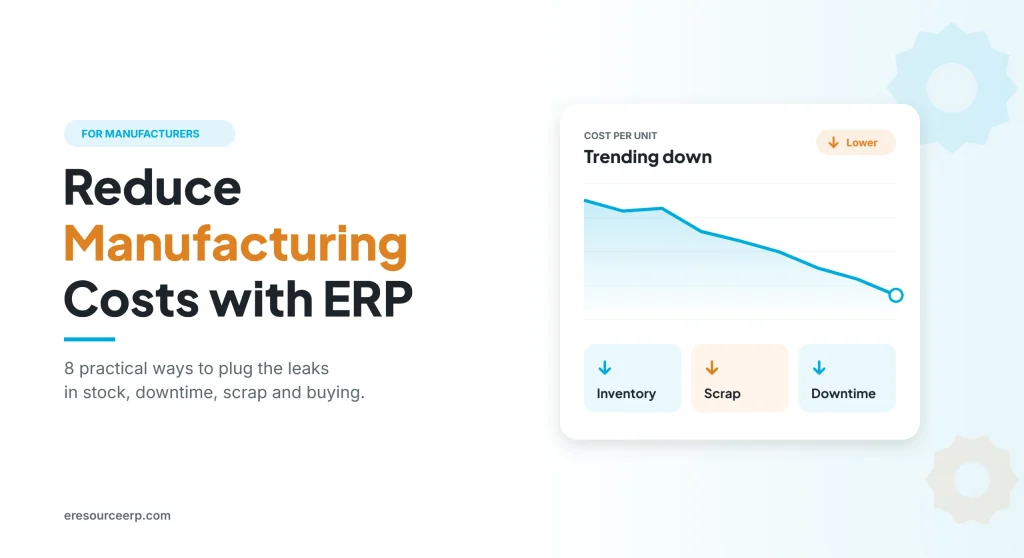
ERP helps reduce manufacturing costs by showing exactly where money leaks, such as excess stock, idle machines, scrap, rush purchases and slow decisions, and then controlling each leak from one live system. For small and mid-sized manufacturers, competition grows tougher every year. So cutting production bottlenecks, improving delivery and using every resource well is now essential. This guide shows where costs hide in a factory, eight practical ways ERP brings them down and which numbers to track.
Key takeaways
- Find the leaks first: stock, downtime, scrap and rush buying are the usual culprits.
- Plan, then buy: MRP orders only what production needs, so cash is not locked in stock.
- Fix quality early: checks at each stage cut scrap and rework.
- Measure every month: track a few clear numbers, so you can prove that you reduce manufacturing costs.
Where manufacturing costs leak
Generally, most factories lose money in the same places. So, to reduce manufacturing costs, start with the areas in the table below:
| Cost area | Typical leak | How ERP helps |
|---|---|---|
| Raw material | Buying too much or too early | MRP plans purchases from real demand |
| Inventory | Slow-moving and duplicate stock | Live stock across stores and reorder levels |
| Machines | Breakdowns and idle time | Planned maintenance and capacity plans |
| Quality | Scrap and rework | Inspections at receipt, in-process and final |
| Purchasing | Rush orders at high prices | Vendor comparison and approval rules |
| Labour | Overtime from poor planning | Balanced schedules and job cards |
| Admin | Re-typing and paperwork | One entry that flows to every team |
In short, plugging these leaks is the fastest way to reduce manufacturing costs. Not sure what the software itself will cost? Then read our guide on manufacturing ERP cost.
8 ways ERP helps reduce manufacturing costs
Each of these levers helps reduce manufacturing costs on its own. Together, however, they add up to real savings:
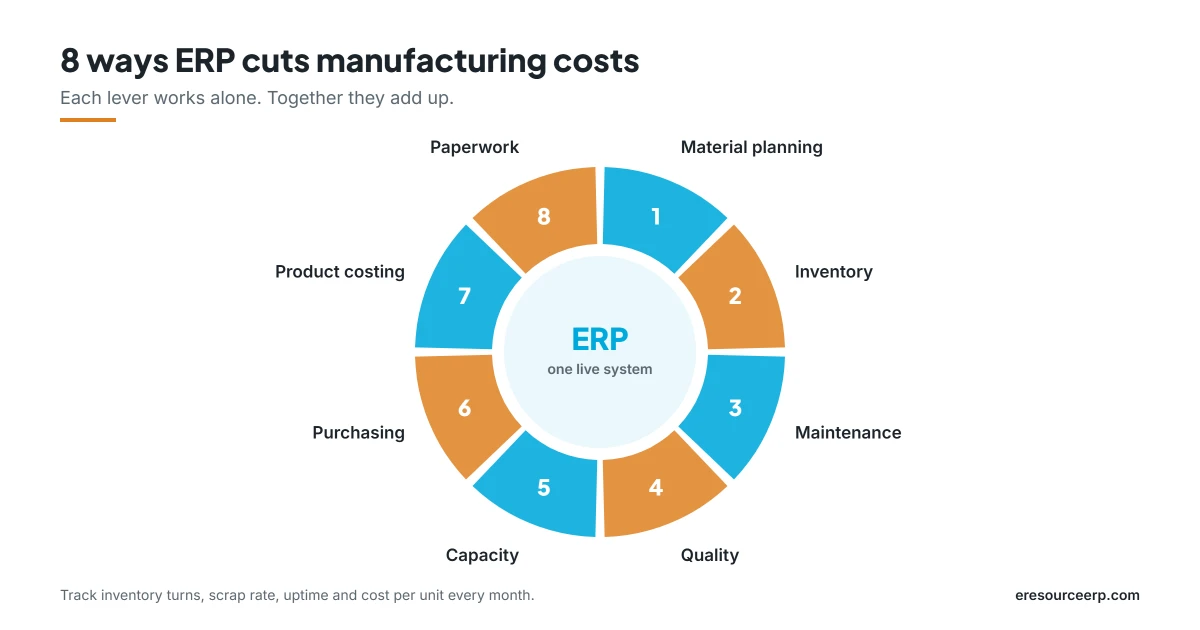
- Plan materials with MRP: first, material requirements planning works out what to buy and when, so you avoid both shortages and excess.
- Cut excess inventory: next, live stock across every store and reorder levels stop duplicate buying.
- Reduce downtime: then planned maintenance keeps machines running, so orders ship on time.
- Lower scrap and rework: also, quality checks at each stage catch defects early, which helps reduce manufacturing costs on every batch.
- Use capacity better: in addition, production planning shows bottlenecks, so you can balance work centres.
- Control purchase prices: similarly, vendor comparison and approval rules stop costly rush orders.
- Know the true product cost: moreover, job and batch costing shows real margins, so you can fix pricing.
- Cut paperwork: finally, one entry flows to every team, which removes re-typing and errors.
For deeper dives, read about the ERP MRP, the plant maintenance module in ERP and how to reduce product defects.
Quick wins for the first 90 days
You do not need to fix everything at once to reduce manufacturing costs. Instead, start with these steps after go-live:
- Correct stock figures: count key items, then fix the records so plans are reliable.
- Set reorder levels: start with your top-value items first.
- Add purchase approvals: route orders above a set value, so a manager checks them.
- Plan maintenance: create a calendar for your most critical machines.
- Record scrap reasons: log every reject with a cause, so patterns become clear.
To speed up buying decisions, also see the procurement process in ERP and warehouse management in ERP.
KPIs that show lower manufacturing costs
Savings only count when you can see them. So, to check that you really reduce manufacturing costs, review these numbers every month:
- Inventory turns: how fast stock moves, because higher turns free up cash.
- Scrap rate: rejected output as a share of total output.
- Machine uptime: or, for a fuller view, overall equipment effectiveness.
- On-time delivery: orders shipped by the promised date.
- Cost per unit: total cost divided by good units produced.
- Purchase price variance: actual buying price against the planned price.
In short, if these numbers improve month after month, the effort to reduce manufacturing costs is working. For related gains, read how ERP improves productivity in the manufacturing sector and cuts lead time.
Why small and mid-sized factories need this now
Above all, manufacturing is a backbone of jobs and growth in India. However, small and mid-sized units often run with thin margins and limited staff. As a result, every rupee saved on material, downtime or rework goes straight to profit.
At the same time, departments and branches need a transparent way to work together. Therefore, one connected system that helps reduce manufacturing costs matters more than ever. For more, read about ERP for midsize companies and lean manufacturing with ERP.
Reduce manufacturing costs with eresource
eresource is a web-based, AI-powered and no-code ERP with 37 integrated modules on one platform. It has also served businesses for 20 years, with 3,000+ go-lives. So here is how it helps factories reduce manufacturing costs:
- Industry editions: eresource Xcel for discrete manufacturing and eresource Bpro for process manufacturing.
- Planning tools: MRP, production planning and capacity views on one platform.
- Quality and maintenance: stage-wise inspections, as well as planned maintenance schedules.
- Accurate costing: job and batch costing with material, labour and overheads.
- Live dashboards: stock, scrap and delivery figures on web and mobile.
- Unlimited users: one flat license, so supervisors and store keepers can join too.
To learn more, explore manufacturing ERP software in India, read our manufacturing ERP selection guide, or browse all eresource ERP products.
Frequently asked questions
How does ERP reduce manufacturing costs?
It plans materials, controls stock, prevents breakdowns and catches defects early. In addition, it removes re-typing and shows the true cost of each product.
Which savings show up first?
Usually, lower inventory and fewer rush purchases come first. After that, scrap and downtime fall as quality and maintenance plans settle in.
Is ERP worth it for small manufacturers?
Yes. In fact, small firms often gain the most, because cloud setup and a flat license keep the first investment low. So they can reduce manufacturing costs without a large budget.
How do we measure the savings?
Track inventory turns, scrap rate, machine uptime, on-time delivery and cost per unit every month, then compare them with your starting point.
Can ERP cut stock without causing shortages?
Yes. MRP plans purchases from real demand, while reorder levels protect key items, so stock falls without stopping production.
Does eresource support job and batch costing?
Yes. For example, it captures material, labour and overheads for each job or batch, so margins are clear.
Want to see how to reduce manufacturing costs in your factory? Start with a free ERP assessment, or book a free demo.
Also Read – Plant Maintenance Module in ERP