How ERP Can Improve Productivity in the Manufacturing Sector
Manufacturing companies need efficient processes to improve productivity. An integrated ERP system can connect departments, simplify workflows, and improve access to business information.
Manufacturers should not use ERP only for transaction automation. Instead, they should use ERP to improve business processes, reduce manual work, and support better decisions.
What Is ERP in Manufacturing?
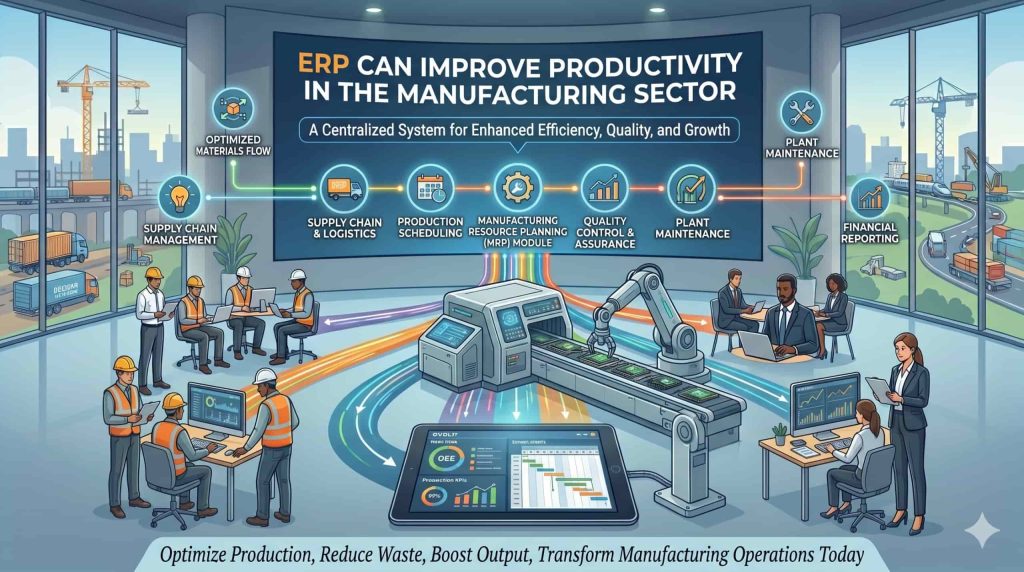
An ERP system connects different business functions through one integrated platform. These functions can include production, purchasing, inventory, sales, finance, and customer management.
A modern Manufacturing ERP system reduces information gaps between departments. It also gives managers access to timely and accurate business data.
With integrated information, employees can complete tasks faster. Managers can also make better decisions based on current business information.
For more information, explore our ERP system.
Also read – ERP for Plastic industry
How ERP Improves Manufacturing Productivity
ERP software can improve productivity in several ways. It helps manufacturers organize processes, automate repetitive tasks, and improve information flow.
1. Automate Routine Manufacturing Processes
ERP can turn unstructured activities into clear and repeatable workflows. For example, the system can automate purchase order approvals based on company rules.
As a result, employees spend less time on repetitive administrative tasks. They can focus more on activities that support production and customer service.
2. Reduce Manual Data Entry
Manufacturing companies handle large amounts of purchasing, inventory, production, and financial data.
ERP reduces repetitive data entry across departments. Employees can enter information once and use it across connected business processes.
This approach can reduce duplicate work and improve data accuracy.
3. Improve Communication Between Locations
Manufacturing businesses often operate across multiple offices, plants, warehouses, and locations.
ERP allows teams to access shared business information from a connected system. Therefore, employees can coordinate activities without relying on disconnected spreadsheets or manual updates.
The system also helps managers review information across different locations.
4. Improve Manufacturing Planning
ERP gives manufacturers better visibility into demand, inventory, production, and purchasing.
Businesses can use this information to plan production more effectively. They can also identify changing demand patterns and adjust operations when required.
ERP can help manufacturing companies with activities such as:
Forecasting market demand using business data.
Identifying changing market trends.
Analyzing production and operational information.
Finding areas that need improvement.
Supporting better production planning.
Consequently, manufacturers can respond faster to changes in business requirements.
5. Provide Better Business Information
Manufacturing companies generate large volumes of operational data every day.
ERP brings this information together in one system. Managers can then review relevant data without collecting reports from multiple departments.
Moreover, real-time information can support faster business decisions.
6. Support Parallel Tasks
ERP can improve the sequence of business activities. It can also help teams handle related tasks at the same time.
For example, purchasing, inventory, production planning, and finance teams can work with connected information.
This reduces unnecessary delays between departments. It also helps employees complete processes more efficiently.
7. Capture and Share Business Knowledge
Manufacturing companies depend on employee knowledge and established processes.
ERP can capture important business information within structured workflows. Teams can then follow consistent processes across departments.
In addition, managers can use shared information to identify process gaps and improvement opportunities.
8. Track Tasks and Process Status
ERP provides better visibility into task status, inputs, and outputs.
Managers can monitor important activities and identify delays earlier. Employees can also understand the status of their work more clearly.
As a result, the business can improve accountability and process control.
Key Productivity Benefits of Manufacturing ERP
An ERP system can support manufacturing productivity in several areas:
Faster business processes
Reduced manual data entry
Better production planning
Improved inventory visibility
Faster information sharing
Better coordination between departments
Improved data accuracy
Easier task tracking
Faster business decisions
Better process control
Why Manufacturing Companies Need an Integrated ERP System
Manufacturing operations involve many connected activities. Purchasing affects inventory. Inventory affects production. Production affects sales and delivery.
Without integration, teams may work with different information. This can create delays, duplicate work, and data errors.
An integrated ERP system connects these processes. Therefore, manufacturers can improve information flow and coordinate operations more effectively.
Improve Manufacturing Productivity With ERP
ERP should support more than transaction processing. It should help manufacturers improve the way they manage daily operations.
By connecting departments, automating repetitive activities, and providing timely information, ERP can create a more efficient manufacturing environment.
For manufacturers, the right ERP solution can support better productivity, stronger process control, and informed business decisions.
Also read – construction erp software in uae