Web-Based ERP System: Track Business Activities Across Your Organization
Many ERP vendors claim that their products can improve business performance. However, businesses need clear reasons to choose one ERP solution over another.
A web-based ERP system can help organizations connect departments and manage business information from one platform.
With eresource ERP, employees enter information once. The system then makes that information available across connected business functions.
As a result, employees can work with accurate and timely information.
How eresource ERP Tracks Business Activities
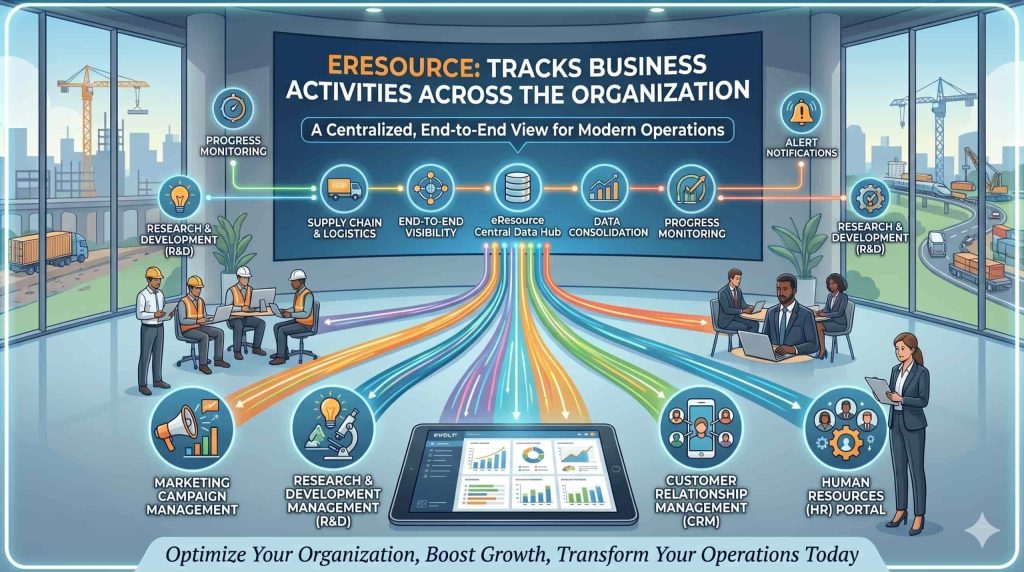
The web-based ERP from eresource connects different business activities through one system.
Employees enter business information at the point of activity. The ERP system then shares that information with relevant departments.
For example, a business transaction can update related accounting and operational records automatically.
Therefore, employees do not need to enter the same information into multiple systems.
This approach can reduce duplicate data entry. It can also reduce the risk of manual entry errors.
One Data Entry for Multiple Business Processes
A major benefit of an integrated ERP system is connected information.
When an employee enters information once, other authorized business functions can use the same data.
For example, an order can connect with inventory, delivery, billing, and accounting processes.
As a result, different teams can access consistent business information.
This helps managers make decisions using current operational data.
Manage Business Operations From One ERP System
The eresource ERP system supports several business activities. These include:
Order management
Accounting
Procurement
Inventory
Warehousing
Customer management
Business reporting
Moreover, the system can support companies across different business sizes and industries.
As business needs change, companies can adapt their ERP processes and modules accordingly.
Support Growing Business Structures
Businesses often expand through new locations, departments, shared services, or additional operations.
As a result, their technology systems must support these changes.
An integrated ERP platform can connect business units through a common system.
Therefore, organizations can reduce their dependence on disconnected legacy applications.
The broad functionality of eresource ERP can support different business structures and operational requirements.
Improve Data Accuracy and Business Decisions
An integrated web-based ERP system can collect business data from different processes.
It then provides that information to authorized users across the organization.
As a result, managers can review consistent information when making business decisions.
Better data integration can also improve operational control.
For example, companies can improve inventory management, order processing, cash management, and customer response.
Benefits of eresource ERP
The eresource ERP system can help businesses manage customer orders and related processes more efficiently.
Faster Customer Order Processing
Consider a customer service agent receiving a call from an existing customer.
The agent can find the customer account and review the required information. Next, the agent can record the order details and check product availability.
Once the agent confirms the order, the system can connect the order with related business processes.
For example, the system can support:
Product allocation
Inventory checks
Production planning
Shipment preparation
Customer billing
Accounts receivable
Therefore, one order entry can connect several processes.
Improve Inventory and Production Coordination
When a customer places an order, the ERP system can check available information.
It can help determine whether the required product exists in finished inventory. It can also connect the order with in-process goods or planned production.
As a result, teams can coordinate inventory and production more effectively.
This connected approach can improve order fulfillment and reduce unnecessary manual work.
Improve Operational Efficiency
Customer service is important. However, companies also need efficient internal operations.
A business cannot maintain strong customer service if its internal processes create delays.
Therefore, companies should improve both customer management and operational efficiency.
An effective web-enabled ERP system can connect business processes and improve information flow.
As a result, employees can access the information they need without moving between disconnected systems.
Reduce Manual Work and Data Errors
Manual data entry creates opportunities for mistakes.
When employees enter the same information several times, the risk of inconsistent data increases.
An integrated ERP system reduces repeated entry by sharing information across connected processes.
Therefore, businesses can improve data consistency and reduce avoidable errors.
Support Better Business Performance
A well-implemented ERP system can improve how departments work together.
It can connect customer orders with inventory, procurement, production, finance, and delivery.
Moreover, centralized information can help managers identify operational issues faster.
This improved visibility supports better planning and more informed decisions.
Why Choose a Web-Based ERP System?
A web-based ERP system gives businesses a connected platform for managing daily operations.
Employees can work with centralized information through authorized access. Meanwhile, management can monitor important business activities across departments.
Furthermore, web-based ERP can support businesses as their operations grow and change.
For organizations that want better integration, data visibility, and process control, an ERP system can provide a strong foundation for business management.
Also Read – ERP for Plastic industry
Conclusion
A web-based ERP system can connect business activities across the organization.
With eresource ERP, companies can manage information across order processing, accounting, procurement, inventory, warehousing, and other functions.
Employees can enter information once and share it across connected processes.
As a result, businesses can reduce duplicate work, improve data accuracy, and support faster decisions.
Also Read – Construction ERP Software in UAE