ERP Workshop: How to Run a Successful Business
Businesses need the right technology to manage changing market demands. An ERP system can connect business processes and improve daily operations.
However, ERP software alone does not guarantee business success. Companies must choose the right system and implement it correctly.
Therefore, an ERP workshop can help business leaders understand ERP technology, business requirements, implementation, and user training.
Why Is an ERP Workshop Important?
The Indian ERP market offers many software options. Therefore, businesses need to compare their requirements before selecting an ERP system.
A suitable ERP solution should match the company’s processes and goals. It should also support future business growth.
An ERP workshop helps decision-makers understand these requirements. It can also provide practical knowledge about ERP systems and their business applications.
A well-planned workshop can help companies understand:
ERP system requirements
ERP software selection
Business process improvement
ERP implementation
User training
ERP modules and functions
Business reporting
Data-based decision-making
Who Can Benefit From an ERP Workshop?
An ERP workshop can help many business leaders and users.
For example, the workshop can support:
CEOs
COOs
CFOs
Accountants
Financial controllers
Business owners
Department managers
ERP project teams
Key decision-makers
As a result, different teams can develop a common understanding of ERP technology.
Understand ERP Software Before Implementation
Companies should understand an ERP system before they implement it. A clear understanding can help them set realistic expectations.
The ERP system should support the company’s business processes. It should also help employees work with accurate and connected information.
Therefore, companies should not select ERP software based only on features. They should also consider usability, business requirements, implementation support, training, and long-term needs.
ERP Workshop and CRM
Customer Relationship Management (CRM) plays an important role in modern business.
The CRM module in the ERP system connects customer-related activities with other business processes.
Sales and marketing teams can use ERP and CRM information to improve customer management.
Moreover, teams can use business data to plan marketing activities and improve customer communication.
As a result, companies can work toward better customer retention, improved sales performance, and stronger business growth.
What Does an ERP Workshop Teach?
An ERP workshop can cover many areas of ERP technology.
ERP Business Processes
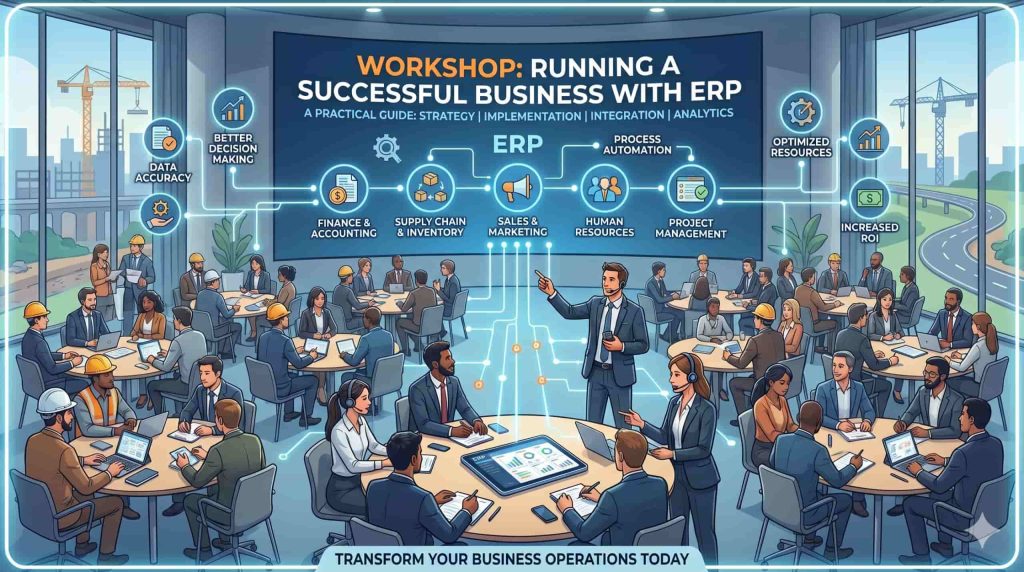
Participants can learn how ERP connects different business functions. These functions may include finance, sales, purchasing, inventory, production, and customer management.
ERP Decision-Making
ERP systems provide business information that can support better decisions.
Therefore, users should learn how to read and use ERP data instead of relying only on assumptions.
ERP User Responsibilities
ERP changes the way employees manage information. Each user plays an important role in maintaining accurate business data.
For this reason, employees should understand how their entries affect other departments and processes.
Why ERP User Training Matters
An ERP system can deliver better results when employees know how to use it correctly.
Therefore, companies should provide proper training before and after implementation.
Effective training helps users understand the system and perform their daily tasks with greater confidence.
The right training can also reduce errors and improve ERP adoption.
ERP Training Should Go Beyond Screen Instructions
Many users learn ERP software by following screen instructions. However, this approach may not explain how their actions affect the wider business process.
Good ERP training should explain the reason behind each important entry.
For example, the trainer should explain:
Why the user needs to enter the information
How the entry affects other ERP modules
How different settings work
Why the company uses a specific setting
How ERP data supports business decisions
How transactions affect financial reports
As a result, users can understand the business impact of their work.
Understand the Financial Impact of ERP Entries
ERP users should understand that business entries can affect financial information.
For example, a transaction may update the General Ledger. It may also affect the Profit and Loss Account or Balance Sheet.
Therefore, users should understand the responsibility that comes with entering accurate data.
This knowledge helps employees become more confident and responsible ERP users.
How to Improve ERP User Training
To improve ERP adoption, companies should focus on ERP functionalities instead of teaching only basic software tools.
Training should match the user’s role and responsibilities.
For example, finance users need different training from sales or inventory users.
Therefore, companies should plan training sessions around individual business requirements.
Key ERP Training Practices
A useful ERP training program should:
Explain business processes
Demonstrate relevant ERP functions
Use practical examples
Explain the impact of user entries
Train users according to their roles
Allow users to practice the system
Answer process-related questions
Provide support after implementation
Moreover, continuous learning can help users improve their ERP skills over time.
How an ERP Workshop Supports Business Success
An ERP workshop can help companies prepare for ERP implementation.
It gives decision-makers a better understanding of ERP technology. At the same time, it helps users understand their responsibilities.
Furthermore, a workshop can connect ERP training with real business processes.
As a result, companies can prepare employees before they start using the ERP system in daily operations.
Conclusion
An ERP workshop helps businesses understand ERP selection, implementation, business processes, user responsibilities, and training.
ERP software can connect departments and improve access to business information. However, employees must understand the system to use it effectively.
Therefore, companies should combine the right ERP solution with proper user training and practical guidance.
A well-planned ERP workshop can help business leaders and employees build the knowledge needed for successful ERP adoption.
Also Read – Construction ERP in UAE