ERP and Reduction of Lead Time: Get Materials When Production Needs Them
When an item required for production is not available, the problems multiply fast: missed delivery schedules, lost customer goodwill from delayed delivery — or losing the customer to competition altogether. Companies traditionally avoid this in three ways: order materials well in advance, keep a large buffer stock, or maintain a very high re-order level. However, all three mean large inventories, and large inventories mean blocked money. ERP reduces lead time instead — attacking the problem at its root. This article explains how.
What Is Lead Time?
Lead time is the elapsed time between placing an order and receiving it. It plays a significant role in purchasing and inventory control, because every buying decision depends on it: order too late and production stops; order too early and money sits in stock.
There is a trap here worth naming. When a company allows longer delivery times “to be safe,” actual lead times quietly grow to consume whatever slack it allowed. Therefore, the right discipline is the opposite: find the minimum real lead time for each item, and contest suppliers’ delivery delays — instead of automatically increasing the allowance.
Why Manual Tracking Fails
In this era of just-in-time manufacturing, knowing the exact lead time of each item is paramount for uninterrupted production. Now consider the scale: a company dealing with hundreds or thousands of raw materials and components. Tracking lead times for every individual item manually is practically impossible. This is precisely the task an ERP automates.
How ERP Cuts Lead Time at Every Step
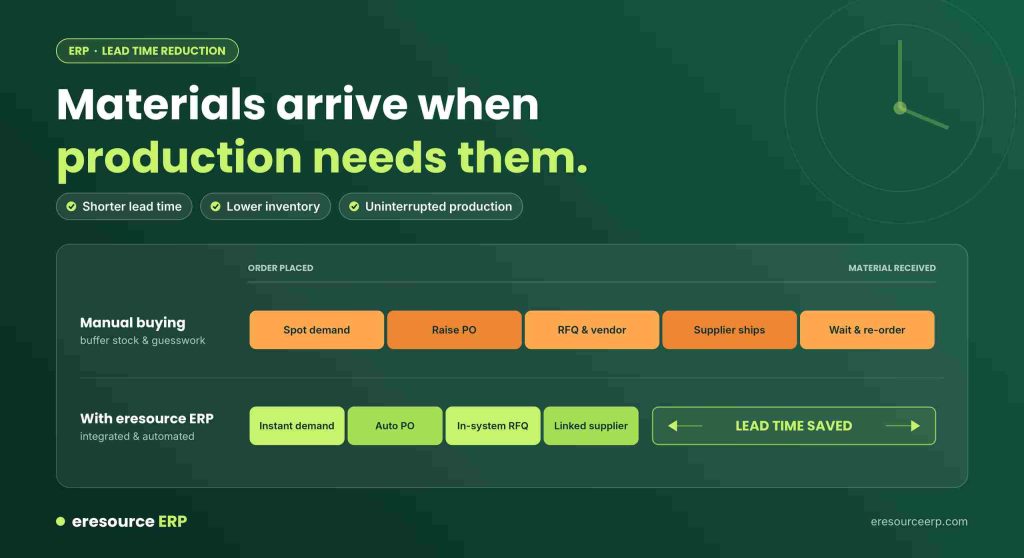
The eresource ERP system makes inventory management efficient because its materials management module integrates with sales, marketing, purchasing, manufacturing, and production planning. That integration compresses time at each step:
- Demand is known instantly. The moment an order arrives, the system knows the demand for every item it requires. All records sit up-to-date in one database, so identifying what to order takes no time.
- Purchase orders generate automatically. Once the production plan is ready, the materials management module prepares purchase orders for every item — taking each item’s lead time and its required-by date into account.
- Even the RFQ cycle runs in the system. Where purchasing must go through invitation of quotations and vendor selection, the system handles that process too.
Connected Suppliers, Phenomenal Time Savings
The compression continues beyond your own walls. When suppliers connect to the organization’s system, a purchase order or requisition updates the supplier’s side the moment it is issued. The supplier knows exactly what to supply, and when. Moreover, contracts, purchase orders, and payments all move electronically through the system — and the savings in time are phenomenal.
The Result: Items Arrive When Needed
By virtue of its integrated nature and modern technology, the eresource ERP system reduces lead times across the chain — so companies have items exactly when they need them, without burying working capital in buffer stock. Shorter lead times, lower inventory, uninterrupted production: that is the equation ERP solves.
Also Read – ERP Software Company in India
Frequently Asked Questions
Common questions about ERP and lead time reduction
What is lead time in purchasing?
Lead time is the elapsed time between placing an order and receiving it. Every buying decision depends on it — order too late and production stops; order too early and money sits blocked in stock.
How does ERP reduce lead time?
ERP knows demand the moment an order arrives, generates purchase orders automatically against each item's lead time, runs the RFQ and vendor-selection cycle in the system, and updates connected suppliers instantly.
Why is buffer stock a poor answer to long lead times?
Buffer stock blocks working capital, and allowed lead times quietly grow to consume whatever slack exists. Reducing the real lead time cuts inventory and protects production at the same time.
Can ERP track lead times for thousands of items?
Yes. Tracking lead times manually across thousands of materials is practically impossible, but an integrated ERP maintains them per item and applies them automatically in every purchase plan.