


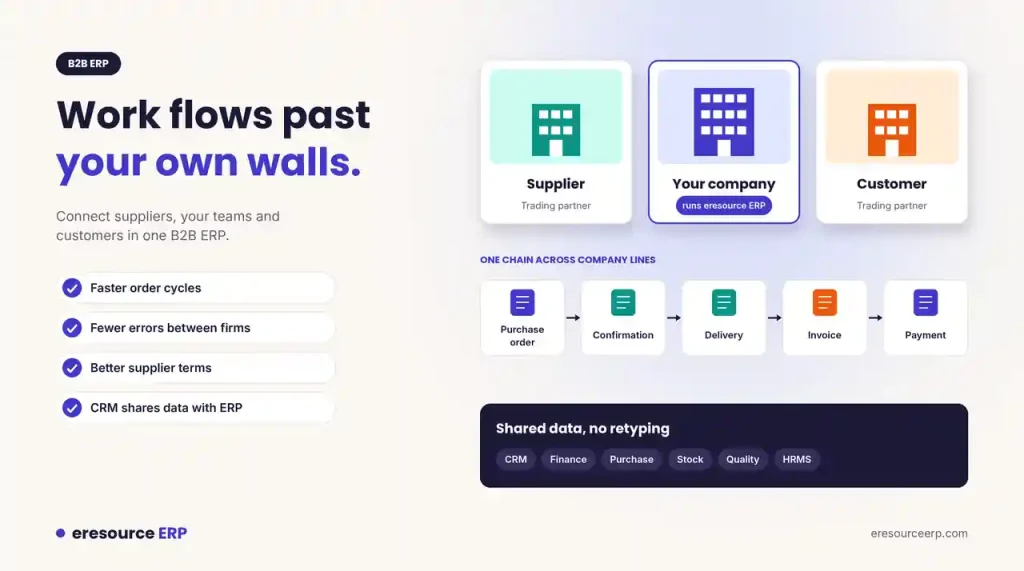
Your business does not stop at your own walls. Orders come in from customers, materials arrive from suppliers, and every handover between firms can slow work down. A B2B ERP connects your company with its trading partners, so work flows smoothly across those boundaries. In this post, we explain what a B2B ERP does and why CRM matters more than many people think. We also share steps to connect your partners and lift productivity.
What a B2B ERP Does
In business-to-business (B2B) trade, companies sell to other companies. Each deal involves quotes, orders, deliveries, invoices and payments that pass between firms.
eresource links your suppliers, your customers and your own teams in one system. As a result, your organisation becomes a fully equipped B2B business. It can make the most of B2B advantages and build stronger customer relationships at the same time. Read more about the competitive advantage of ERP.
Start With a Deep Look at Your Needs
Before you implement any ERP, study your business requirements and the way you work today. This step shapes everything that follows.
eresource has worked with firms of many sizes and sectors since 2006. So our team knows which questions to ask and which processes to map first. A free ERP assessment is a good place to begin. For a full plan, read our guide to ERP implementation strategy.
Processes That Cross Company Lines
A B2B ERP also supports inter-enterprise process engineering (IPE). In simple terms, IPE means redesigning the processes that run between you and your partners. A purchase order, a supplier’s confirmation, a delivery and an invoice can then flow as one smooth chain.
eresource also supports data warehousing and costing models. Together, they let you study years of trading data and see the true cost of each product, customer or deal. For deeper analysis, see ERP with business intelligence.
CRM Is More Than a Contact List
Many people think CRM is just a tool for sorting marketing contacts. In reality, it does much more.
The eresource CRM shares data with the ERP. So sales teams can see each customer’s orders, stock and payments in one place. In turn, they answer faster and spot new chances to sell. Learn more about ERP and CRM integration.
Strong Finance Behind Every Deal
Every B2B deal ends in a payment, so finance sits at the heart of the system. The financial management module helps your accounts team track net cash flow more closely.
It also speeds up the order-to-cash cycle. Meanwhile, buyers can negotiate and manage purchase agreements with better data in hand.
A B2B ERP Supports Every Team
The system helps teams beyond sales and finance too. For example, HR handles payroll and attendance in the HRMS solution. Quality teams run checks through total quality management, and buyers manage suppliers in the purchase module.
The system also tracks stock held at suppliers’ sites or remote warehouses. Learn more about inventory management with ERP software. For the full list of gains, read about the benefits of ERP implementation.
Training Unlocks the Full Value
Other ERP systems may offer some of the same features. However, software only pays off when people use it well.
That is why eresource trains your end users to get the most from the system. Well-trained teams help the business grow, and they raise the return on your ERP. See how to get more ROI from ERP.
Benefits of a B2B ERP
When you connect your partners in one system, the gains add up:
- Faster order cycles: Orders, deliveries and invoices move without delay.
- Fewer errors between firms: Nobody retypes data from emails or PDFs.
- Better supplier terms: Buyers negotiate with clear purchase history.
- Loyal customers: Sales teams see the full picture of each account.
- Higher productivity: Teams spend time on growth, not paperwork. Read how to raise productivity with ERP.
Steps to Roll Out a B2B ERP
Follow these steps to connect your partners:
- Map partner touchpoints: List every place where data passes between you and a partner.
- Start with key partners: Connect your top suppliers and customers first.
- Agree on data standards: Use the same item codes, units and terms.
- Link systems: Connect partner tools through IoT and open APIs.
- Measure results: Track order cycle time and errors every month.
Reach Peak Productivity With eresource
eresource is also one of the most affordable ERP systems in India. It helps companies build and keep a strong competitive edge. To see a B2B ERP working on your own processes, book a free ERP demo.
Also Read – Transportation ERP Software
FAQs About B2B ERP
What is a B2B ERP?
A B2B ERP connects your company with its business customers and suppliers in one system. Quotes, orders, deliveries, invoices and payments flow between firms without retyping.
What is inter-enterprise process engineering?
Inter-enterprise process engineering (IPE) means redesigning the processes that run between you and your partners. For example, a purchase order, supplier confirmation, delivery and invoice can flow as one chain.
Is CRM only for managing marketing contacts?
No. When CRM shares data with ERP, sales teams also see each customer's orders, stock and payments. This helps them answer faster and spot new chances to sell. Read more about ERP and CRM integration.
How does a B2B ERP improve productivity?
It removes the retyping and email chasing between firms. Orders move faster, errors drop and teams spend more time on work that grows the business.
Can eresource connect with our partners' systems?
Yes. eresource connects with other tools through IoT and open APIs. Start with your key suppliers and customers, then add more over time.


