ERP and CRM Integration: Why Customer Relationships Are Key to Business Success
Serving customers well is one of the main keys to business success. To do that, you need to understand every customer and their full history. ERP and CRM integration gives you exactly that. It joins sales, orders, invoices and service records into one view of each customer.
In this post, we explain why customer relationships matter so much. We also show how eresource brings ERP and CRM together, and how to plan your own integration.
Why Customer History Matters
Every customer has a story. It includes past enquiries, orders, payments, complaints and preferences. When your team sees that full history, it can tailor each reply to the customer’s real situation.
For example, a service agent who knows about a delayed order can apologise before the customer even asks. Similarly, a sales rep who sees past purchases can suggest the right product. In short, context turns a routine reply into a valued relationship.
The Real Value of Customer Loyalty
Customer loyalty has a powerful effect on the bottom line. You see this most clearly when you look at the value of a customer over their whole lifetime.
A customer who stays with you costs less to serve and buys more over time. Loyal customers also bring in new business through referrals. In fact, Frederick Reichheld of Bain & Company found that a 5% rise in retention can lift profits by 25% to 95%. Harvard Business Review explains why. So keeping customers is one of the best investments a business can make.
How ERP and CRM Integration Builds a 360° View
With eresource CRM, customer management sits inside the ERP itself. As a result, every team works from the same company-wide customer database. It includes:
- One timeline: Enquiries, visits, quotes, orders, invoices and tickets appear in a single record.
- Service tickets: Requests from email, WhatsApp and the customer portal flow into one queue, with SLA timers and escalation rules.
- Live account data: Sales reps can see stock, credit status and outstanding balances before they promise anything.
- Order flow: A won quote turns straight into a sales order, an invoice and a delivery.
Because of this, nobody waits for another department to share information. Your team can serve and market to customers right away.
Serve Customers Better at Every Touchpoint
When every contact is on record, each interaction builds on the last one. Over time, you learn what each customer values most.
As a result, you can offer more personal service and the right products. Customers notice the difference, and they are far more likely to stay.
Integration Does Not Have to Be Hard
Many companies think that linking business apps is a slow, hard job. That is often true when you bolt a separate CRM onto an ERP. eresource takes a different path, because its CRM is part of the same platform.
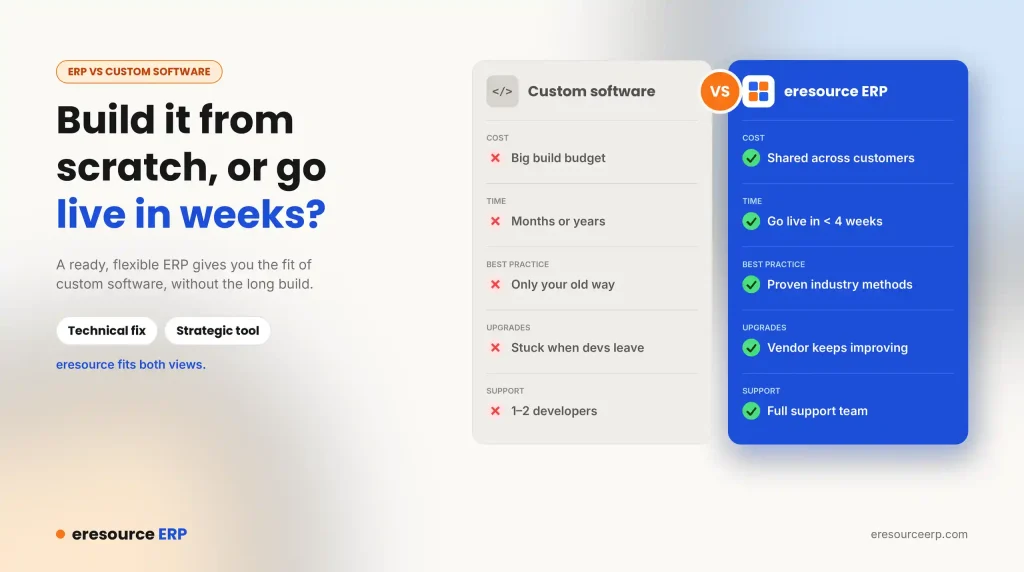
So you do not need a long, separate integration project. Our proven implementation method, case studies and hands-on training help your team settle in quickly. In addition, the 3X faster implementation method aims for go-live in under four weeks.
Treat Integration as a Company-Wide Strategy
Enterprise application integration is a company-wide issue, not just an IT task. Therefore, it needs a company-wide plan.
First, list the other apps your ERP must talk to, such as online store, payment or delivery tools. eresource can link to them through open APIs. The right approach depends on how much data each system must share. Above all, move carefully and follow a proven method. For tips, read how to make ERP implementation successful.
Benefits of ERP and CRM Integration
When ERP and CRM share one database, the whole business gains:
- One customer record: Every team sees the same, up-to-date history.
- Faster quotes and orders: Won deals move into orders and invoices without retyping.
- Smarter credit decisions: Reps check dues before they accept a new order.
- Quicker service: Tickets follow clear SLAs, so your team fixes problems on time.
- Better marketing: You can target campaigns using real buying patterns.
- Higher retention: Happy customers stay longer and refer others.
How to Plan Your ERP and CRM Integration
Follow these steps for a smooth start:
- Map the customer journey: Write down every step from first enquiry to after-sales service.
- Clean your customer data: Merge duplicates and fix missing details before you move them.
- Decide what to share: Agree which records, such as orders, invoices and tickets, each team needs.
- Train your teams: Show sales and service staff how to use the shared record every day.
- Track retention: Watch repeat orders, ticket times and customer feedback each month.
See ERP and CRM Integration in Action
eresource has helped businesses build stronger customer relationships since 2006. To see the CRM inside our ERP, book a free demo. You can also read why, for a successful business, ERP is the future.
Also Read – ERP for Plastic industry
FAQs About ERP and CRM Integration
What is ERP and CRM integration?
ERP and CRM integration joins customer data with orders, invoices, stock and service records. So every team sees one complete view of each customer.
Why is customer retention so important?
Loyal customers cost less to serve, buy more and refer others. Bain & Company research found that a 5% rise in retention can lift profits by 25% to 95%.
Is eresource CRM a separate product?
No. eresource CRM sits inside the ERP, so you do not need a separate integration project. Won quotes turn straight into sales orders, invoices and deliveries.
Can eresource connect to other business applications?
Yes. Open APIs link eresource to other tools, such as e-commerce, payment or logistics systems.
How long does it take to go live?
The 3X faster implementation method aims for go-live in under four weeks. However, the exact time depends on your data and processes.