How ERP Helps You Reduce Cycle Time and Improve Efficiency
ERP brings many benefits, and a shorter cycle time is one of the most valuable. When you reduce cycle time, customers get their goods sooner and your cash comes in faster. In this post, we explain what cycle time means and why it runs long in many firms. We also show how eresource ERP cuts it down, step by step.
What Is Cycle Time?
In this context, cycle time is the time between a customer placing an order and receiving the product. It includes order entry, stock checks, production, packing, shipping and invoicing.
So every delay at any step adds to the total. To shorten the cycle, you need to see and speed up the whole chain, not just one part of it.
Make-to-Order vs Make-to-Stock
Manufacturers usually work in one of two ways, or a mix of both.
At one end is make-to-order (MTO). Here, the manufacturer starts designing or making the product only after the order arrives. It also buys materials and parts only after that point. As a result, both cycle time and production cost tend to run high.
At the other end is make-to-stock (MTS). In this case, the company makes products in advance and keeps them in finished goods stock. Then it ships from stock when an order comes in.
How ERP Helps Reduce Cycle Time in Both Models
ERP can shorten the cycle in both models. However, the gain is usually larger for make-to-order firms. ERP helps them plan materials, schedule production and track each job from the moment the order arrives.
For make-to-stock firms, the items already sit in warehouses or with distributors. So the time saving comes mainly from faster order fulfilment rather than from the shop floor.
The Old Way: Manual Order Processing
In the past, cycle times ran long even for stock items. Most of the work was manual. Even where companies used computers, their systems rarely talked to each other.
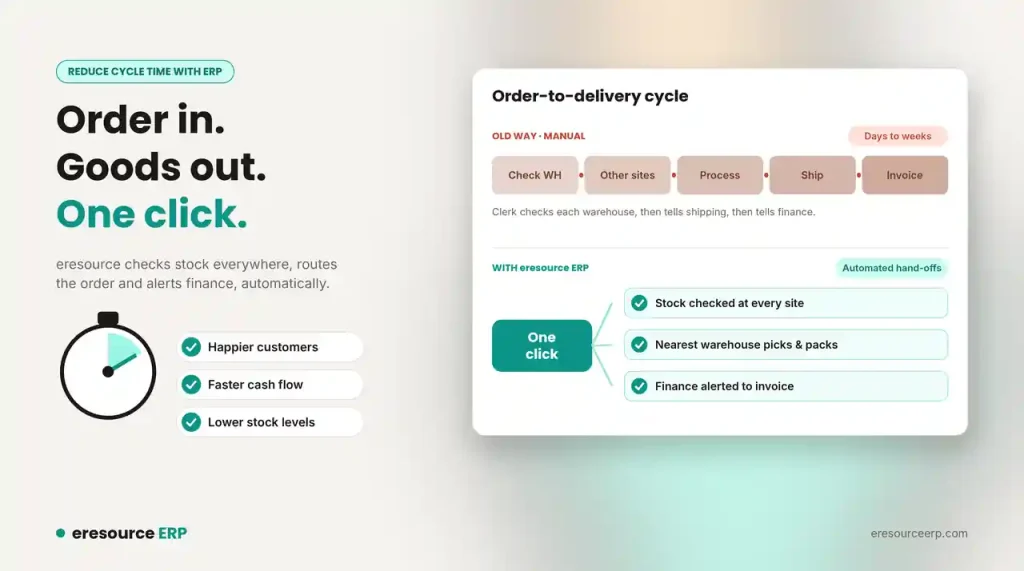
Here is a typical example. A customer places an order. First, the order clerk checks whether the nearest warehouse has the item. If not, the clerk checks other warehouses and distributors one by one. Next, the clerk processes the order and tells the right warehouse to ship it. Finally, someone informs the finance team to raise the invoice. All of this could take days, and sometimes even weeks.
The New Way: Automated Order Fulfilment With eresource
eresource changes this process completely. As soon as the clerk enters the order, the system checks stock across every location. If the nearest warehouse is out of stock, it finds the closest one that has the item.
Then the system sends the order to that warehouse and passes the shipping details to the distribution team. The team handles picking and packing, so the goods leave on time. At the same time, the finance module receives an alert to raise the invoice.
One click from the clerk sets all of this in motion. Because every record lives in one central, up-to-date database, most steps need no manual work. That is how eresource helps you reduce cycle time.
Key Benefits When You Reduce Cycle Time
A shorter cycle helps every part of the business:
- Happier customers: Orders arrive sooner and on schedule.
- Faster cash flow: Invoices go out as soon as goods ship.
- Lower stock levels: You can hold less buffer stock when you ship faster.
- Fewer errors: Automated steps remove manual re-entry and missed messages.
- Better use of staff: Teams spend time on customers instead of chasing paperwork.
Flexibility Without the Long Wait
With eresource, manufacturers can offer make-to-order flexibility while keeping much of the speed of make-to-stock. In other words, customers get the features they want without paying more or waiting for long periods.
In addition, a web-enabled system lets customers place orders and track their status online. The sales module and the store module share live data, so every promise you make is based on real stock.
How to Start Cutting Cycle Time
Follow these steps to find and remove delays:
- Measure today’s cycle: Track the time from order to delivery for a sample of orders.
- Find the slowest steps: Look for waits between teams, not just slow tasks.
- Connect your data: Put orders, stock, production and finance in one system.
- Automate hand-offs: Let the system alert each team the moment work arrives.
- Review every month: Check your cycle time and fix the next bottleneck.
See How eresource Can Reduce Cycle Time
eresource has helped businesses ship faster since 2006. To see the order-to-delivery flow on your own processes, book a free demo. You can also learn about operational efficiency with ERP.
Also Read – ERP for Trading industry
FAQs About How ERP Helps Reduce Cycle Time
What is cycle time in order fulfilment?
Cycle time is the time between a customer placing an order and receiving the product. It covers order entry, stock checks, production, packing, shipping and invoicing.
How does ERP reduce cycle time?
ERP checks stock across all locations, routes the order to the right warehouse and alerts finance at once. Because every step runs from one database, most hand-offs need no manual work.
Does ERP help make-to-order or make-to-stock firms more?
It helps both. However, the gain is usually larger for make-to-order firms, because ERP also speeds up material planning and production scheduling.
What are the benefits of a shorter cycle time?
A shorter cycle means happier customers, faster cash flow, lower stock levels, fewer errors and better use of staff time.
Can customers track their orders online?
Yes. A web-enabled ERP lets customers place orders and track their status online.