ERP Finance Module: See Your Tomorrow Today
In today’s business environment, financial decisions need accurate and current data. Outdated records can slow down decision-making. Therefore, businesses need financial information that reflects current operations.
This becomes even more important when an organization operates across multiple departments, branches, or locations. With an integrated ERP system, businesses can connect financial data with other business activities.
Why Is an ERP Finance Module Important?
A business needs a clear view of its current financial position. This information helps management plan future activities with greater confidence.
Therefore, an ERP finance module connects financial data with daily business operations. It helps teams manage accounting, reporting, budgeting, and financial analysis from one system.
The financial components of the ERP software solution from eresource ERP work together to support better financial management. Moreover, the finance module connects with other business areas to improve data flow.
As a result, finance teams can access information from different departments without maintaining separate systems.
How ERP Finance Software Connects Business Operations
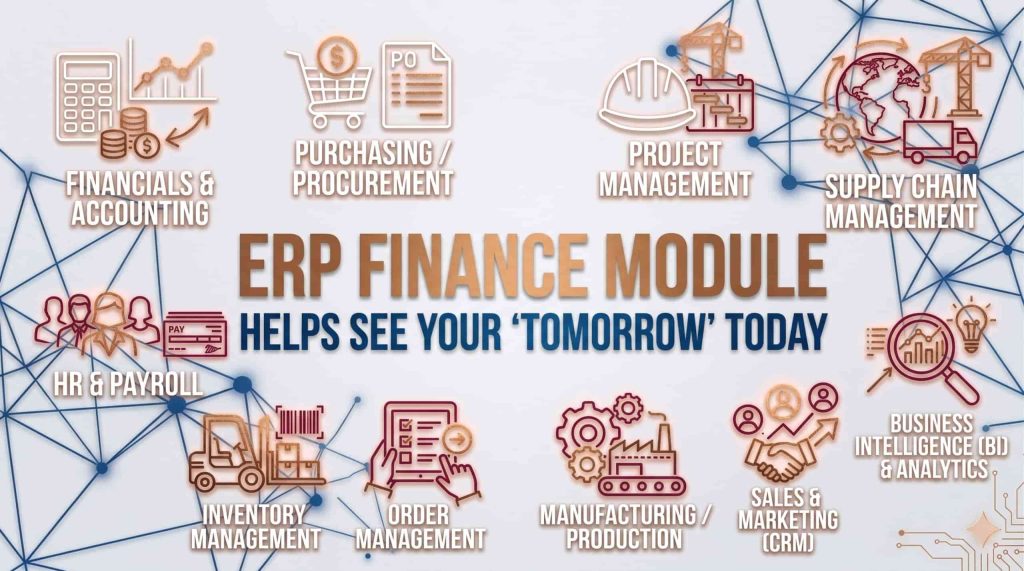
An ERP finance module does not work as a standalone accounting system. Instead, it connects finance with other ERP modules.
These modules can include:
Materials management
Human resource management
Logistics
Sales
Purchase
Inventory
Production
Customer management
Because the modules share data, employees do not need to enter the same information multiple times. In addition, the ERP system can automatically link related transactions.
For example, purchase transactions can connect with inventory and financial records. Similarly, sales transactions can flow into accounting processes.
As a result, businesses can reduce repetitive work and improve financial data consistency.
Within the ERP system, different departments can work with connected information. Therefore, management gets a more complete view of business performance.
Key Features of the ERP Finance Module
The finance module of eresource ERP supports financial management for medium and large enterprises in India and other markets.
It includes several important financial subsystems.
1. Financial Accounting
The financial accounting section helps businesses manage essential accounting activities.
It includes:
General Ledger
Accounts Receivable
Accounts Payable
Fixed Asset Accounting
Debit Notes
Credit Notes
Journal Entries
Bank Reconciliation
These functions help finance teams manage daily accounting tasks within a centralized system.
Furthermore, centralized accounting can make financial information easier to access and review.
2. Statutory and Regulatory Management
Businesses also need to manage tax and regulatory requirements.
The finance module supports areas such as:
Value Added Tax analysis and reporting
TDS and service tax
Excise
Therefore, finance teams can manage relevant statutory information within the ERP environment.
The exact tax and compliance features available can depend on the business requirements and applicable regulations.
3. Enterprise Controlling
Financial management also requires planning and performance monitoring. For this reason, enterprise controlling features can support management-level analysis.
The module includes:
Executive Information System
Business Planning and Budgeting
Profit Centre Accounting
In addition, these features can help management review financial performance and plan future activities.
Improve Financial Decision-Making with ERP
Accurate financial information plays an important role in strategic decision-making.
With an integrated ERP finance module, businesses can centrally manage financial data. The system can also support multiple companies, branches, and charts of accounts within a single framework.
As a result, finance teams can spend less time collecting data from separate systems. Instead, they can focus more on analysis and financial planning.
Moreover, integrated financial information gives management better visibility into business operations.
The financial accounting module in eresource ERP supports company-wide financial integration. This approach can help businesses connect accounting information with wider operational activities.
Benefits of an Integrated ERP Finance Module
An integrated finance module can provide several business benefits.
Centralized Financial Data
All financial information can stay within a connected ERP environment. Therefore, teams can access relevant information from one system.
Better Data Coordination
Finance connects with purchasing, inventory, sales, and other departments. Consequently, teams can work with related business data more efficiently.
Reduced Repetitive Data Entry
Users do not need to enter the same information into multiple systems. Instead, integrated modules can share relevant transaction data.
Better Financial Visibility
Management can review financial information alongside operational data. This helps provide a broader view of business performance.
Support for Business Planning
Budgeting and financial analysis help businesses plan future activities. In addition, management can use financial information to monitor performance against business goals.
Why Choose an Integrated ERP Finance Solution?
Financial management becomes more complex as a business grows. Multiple branches, departments, transactions, and business processes can increase the amount of financial data.
Therefore, an integrated ERP finance solution can help businesses manage this complexity through a centralized system.
At the same time, ERP integration connects financial activities with other business functions. This creates a more coordinated approach to accounting and business management.
Conclusion
An ERP finance module helps businesses manage financial accounting, budgeting, reporting, and analysis within an integrated system.
More importantly, it connects finance with other business functions. As a result, businesses can improve data coordination, reduce repetitive work, and gain better financial visibility.
With accurate and connected financial information, management can understand the current position of the business and plan future activities with greater confidence.
Also Read: ERP for Plastic industry