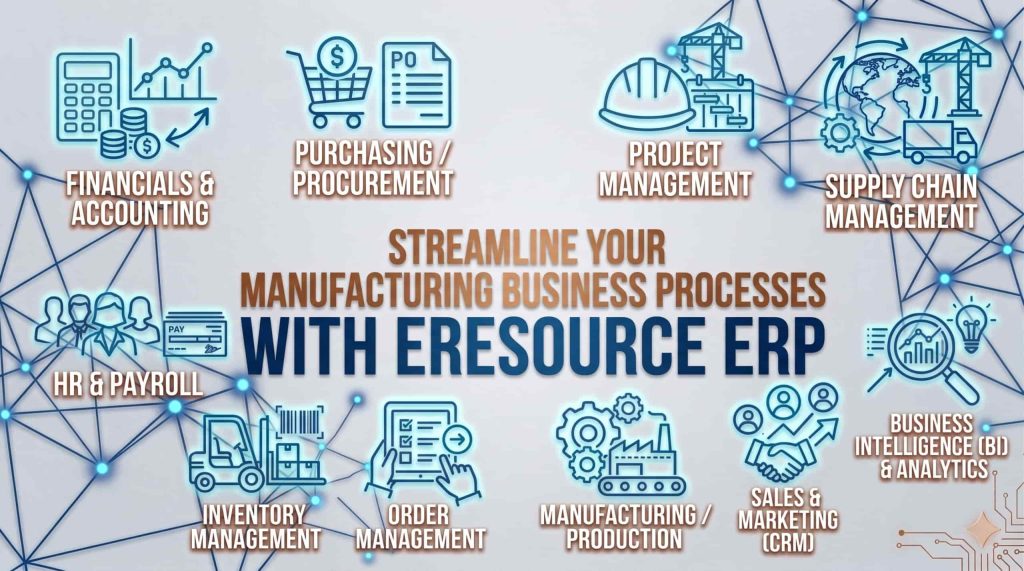
ERP Manufacturing Solution: Streamline Your Business Processes
Manufacturing businesses need efficient processes to control costs and meet customer expectations. An ERP manufacturing solution helps small and mid-sized manufacturers connect their key business activities.
With integrated ERP software, manufacturers can manage production, purchasing, inventory, sales, and delivery through one connected system. As a result, teams can improve coordination and respond faster to changing market demands.
How ERP Manufacturing Software Streamlines Operations
The eresource ERP manufacturing solution helps manufacturers manage daily operations more efficiently.
In addition, the system provides flexibility as business requirements change. Manufacturers can adapt processes and add operational functionality when needed.
The ERP software for Manufacturing also helps organizations respond to changing customer needs. Therefore, businesses can adjust their processes without disrupting their overall operations.
Key Benefits of ERP for Manufacturing
An integrated manufacturing ERP system can improve several areas of business performance.
1. Streamline Production and Delivery
Manufacturing operations involve many connected activities. These include production planning, order processing, warehousing, and delivery.
With eresource ERP, manufacturers can improve visibility across these processes. Consequently, teams can monitor production and delivery schedules more effectively.
The system also helps users track order processes and warehouse activities. As a result, managers can identify delays and take action sooner.
2. Automate Manual Manufacturing Processes
Manual processes can consume valuable employee time. They can also create delays and data-entry errors.
Therefore, automation plays an important role in modern manufacturing. Eresource ERP can automate repetitive processes used by manufacturing companies.
This approach helps employees focus on more important activities. At the same time, manufacturers can improve operational efficiency and explore new business opportunities.
3. Improve Customer Responsiveness
Customer expectations can change quickly. Manufacturers need accurate information to respond to these changes.
Eresource ERP supports multidimensional tracking and advanced order-promising capabilities. As a result, organizations can improve their response to customers and business partners.
Furthermore, connected information helps teams coordinate sales, production, and delivery activities.
4. Control Manufacturing Costs
Cost control is essential for profitable manufacturing operations. The eresource manufacturing ERP software system helps manufacturers set budgets and review costs.
Users can also track business activities and resources through the ERP system. Therefore, managers can monitor spending and make better use of available resources.
5. Support Real-Time Information Sharing
A web-based ERP solution allows users to share business information online. Employees can access relevant data in real time.
As a result, departments can communicate more effectively. Moreover, managers can work with current information when they need to make operational decisions.
6. Identify Problems and Take Corrective Action
Manufacturing businesses need early visibility into operational problems. Delays or process issues can affect production and customer service.
Eresource ERP helps manufacturers identify problem areas. Therefore, teams can take corrective action before small issues become larger problems.
Major ERP Advantages for Manufacturing Businesses
The eresource ERP advantages extend beyond production management. The system also supports collaboration, customer management, e-commerce, business intelligence, and technology management.
Supplier Collaboration
Effective supplier collaboration can improve procurement execution. Two-way information exchange helps businesses coordinate with suppliers.
In addition, better collaboration can help reduce material costs. At the same time, manufacturers can maintain the flexibility needed to respond to production requirements.
Customer Relationship Management
Strong customer relationships support long-term business growth. Eresource ERP integrates sales, marketing, support, and e-commerce activities.
The Customer Relationship Management (CRM) capabilities help businesses improve customer service. Consequently, manufacturers can respond to customer requirements more efficiently.
Better integration can also support customer satisfaction and long-term loyalty.
E-Commerce
Modern manufacturers may need to manage online sales and customer interactions. A web-based application provides access to business information through the internet.
Eresource ERP uses Microsoft .NET technology to support online access and business connectivity. Therefore, users can access information and manage business processes from different locations.
This flexibility can also help businesses connect with customers and partners.
Extended Enterprise Support
Manufacturing organizations may operate from one location or multiple plants. An ERP system should support both business structures.
Eresource ERP is designed to support businesses with single or multiple plant operations. As a result, growing manufacturers can manage connected operations through one ERP environment.
Business Intelligence
Manufacturers need clear visibility into important business data. Business intelligence tools can help users analyze critical information.
Therefore, managers can review business data and identify important trends. In addition, better visibility supports faster and more informed business decisions.
Technology Infrastructure
A reliable technology infrastructure supports long-term ERP use. The Microsoft-based eresource ERP solution supports implementation, administration, customization, and integration.
Furthermore, the system provides a scalable technology foundation. This can help businesses adapt their ERP environment as operational requirements change.
Why Choose an ERP Manufacturing Solution?
Manufacturing involves many connected processes. Production, procurement, inventory, sales, finance, and delivery must work together.
An integrated ERP manufacturing solution brings these activities into one connected environment. Consequently, businesses can improve data flow and operational coordination.
Moreover, automation reduces repetitive work. Real-time information also helps teams respond faster to business changes.
For these reasons, manufacturers can use ERP software to build more structured and connected business processes.
Conclusion
An ERP manufacturing solution can help manufacturers streamline operations, automate processes, control costs, and improve information visibility.
It also supports supplier collaboration, customer relationship management, e-commerce, business intelligence, and multi-location operations. In addition, web-based access helps users share information across connected business functions.
By connecting important manufacturing processes, eresource ERP helps businesses create a more coordinated and efficient operating environment.
Also Read: ERP for packaging industry