ERP Implementation Strategy: Planning Tips for a Smooth Rollout
Time is one of the biggest factors in any ERP project. Delays cost money, and setbacks can shake your team’s confidence. That is why a clear ERP implementation strategy matters so much. A good method should satisfy the business and also build trust among the people who will use the system.
In this post, we answer two questions that many decision makers ask. Should you roll out ERP module by module or all at once? And should business process re-engineering come before ERP or during it? We also share a simple checklist for planning your rollout.
Choosing an ERP Implementation Strategy: Phased or All at Once?
Many leaders are unsure whether to go live one module at a time or with all modules together. There is no single answer, because every company is different. So study your own situation carefully before you decide.
In most cases, the choice depends on five factors:
- Readiness: The results of your ERP readiness audit.
- People: How many internal and external consultants you have.
- Sites: How relevant the ERP is to each of your locations.
- Time: The deadline you need to meet.
- Budget: How much you can spend in each phase.
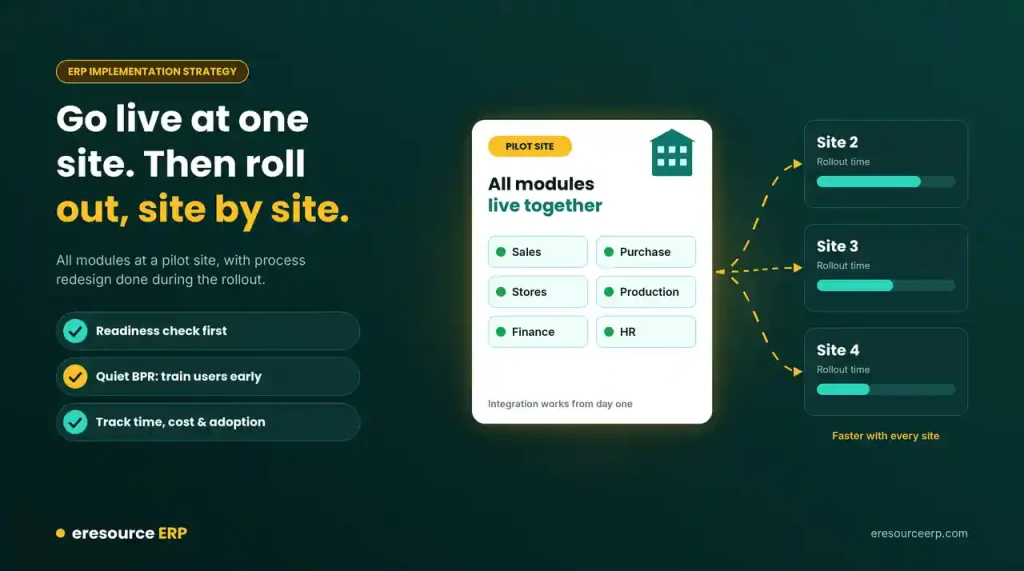
That said, we usually recommend one approach. First, go live with all the modules at one site. Then, once that site runs smoothly, roll the system out to your other sites one by one.
Why a Pilot-Site ERP Implementation Strategy Works Well
A single pilot site gives you the best of both worlds. On one hand, every module goes live together, so the integration works from day one. On the other hand, you limit the risk to one location.
As a result, your team learns on a smaller scale. Then it can carry that experience to every other site. Each later rollout also becomes faster and smoother.
Should BPR Come Before ERP?
Many decision makers also ask about business process re-engineering (BPR). Should you redesign your processes first and then implement ERP, or the other way round?
In our experience, the ERP system is the practical form of BPR. We have seen companies that completed BPR first and then implemented ERP. In almost every case, they threw away the BPR document. Instead, they wrote a new “to-be” process plan to suit the ERP.
Run BPR During the Implementation
These cases show a simple truth. BPR brings little value without an ERP in mind, and ERP cannot succeed without good BPR. So the best time to redesign processes is during the implementation itself.
However, the biggest part of BPR is a change in mindset. You can start that change early, for example through user training during the first analysis. We call this a “quiet BPR”. It prepares people for change without disrupting daily work, and it helps the rollout run smoothly.
Why Tight Module Integration Matters
An efficient ERP depends on tight links between its modules. In eresource, for instance, manufacturing connects directly with customer service, logistics and delivery.
So a new customer order automatically starts the right warehouse action. Likewise, each shipment triggers billing. Sales, production and purchase teams work together to fill urgent orders and adjust output to demand. See how this flow helps you reduce cycle time.
Avoid Building ERP In-House
ERP is not like other software projects that focus only on automating tasks. Yet some Indian companies, both big and small, still try to build their own ERP. This is usually a costly mistake.
An in-house system often automates separate tasks but misses the deep integration that defines real ERP. Today, quality ERP products are within reach of most companies. Read our comparison of ERP vs custom software before you decide.
ERP Is Now Within Reach of Every Company
Hardware, infrastructure and ERP software all cost far less than they did a decade ago. Therefore, a modern ERP is now within reach of almost any growing business. In fact, cloud ERP removes most of the upfront cost.
ERP Implementation Strategy Checklist
Use these steps to plan your rollout:
- Run a readiness check: Start with a free ERP assessment to find gaps.
- Pick a pilot site: Choose a location with strong leaders and clean data.
- Train users early: Begin the mindset change before go-live.
- Design to-be processes: Redesign processes during the implementation, not before.
- Roll out site by site: Use lessons from the pilot to speed up each new site.
- Track results: Measure time, cost and user adoption after every phase.
For more on scheduling, read how to implement a strong ERP program.
Plan Your ERP Implementation Strategy With eresource
eresource has guided ERP rollouts for growing businesses since 2006. Our 3X faster implementation method aims for go-live in under four weeks. To plan your own rollout, book a free demo with our team.
Also Read – ERP for Manufacturing Company
FAQs About ERP Implementation Strategy
Should ERP go live module by module or all at once?
It depends on your readiness, people, sites, time frame and budget. Usually, though, it works best to launch all modules at one pilot site. Then you roll out to the other sites.
Should BPR come before ERP implementation?
In most cases, no. Companies that finish BPR first often rewrite their process plan to suit the ERP anyway. So the best time to redesign processes is during the implementation.
What is a quiet BPR?
It means starting the mindset change early, for example through user training. As a result, people get ready for new processes without disrupting daily work.
Why not build an ERP in-house?
In-house systems often automate separate tasks but miss the deep integration of real ERP. They also cost more to build and maintain.
How long does an eresource implementation take?
The 3X faster implementation method aims for go-live in under four weeks. However, the exact time depends on your data, sites and processes.