Integrated Finance Module: Why a Strong ERP Finance Core Keeps Your Business Healthy
When a company decides to buy ERP, better financial management is usually the first goal. However, a rushed choice can do more harm than good. So the system you pick must fit both your business processes and your finance needs. At the heart of that choice sits one thing: an integrated finance module.
In this post, we explain why finance drives most ERP decisions. We also show how the eresource finance module links every part of your business. Finally, we list what to check before you buy.
Why Finance Drives Most ERP Decisions
Every business decision ends up in the books. Sales, purchases, payroll and stock all affect cash and profit. That is why finance teams often push hardest for ERP.
Yet many firms choose a system in a hurry. As a result, they end up with software that fits neither their processes nor their accounts. A careful selection avoids this problem. To see why finance should lead the project, read about the competitive advantage of ERP.
Efficiency Needs Teamwork Across Departments
Business conditions change constantly, so no company can afford to waste time or money. To stay efficient, every department must share information both ways.
In other words, sales, stores, production and accounts need to work as one team. This teamwork covers planning and admin work in every area of the company. A strong ERP makes it possible.
General Accounting at the Centre
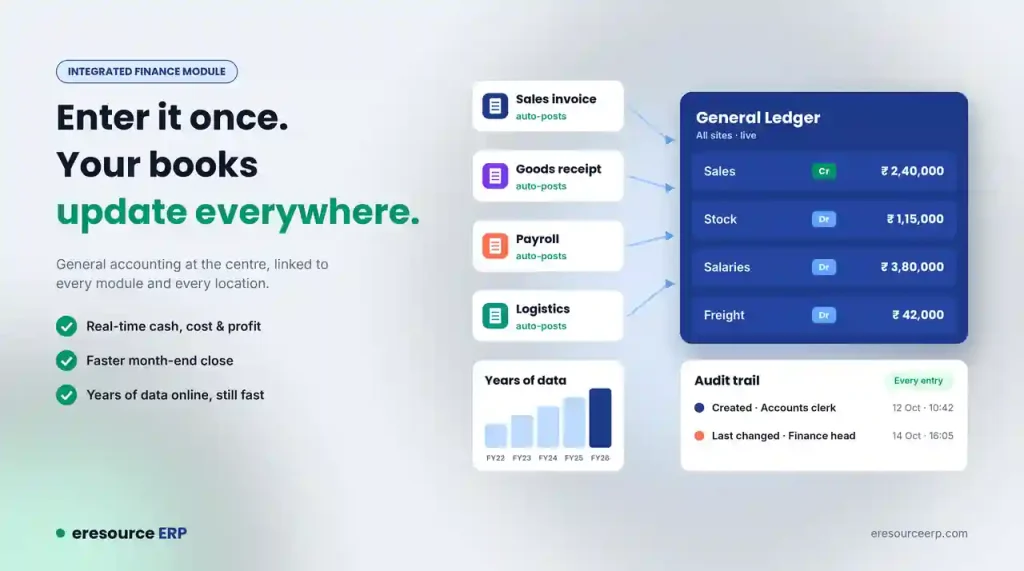
In eresource, general accounting sits at the centre of all financial activity. It captures every transaction from across the system and brings it together.
Because of this, you can see the financial impact of each action on the company as a whole. For example, a delayed delivery shows up in sales, stock and cash forecasts at the same time. You can learn more on our accounts and finance module page.
How an Integrated Finance Module Works
Whatever your financial goals, the eresource finance tools work together to improve your bottom line. That is because finance links tightly with every business area and every location.
This integration reaches every other module, from materials management and purchase to human resources and logistics. The system links related areas on its own, so nobody repeats the same steps. In short, you enter data only once. Every area then works in step, which handles your financial data with far greater efficiency.
Complete Audit Trails
Good finance needs clear records of every change. eresource keeps a full audit trail for each entry. It records who created the entry and when, and who changed it last.
You can also filter these details by date to find what you need quickly. Moreover, the trail lets auditors trace any transaction back to its source. For more on keeping data safe, read about ERP security.
Years of Data Without Slowing Down
Many older systems slow down as the data grows. As a result, companies often archive past years and lose easy access to them.
The eresource finance module keeps several years of accounting data online without affecting performance. So you can compare this year with past years in seconds.
Benefits of an Integrated Finance Module
When finance connects to every part of the business, the gains add up:
- One entry, many uses: A single transaction updates stock, sales and accounts.
- Real-time view: Managers see cash, costs and profit at any moment.
- Faster month-end: Most entries already sit in the books when the month closes.
- Stronger control: Audit trails show who did what, and when.
- Company-wide view: Figures from every branch and location roll up together.
- Better decisions: Live dashboards support planning. See ERP with business intelligence.
How to Choose an Integrated Finance Module
Use these questions when you compare ERP vendors:
- Process fit: Does the finance module match how your business actually works?
- Depth of integration: Does a goods receipt or a sales invoice post to the books on its own?
- Audit trail: Can you see who created and changed each entry?
- Multiple sites: Can it combine figures from all your branches and locations?
- History: Can it keep years of data online without slowing down?
- Local rules: Does it support GST and your other tax needs?
See the eresource Finance Module in Action
eresource has helped finance teams run on one set of numbers since 2006. To see the finance module with your own processes, book a free ERP demo. You can also read how the ERP finance module helps you see tomorrow today.
Also Read – ERP Software for Manufacturing Industry
FAQs About the Integrated Finance Module
What does an integrated finance module do?
It links the finance part of an ERP to every other module, such as sales, purchase, stores and HR. So each transaction flows into the books automatically.
Why is general accounting at the centre of ERP?
General accounting captures every transaction from across the system. As a result, you can see the financial impact of each action on the whole company.
Does eresource keep an audit trail?
Yes. It records who created each entry and when, and who changed it last. You can also filter these details by date.
Can eresource keep several years of accounting data?
Yes. The finance module keeps several years of data online without affecting performance.
What should we check before choosing a finance module?
Check process fit, depth of integration, audit trails, multi-site support, data history and local tax rules such as GST.