ERP ROI: How to Get More Return on Investment from ERP
A new ERP system can help businesses reduce operating costs.
It can also automate manual processes and improve employee productivity.
ERP software brings different business functions together.
This approach can reduce the need for separate systems.
However, buying ERP software alone does not guarantee a strong return on investment.
Businesses need to use the system effectively to achieve better results.
ERP ROI depends on several factors.
These include implementation, employee adoption, process improvement, and ongoing system usage.
What Is ERP ROI?
ERP ROI measures the value a business receives from its ERP investment.
Companies can measure this value through financial and operational improvements.
For example, businesses can track:
Reduced operating costs
Lower manual work
Higher employee productivity
Better inventory control
Faster business processes
Improved customer service
Better financial visibility
Increased revenue opportunities
Therefore, businesses should track both cost savings and business improvements.
Why ERP ROI Matters
Many organizations spend significant time and money selecting ERP software.
However, some businesses do not measure the results after implementation.
This can make it difficult to understand the actual value of the ERP system.
Businesses should review ERP performance after implementation.
They should also compare results with their original business goals.
An Enterprise Resource Planning (ERP) system can deliver value when employees use it correctly.
The organization must also align the system with its business processes.
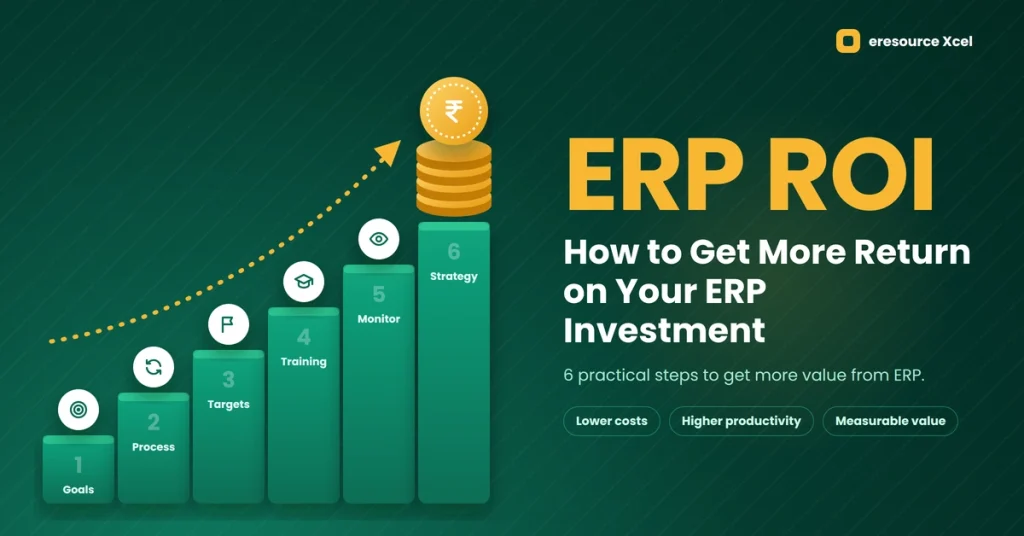
How to Improve ERP ROI
Businesses can take several steps to improve their ERP return on investment.
1. Set Clear Business Goals
Start by defining what you want to achieve with your ERP system.
For example, your goals may include reducing costs or improving productivity.
You may also want to improve inventory accuracy or speed up order processing.
Clear goals make ERP performance easier to measure.
They also help teams understand the purpose of the ERP implementation.
2. Improve Your Business Processes
ERP software works best when businesses use efficient processes.
Review your current workflows before and during implementation.
Identify tasks that create delays or require unnecessary manual work.
Then, use ERP features to simplify those processes.
Automation can reduce repetitive tasks and free employees for higher-value work.
As a result, better processes can contribute to higher ERP ROI.
3. Set Realistic ERP Expectations
Businesses should set practical expectations for ERP implementation.
You cannot achieve every business goal immediately after deployment.
Employees also need time to learn the new system.
A successful ERP implementation requires planning and user adoption.
Set measurable targets for each stage of the implementation.
Then, track progress against those targets.
This approach helps your organization stay focused on long-term ROI.
4. Train Your Employees
Employee adoption plays an important role in ERP ROI.
Employees need proper training before they start using the system.
They should understand the workflows that relate to their roles.
Good training can reduce errors and improve system usage.
It can also help employees discover useful ERP features.
Therefore, businesses should provide ongoing training after implementation.
5. Monitor ERP Performance
Regular performance reviews can help businesses identify improvement areas.
Track important ERP metrics based on your business goals.
These metrics can include processing time, operating costs, and employee productivity.
You can also monitor inventory accuracy and customer response times.
Compare current results with your results before ERP implementation.
This comparison can show where the ERP system creates measurable value.
6. Maintain a Long-Term ERP Strategy
ERP ROI does not end after implementation.
Businesses should continue improving their ERP processes as they grow.
They should also review new features and system capabilities.
A long-term relationship with your ERP solution can support continuous improvement.
Regular reviews can help your team identify new opportunities for automation.
Key Benefits of Improving ERP ROI
A well-managed ERP system can provide several business benefits:
Lower operating costs
Better employee productivity
Faster business processes
Improved data accuracy
Better inventory management
Stronger financial control
Better customer service
Improved decision-making
Greater process visibility
Better use of ERP features
These benefits can increase the overall value of your ERP investment.
Measure ERP ROI Continuously
Businesses should not wait until the end of the ERP project to measure ROI.
Instead, review performance at regular intervals.
Compare actual results with your original targets.
For example, check whether automation has reduced manual work.
Also, review whether employees complete tasks faster.
You can then identify areas that need further improvement.
This continuous approach helps businesses get more value from their ERP system.
Conclusion
ERP software can deliver significant business value when companies use it effectively.
However, successful ERP ROI requires more than software implementation.
Businesses need clear goals, efficient processes, employee training, and regular performance tracking.
Start by defining measurable objectives for your ERP project.
Then, improve processes and train employees to use the system correctly.
Finally, monitor results and continue improving the ERP environment.
With the right approach, businesses can increase the value of their ERP investment and support long-term growth.