Understanding ERP System: What Is ERP and How Does It Work?
An Enterprise Resource Planning system, commonly known as an ERP system, helps businesses manage their core operations. ERP software brings different business functions into one integrated platform.
Modern ERP systems support both manufacturing and service businesses. They help companies manage data, improve workflows, and make better business decisions.
What Is an ERP System?
An ERP system connects multiple business functions through one software platform. It can manage finance, sales, purchasing, inventory, manufacturing, human resources, and other operations.
Businesses can use ERP software to reduce manual work. They can also access important information from a central system.
Earlier ERP systems focused on a limited number of business functions. Today, modern ERP packages cover many areas of business management.
How ERP Software Has Evolved
The term ERP originally focused on enterprise-wide resource planning. Large organizations were the first major users of ERP systems.
However, ERP adoption has expanded over time. Today, businesses of different sizes and industries use ERP software.
Small and medium-sized businesses can also use ERP systems to manage daily operations. The right ERP solution can support business growth without adding unnecessary complexity.
What Functions Does an ERP System Manage?
Modern ERP software can connect many business functions. It stores their information in a unified database.
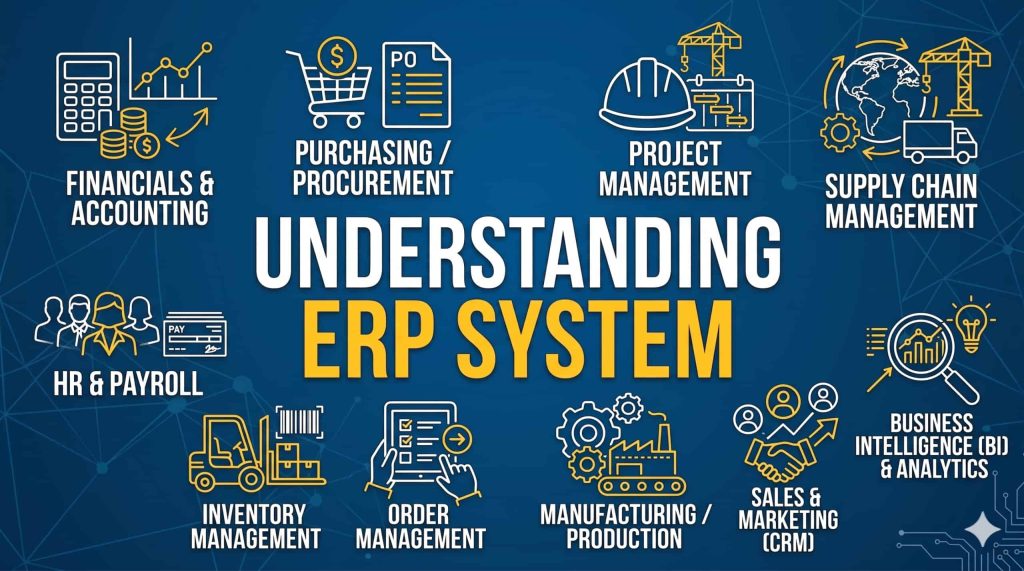
For example, an ERP system can integrate:
Financial management
Human resource management
Supply chain management
Customer relationship management
Manufacturing management
Sales management
Purchasing
Inventory management
Warehouse management
Previously, businesses often managed these functions through separate applications. Each application could use its own database and network.
An ERP system brings these functions together. Therefore, teams can access consistent information from one platform.
Businesses can also explore different ERP packages based on their industry and operational needs.
Why Do Businesses Use ERP Systems?
ERP software has become an important business management tool. Companies use ERP systems to improve control over their operations.
An integrated ERP system can help businesses manage several challenges, including:
Growing business operations
Production planning
Sales management
Inventory control
Supplier coordination
Customer management
Financial reporting
Business data management
Moreover, ERP software gives teams better access to business information. This can support faster decisions and smoother workflows.
ERP for Small and Medium-Sized Businesses
ERP systems are no longer limited to large enterprises. Many small and medium-sized businesses also use ERP software.
A suitable ERP system can help these companies organize their processes. It can also connect departments and reduce duplicate data entry.
Businesses can improve their operations as they grow. However, companies should select ERP software based on their actual business requirements.
Web-Based ERP
What Is Web-Based ERP?
Web-based ERP software runs through a web browser. Users can access the system without installing the complete application on every computer.
Many businesses use web-enabled ERP as a central business platform. It can provide a strong information backbone for digital business operations.
Web-based ERP can also help companies share information with business partners. As a result, teams can improve collaboration and business communication.
Benefits of Web-Based ERP
A fully integrated web-based ERP system can capture accurate and timely business data. It can also connect information from different departments.
This integration can support better business decisions. It can also improve inventory control, order management, and cash management.
Web-based ERP can provide several benefits:
Better access to business information
Improved data consistency
Faster business reporting
Better order management
Improved cash flow visibility
Lower IT maintenance costs
Better customer responsiveness
Easier remote access
In addition, web-based ERP can support businesses with distributed teams and remote users.
Access ERP Software from Anywhere
One major benefit of a web-based ERP solution is flexible access.
Executives and sales teams can access the ERP system through a web browser. They do not need to depend on a specific office computer.
This setup can also simplify remote business operations. Users can access relevant information when they need it.
Reduce ERP Infrastructure Costs
Web-based ERP can reduce the need for extensive local hardware. Businesses can manage their ERP environment with a more flexible technology setup.
The system can also reduce server maintenance requirements. Therefore, businesses can spend less time managing ERP infrastructure.
A well-planned implementation can also use the company’s existing technology environment. This can help businesses control implementation and infrastructure costs.
How ERP Improves Business Management
ERP software connects business functions through a common platform. Therefore, employees can work with consistent information.
For example, sales data can support inventory planning. Purchasing data can support production planning. Financial data can help management monitor business performance.
This connected approach helps businesses improve process visibility. It also supports better coordination between departments.
Key Benefits of an ERP System
An ERP system can help businesses achieve several operational benefits:
Centralized business data
Better process visibility
Improved department coordination
Reduced manual data entry
Faster reporting
Better inventory management
Improved financial control
Better customer service
Support for business growth
However, businesses should choose an ERP system that matches their processes and long-term goals.
Conclusion
An ERP system provides a unified platform for managing business operations. It connects functions such as finance, sales, manufacturing, inventory, purchasing, and customer management.
Modern web-based ERP solutions also provide flexible access and better data connectivity. As a result, businesses can improve workflow management and access important information faster.
For businesses looking to improve operational control, ERP software can provide a structured approach to managing daily processes and future growth.
Also Read – ERP for trading industry