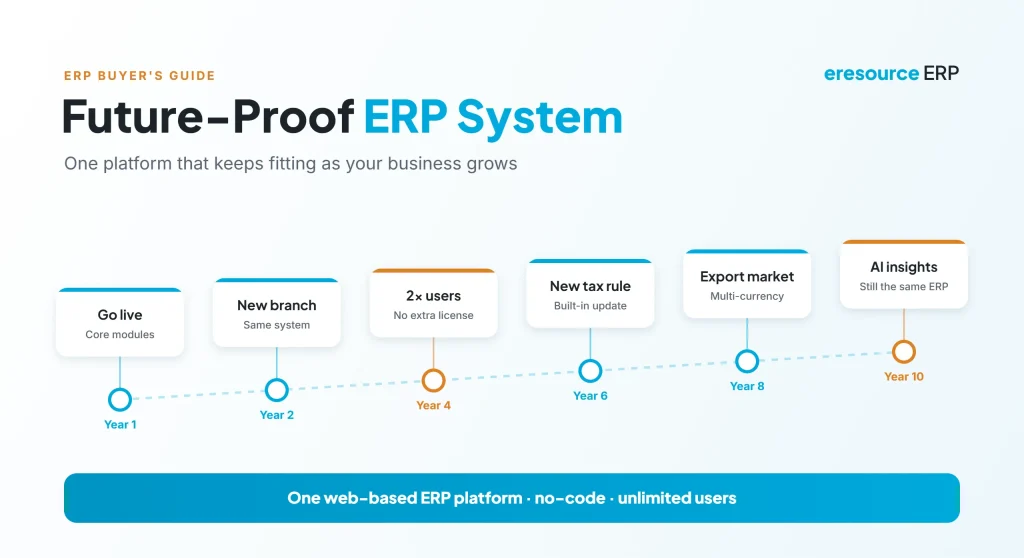
A future-proof ERP system keeps serving your business for many years, because it can grow, change and stay compliant without a costly replacement. Choosing an ERP is usually a ten-year decision. However, many companies pick a system that fits today and then outgrow it within a few years. As a result, they pay twice: once for the first ERP and again for the painful switch. This guide explains what makes an ERP future-proof, the warning signs of a short-lived system, and eight things to check before you buy.
Key takeaways
- Think in years, not months: judge an ERP on how well it will fit in five to ten years.
- Change without code: your own team should adapt forms, approvals and reports.
- Growth should not cost more licenses: flat pricing protects you as headcount rises.
- Check the vendor too: a long track record matters as much as the feature list.
What makes an ERP system future-proof?
A future-proof ERP system is one you can keep using as your business changes. For example, it should handle new branches, products, users and tax rules without a rebuild. It should also run on a modern web platform, so access, upgrades and integrations stay simple.
In contrast, a short-term system works only as long as nothing changes. Then every new need turns into custom code, workarounds or a separate tool.
Signs your current ERP will not last
Most legacy systems do not fail overnight. Instead, they slowly push people back to spreadsheets. Watch for these signs:
- Every small change needs custom development.
- Departments keep their own spreadsheets because the ERP data is not trusted.
- Branches or plants run different systems, so data sits in islands.
- Each new tax or e-invoicing rule needs a costly patch.
- Adding users means buying more licenses every year.
If several of these sound familiar, your next system should be a future-proof ERP system, not another short-term fix.
Short-term ERP vs future-proof ERP system
The table below compares a short-term choice with an ERP built to last:
| Area | Short-term choice | Future-proof ERP system |
|---|---|---|
| Platform | Desktop or old client-server | Web-based, cloud or on-premise |
| Changes | Custom code for each request | No-code setup by your own team |
| Pricing | Per user, rising with headcount | Flat license, unlimited users |
| Locations | Separate systems per site | All entities on one platform |
| Compliance | Patches for each new rule | Updates built into the product |
| Data | Islands of information | One live database |
| Insights | Static month-end reports | Live dashboards and AI alerts |
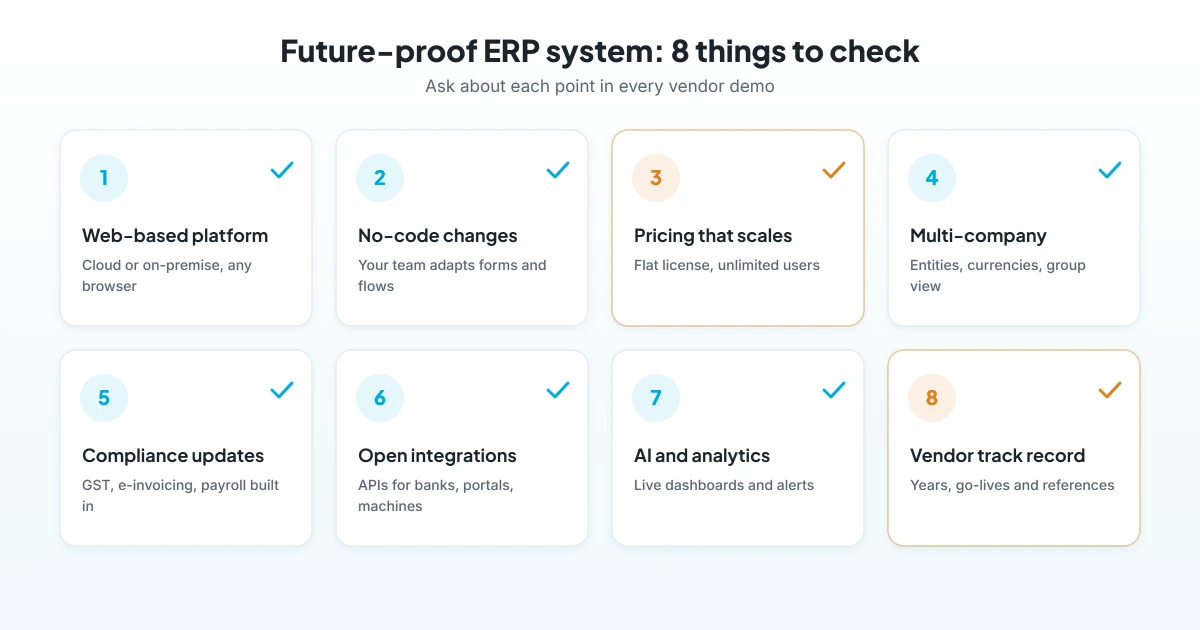
8 things to check in a future-proof ERP system
Use this list in every vendor demo. Together, these points show whether a system will still fit in ten years.
1. Web-based platform
First, the ERP should run in a browser, on cloud or on your own servers. So teams in any office, site or country can work on the same live data.
2. No-code configuration
Next, your processes will keep changing. Therefore, your own team should add fields, forms, approvals and reports without waiting for a developer.
3. Pricing that scales
Also, check what happens when you double your users. A flat license with unlimited users keeps costs steady, while per-user fees grow every year.
4. Multi-company and multi-currency
Even if you have one entity today, you may add branches or export later. So the ERP should handle several companies, currencies and a consolidated group view.
5. Compliance updates
Tax rules change often. As a result, GST, e-invoicing and payroll updates should come as part of the product, not as paid projects.
6. Open integrations
In addition, the system should connect to banks, portals, machines and other tools through APIs. That way, you can add new tools without replacing the ERP.
7. Built-in AI and analytics
Meanwhile, AI is quickly becoming standard in business software. A future-proof ERP system should already offer live dashboards and AI that flags risks.
8. Vendor track record
Finally, look at the vendor’s history. Years in business, number of go-lives and customer references show whether it will still support you a decade from now.
Speed matters too: a 40-day go-live
A long-term system should not take forever to start. For example, Byteware Technologies in Dubai chose eresource after evaluating several ERP products. The project covered sales, procurement, material management, distribution, warehouse management, project sales and finance. Even so, it went live on 8 January 2012, about 40 days after the order.
Today, eresource’s no-code framework enables go-live up to 3X faster than traditional ERP. To plan your own rollout, see how to implement ERP in 90 days.
How to choose a future-proof ERP system
- Write a five-year plan: first, list the branches, products and users you expect.
- Turn it into requirements: next, note what the ERP must handle by year five, not just today.
- See demos on your own processes: then ask vendors to show a real change, made live without code.
- Price the future: after that, compare five-year costs at your expected headcount.
- Check references: finally, speak to customers who have used the system for several years.
For more help, read why a modern ERP system beats legacy software and how to balance flexibility and control.
Why eresource is a future-proof ERP system
eresource has built ERP for 20 years, with 3,000+ implementations in 25+ countries. It is also web-based, AI-powered and no-code, with 37 modules on one platform.
- Cloud, on-premise or hybrid: choose the deployment that suits you, and change it later.
- Dashboard Studio: users build their own apps and workflows with zero coding.
- Unlimited users: scale from 50 to 500+ users without extra license fees.
- Compliance built in: GST, ZATCA and e-invoicing, plus statutory payroll for India, the UAE, Saudi Arabia and Nigeria.
- AzaaleaGPT AI: works on your live ERP data and flags what needs attention.
- Industry editions: ready processes for manufacturing, process industries, construction and trading.
To learn more, explore the full range of eresource ERP products, read why eresource is a next-generation ERP, and see how a web-based ERP can boost your business.
Frequently asked questions
What is a future-proof ERP system?
It is an ERP that can grow and change with your business for many years. It handles new users, entities and rules without a costly rebuild.
How long should an ERP system last?
Generally, a well-chosen ERP should serve a business for ten years or more. Regular updates keep it current during that time.
Why do companies replace their ERP?
Usually, the old system cannot handle growth, new rules or new locations without heavy custom work. As a result, teams fall back on spreadsheets.
Is a cloud ERP system more future-proof than on-premise?
Cloud ERP is easier to upgrade and scale. However, a modern web-based ERP can be future-proof on either cloud or your own servers.
How do I check if an ERP vendor will last?
First, look at years in business, number of implementations and customer references. Then ask how often the product is updated.
Is eresource a future-proof ERP system?
Yes. eresource is web-based, no-code and AI-powered, with unlimited users and 20 years of ERP experience.
Want an ERP that will still fit in ten years? Book a free demo, or start with a free ERP assessment.
Also Read – ERP for Automotive Industry