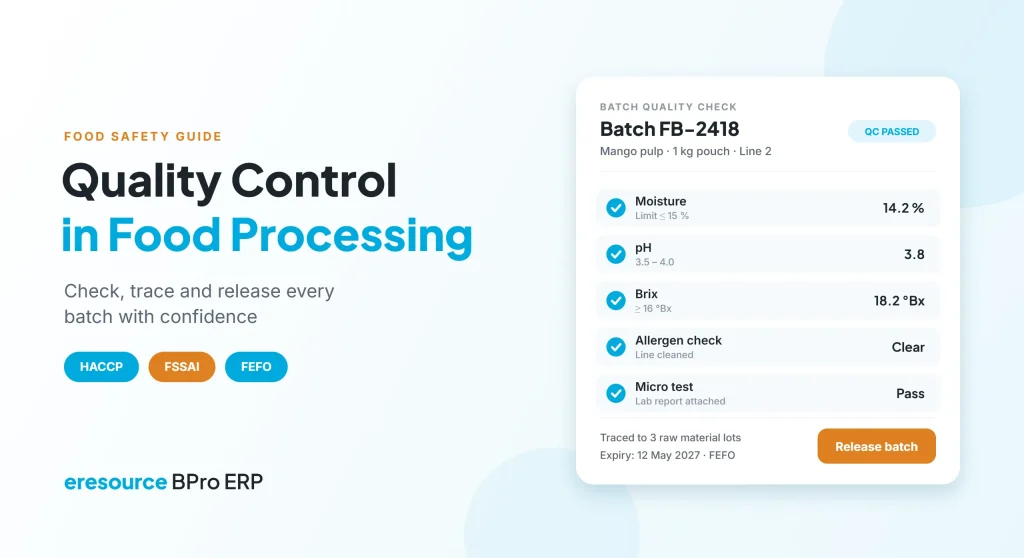
Quality control in food processing means checking raw materials, every production stage and the finished pack, so that only safe and consistent food reaches your customers. In fact, one missed check can lead to a rejected consignment, a product recall or a regulatory notice. However, many food plants still record tests on paper and in spreadsheets. As a result, finding the right batch record during an audit or a complaint can take hours. This guide explains where quality checks belong, how an ERP makes them faster and more reliable, and how to set one up.
Key takeaways
- Quality starts at receipt: check every raw material lot before it enters the store.
- Test at each stage: in-process checks catch problems before you lose a full batch.
- Trace in seconds: link every raw material lot to the batches and customers it reached.
- Keep records audit-ready: digital batch records make HACCP and FSSAI audits far easier.
What is quality control in food processing?
Quality control (QC) is the hands-on checking of materials and products against set specifications. For example, a team may test moisture, pH, temperature, weight or microbial counts. Quality assurance (QA), in contrast, is the wider set of rules that stops problems from starting.
Generally, most food safety systems build on HACCP principles, which identify hazards and set critical control points. So quality control in food processing is where teams measure, record and act on those control points.
Where quality control in food processing happens: receipt to dispatch
In short, good QC follows the product through the whole plant. The table below shows the main checkpoints and what an ERP should record at each one:
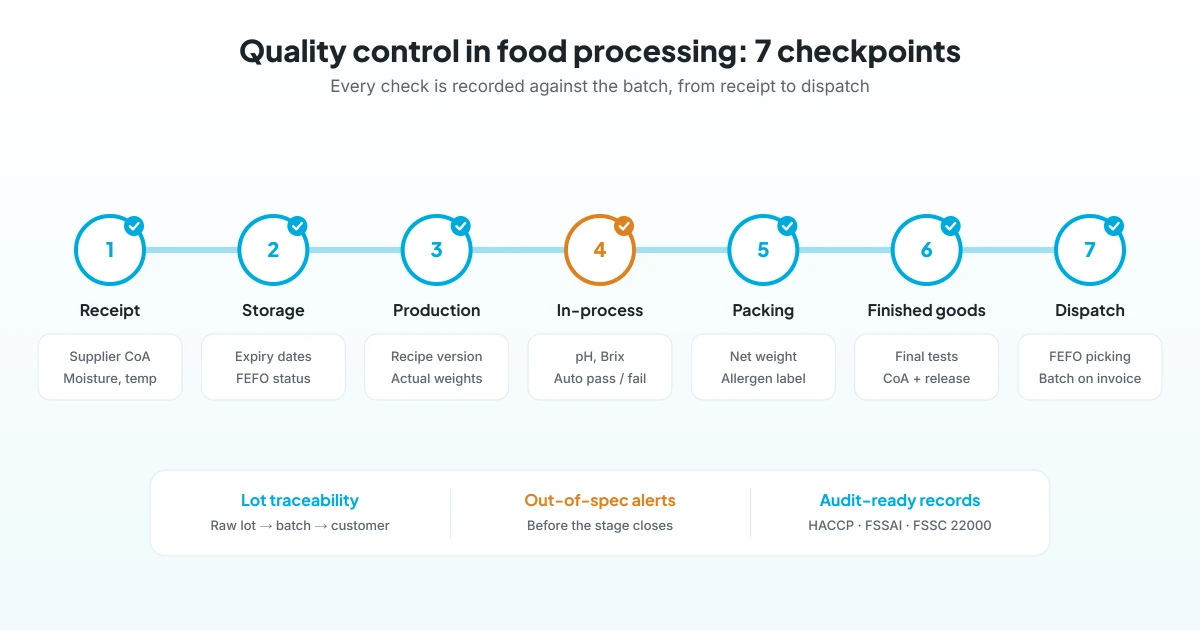
| Stage | What to check | What the ERP records |
|---|---|---|
| Raw material receipt | Supplier CoA, moisture, temperature, allergen status | Inspection result, lot number, accept or reject |
| Storage | Storage temperature, expiry dates | Stock by lot with expiry, FEFO status |
| Production | Recipe version, weights, process temperature and time | Batch record with actual quantities |
| In-process | pH, Brix, viscosity, fill weight | Test values with automatic pass or fail |
| Packing and labels | Net weight, batch code, allergen declaration | Packing record linked to the batch |
| Finished goods | Final tests and retained samples | Release decision and certificate of analysis |
| Dispatch | First-expiry-first-out picking | Batch numbers on every delivery and invoice |
Why paper-based quality control in food processing fails
Of course, paper checklists work for a small kitchen. However, they break down in a growing plant:
- Managers see test results only at the end of the batch.
- Nobody compares readings in real time, so bad values slip through.
- Expired or quarantined material sometimes reaches production by mistake.
- A customer complaint means searching files to find the right batch.
- Audits take days, because records sit in different folders and registers.
Therefore, more food companies now manage quality control in food processing inside their ERP, where every check is linked to the batch it belongs to.
7 ways an ERP improves quality control in food processing
An ERP turns QC from a separate paper process into part of daily production. Here is how.
1. Incoming inspection and supplier quality
First, QC staff check each raw material lot against its standard at receipt. Meanwhile, rejected lots go on hold, and the ERP builds a quality record for each supplier.
2. Recipe and specification control
Next, every product uses an approved recipe version with set limits for each test. As a result, operators cannot use an old formula by mistake.
3. In-process checks with pass or fail
Then QC staff record test results at each production stage. The system then compares them with the limits and flags any failed value before the stage closes.
4. Batch and lot traceability
Also, the ERP links each raw material lot to the batches it went into and the customers who received them. So you can trace forward or backward in seconds.
5. FEFO and expiry control
In addition, the system issues stock on a first-expiry-first-out basis. Near-expiry alerts help teams use material in time, so expired ingredients stay out of production.
6. Electronic batch records and CoA
Similarly, the ERP saves every quantity, test and approval against the batch. Then you can print a certificate of analysis from these results instead of typing it by hand.
7. Complaints, recalls and corrective action
Finally, when a complaint arrives, the team looks up the lot and its full history inside the ERP. If needed, the recall covers only the affected batches, and the team tracks each corrective action to closure.
Compliance: HACCP, FSSC 22000 and FSSAI
Above all, food regulators and buyers expect proof, not promises. For instance, HACCP plans need monitoring records at each critical control point, and FSSC 22000 audits review traceability and corrective actions. In India, FSSAI licensing also requires proper records and labelling.
Because the ERP stores these records as part of normal work, quality control in food processing becomes audit-ready every day, not just in the week before an audit.
How to set up quality control in food processing on an ERP
- Define specifications: first, list the parameters and limits for each raw material and product.
- Map your control points: next, mark where checks happen, from receipt to dispatch.
- Set up lots and expiry: then make sure every item carries a lot number and an expiry date.
- Train QC and floor teams: after that, show staff how to record tests on desktops or tablets.
- Review trends: finally, check rejection rates and out-of-spec results every month.
For a full rollout plan, see how to implement ERP in 90 days.
Why eresource BPro suits food processors
eresource BPro is a process manufacturing ERP built for formula-based and batch production. It has 20+ years of process industry focus and 350+ plant go-lives.
- Food and beverage ready: covers FSSC 22000, HACCP, allergens, nutritional formulas, FEFO and FSSAI needs.
- In-process QC: records results at every stage, with automatic pass or fail against specifications.
- Lot traceability: traces from raw material lot to batch to customer in seconds.
- Expiry-driven inventory: enforces FEFO and alerts teams before material expires.
- Batch records and CoA: electronic batch records and automatic CoA generation.
- Mobile QC entry: lab analysts record test results from tablets at the bench.
Beyond quality, the same platform also runs demand planning, depot stock and customer service, including eresource CRM. To learn more, read about the best ERP for process industry and ERP for food processing in Nigeria.
Frequently asked questions
What is quality control in food processing?
It is the checking of raw materials, in-process product and finished goods against set specifications. The aim is to make sure only safe, consistent food leaves the plant.
What is the difference between QC and QA in the food industry?
QC tests and inspects products. In contrast, QA sets up the procedures and systems that prevent quality problems.
How does ERP help quality control in food processing?
Generally, an ERP links every test to its batch, flags out-of-spec results, enforces FEFO and keeps full lot traceability. As a result, audits and recalls become much faster.
Why is lot traceability important for food manufacturers?
Above all, it shows which raw material lots went into which batches and which customers received them. So a recall can cover only the affected stock.
Does an ERP support HACCP and FSSAI compliance?
Yes. A good food ERP stores monitoring records, batch records and corrective actions, which auditors under HACCP and FSSAI expect to see.
Is eresource BPro suitable for food and beverage companies?
Yes. BPro covers FSSC 22000, HACCP, allergens, nutritional formulas, FEFO and FSSAI needs, along with in-process QC and lot traceability.
Want to see quality control on your own products? Book a free demo, or start with a free ERP assessment.
Also Read – Best ERP System for Food Processing: Complete Guide