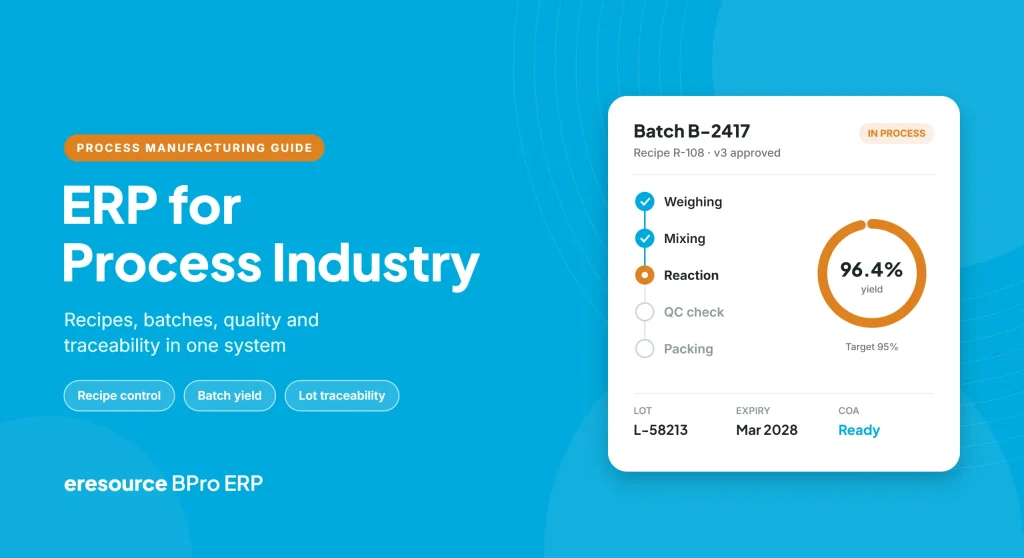
The best ERP for process industry is one that thinks in recipes, batches and quality checks, not just parts and assemblies. For example, chemical, pharma, food and paint plants mix ingredients, run reactions and pack products that can expire. So a generic ERP with a “batch” add-on often leaves gaps in yield, traceability and compliance. This guide explains what process manufacturers need, which features matter most, and how to pick the right system for your plant.
Key takeaways
- Recipes, not just BOMs: process plants need formula-based production with versions, potency and scaling.
- Batch control end to end: yield, by-products and stage-wise quality checks should sit in one system.
- Traceability is a must: you should trace any lot from supplier to customer in seconds.
- Compliance built in: GMP, 21 CFR Part 11, FSSC 22000 and HACCP workflows should not need add-ons.
What is an ERP for process industry?
An ERP for process industry is a business system built for companies that make products by mixing, blending, cooking or reacting ingredients. Once you blend a batch of paint or brew a syrup, you cannot take it apart again. Consequently, this changes how you plan, cost and control production.
In contrast, discrete manufacturers assemble countable parts, such as cars or machines. So their ERP works with bills of materials and serial numbers. A process plant, however, works with formulas, batches, potency and shelf life. Therefore, the best ERP for process industry is designed around those ideas from day one.
Process vs discrete manufacturing: why a generic ERP falls short in the process industry
The table below shows where the two models differ, and what that means for your ERP:
| Area | Discrete manufacturing | Process manufacturing |
|---|---|---|
| Product structure | Bill of materials with fixed parts | Recipe or formula with ratios and potency |
| Production unit | Units, serial numbers | Batches and lots |
| Output | One finished item | Main product plus co-products, by-products and waste |
| Quality | Final inspection | Inward, in-process and final checks, plus CoA |
| Inventory | Count by piece | Track by lot, potency, QC status and expiry |
| Compliance | Product safety rules | GMP, 21 CFR Part 11, FSSC 22000, HACCP |
As a result, a discrete ERP often forces process teams back to spreadsheets. Teams then calculate yield by hand, and batch records live on paper. That is why the best ERP for process industry handles batches from the start.
8 must-have features in the best ERP for process industry
So use these eight features as your shortlist when you look for the best ERP for process industry. Together, they cover the full journey from raw material to dispatch.
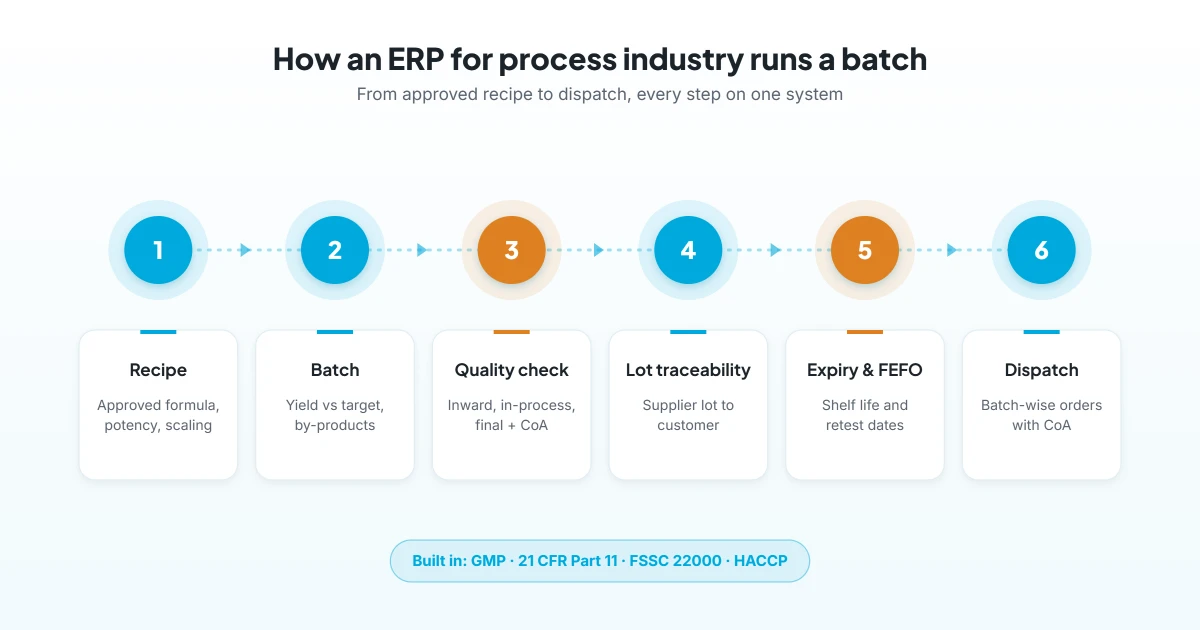
1. Recipe and formula management
Your ERP should hold several versions of each formula, with approval before any change goes live. It should also set strength, potency and concentration. In addition, it should convert quantities automatically when you scale a batch up or down.
2. Batch management and yield control
First, every batch needs its own number, status and link to the recipe. So the system should compare actual yield with target yield as the batch runs. It should also capture waste and by-products, because they affect your real cost.
3. Quality control and CoA
In fact, quality checks happen at every stage, not just at the end. For example, your team should record inward, in-process and final test results against set parameters. Then the ERP should generate the Certificate of Analysis (CoA) and log any non-conformance or CAPA.
4. Lot traceability and recalls
Today, regulators and buyers also expect full traceability. Therefore, you should trace any lot forward to customers and backward to the supplier lot. When a problem appears, a good system narrows a recall to the exact batches in seconds.
5. Shelf life, expiry and FEFO
Many process products also expire. So your ERP should track shelf life, expiry and retest dates for every lot. It should also allocate stock on a first-expiry, first-out (FEFO) basis, which cuts write-offs.
6. Process control and plant floor links
Each stage also has its own steps, time, temperature and pressure. So a process ERP should give operators checklists for every stage and flag values that go out of range. It should also be ready to connect with SCADA or PLC systems on the plant floor.
7. Production and material planning
Likewise, planning in a process plant depends on demand, capacity and material availability. So look for MRP logic, material reservation by batch and automatic purchase suggestions. It should also respect vendor lead times and minimum order quantities.
8. Compliance built into the process industry ERP
However, rules differ by sector. Pharma plants follow GMP and the US FDA’s 21 CFR Part 11 for electronic records. Similarly, food plants often certify against FSSC 22000. Meanwhile, many batch plants model their control logic on the ISA-88 batch standard. So your ERP should support these workflows without a separate tool.
Which process industries need this kind of ERP?
In short, any business that makes products by recipe or batch can benefit. Common examples include:
- Pharmaceuticals, API and bulk drugs
- Specialty chemicals and agrochemicals
- Food and beverages, including nutraceuticals
- Paints and coatings
- Cosmetics, personal care, flavours and fragrances
- Lubricants, detergents and rubber chemicals
Of course, each sector has its own focus. Food plants care about allergens and FEFO, while paint plants care about shade matching and viscosity. Still, they all need the same core of recipes, batches, quality and traceability.
Checklist: how to choose the best ERP for process industry
To find the best ERP for process industry, ask every vendor these seven questions before you decide:
- Is it built for process, or adapted? Ask whether recipes, batches and potency sit in the core product.
- Can it show my own formulas? Request a demo with your real recipes, not a generic sample.
- How does it handle quality? Check stage-wise QC, CoA generation and CAPA tracking.
- Can it trace a lot both ways? Ask for a live recall test during the demo.
- Which rules does it support? Confirm GMP, 21 CFR Part 11, FSSC 22000 or HACCP, as your sector needs.
- How is it priced? Per-user pricing gets expensive when every lab analyst and operator needs access.
- Who implements it? Ask how many process plants the vendor has taken live, and what support follows.
Why process manufacturers choose eresource BPro
eresource BPro is a process manufacturing ERP with formula-based BOMs, batch-level traceability, stage-wise QC, FEFO and yield tracking in its core. So far, it has gone live in 350+ plants across 20+ industry types, and eresource also serves customers in 25+ countries.
- Compliance workflows: GMP, Schedule M, 21 CFR Part 11, EU GMP, WHO GMP, FSSC 22000 and HACCP.
- AzaaleaGPT AI: it monitors batches, predicts yield deviations, warns of quality drift and flags expiring raw materials.
- Unlimited users: every operator, lab analyst and store keeper gets access on one flat license.
- Mobile app: lab and shop floor teams record data where the work happens.
- No-code setup: your team can adjust forms and approvals without writing code.
BPro also runs finance, purchase, sales and HR on the same platform. For pharma plants, read why pharma companies must change their business processes. For a wider view, see our batch manufacturing software guide.
Common mistakes to avoid
- Choosing a discrete ERP and then patching it with spreadsheets.
- Skipping a recall test during the demo.
- Ignoring by-products and waste in costing, so margins look better than they are.
- Leaving lab and QC teams out of the system because of per-user license costs.
- Treating compliance as an add-on project after go-live.
Frequently asked questions
What is the best ERP for process industry?
Overall, the best ERP for process industry is a system built for recipes, batches, quality and traceability, rather than a generic ERP with add-ons. eresource BPro is one such system, with 350+ plant go-lives across 20+ industry types.
How is an ERP for process industry different from a regular ERP?
Generally, a regular ERP works with fixed bills of materials and countable parts. A process ERP, however, works with formulas, potency, batches, co-products and expiry, and it builds in stage-wise quality checks.
Which industries use process manufacturing ERP?
For example, pharma, chemicals, agrochemicals, food and beverages, paints, cosmetics, nutraceuticals, lubricants and detergents all use it.
Does eresource BPro support GMP and FSSC 22000?
Yes. BPro supports GMP, Schedule M, 21 CFR Part 11, EU GMP, WHO GMP, FSSC 22000 and HACCP workflows.
Can a process ERP connect with plant machines?
Yes. For instance, eresource BPro monitors temperature, pressure and time at each stage, and it is ready to integrate with SCADA and PLC systems.
How do we get started?
Book a free demo. First, a consultant maps your recipes and batch flow on BPro. Then you get clear answers on timelines, pricing and support.
Ready to see your own process on BPro? Book a free demo, or request a free ERP assessment first.
Also Read – ERP Software for Chemical Manufacturing: Complete Guide