Many firms put off ERP because they fear a long, costly project. Their worry is fair, since large rollouts can drag on for months. A clear ERP implementation timeline removes much of that risk. In this post, we explain why projects run late and how eresource keeps them on schedule. We also walk through each phase and share tips to help you go live on time.
Why Timely Delivery Matters
The case for ERP keeps growing across Indian industry. Still, the time it takes to deploy remains a real concern for buyers.
Every week of delay costs money. Staff run old and new systems side by side, and consultants bill for extra days. Above all, the benefits you planned for arrive later. That is why a fast, well-run project does so much to protect your return on investment from ERP.
Why an ERP Implementation Timeline Slips
Most delays come from the same few causes:
- Unclear requirements: Teams start building before they agree on what they need.
- Heavy custom coding: Each new feature adds weeks of development and testing.
- Scope creep: New requests keep arriving after you set the plan.
- Poor master data: Old records need cleaning before anyone can load them.
- Late training: Users see the system for the first time just before go-live.
Custom coding is often the biggest risk. Read why you should not customise your ERP too often.
A Typical eresource ERP Implementation Timeline
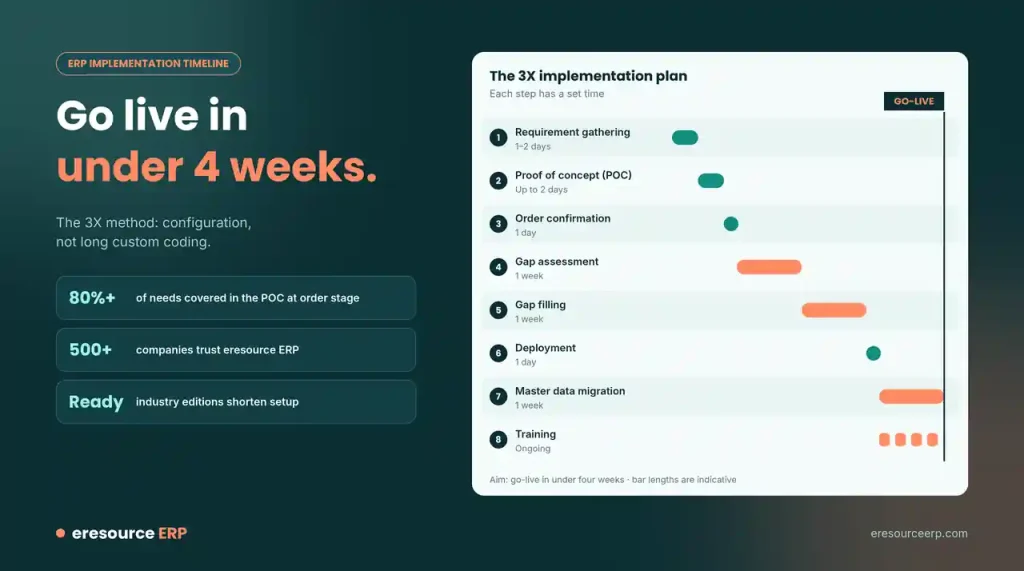
Our 3X faster implementation method follows clear steps, each with a set time:
- Requirement gathering: 1 to 2 days.
- Configuring and mapping your needs in a proof of concept (POC): up to 2 days.
- Order confirmation: 1 day.
- Gap assessment: 1 week.
- Gap filling through configuration and mapping: 1 week.
- Deployment: 1 day.
- Master data migration: 1 week.
- Training: ongoing, followed by go-live.
In total, the method aims for go-live in under four weeks.
Why the 3X Method Moves Faster
Traditional ERP projects rely on long custom development cycles. In contrast, eresource works on configuration, not coding.
By the time you confirm your order, the POC already covers more than 80% of your requirements. As a result, the team spends far less time on rework. The Azaalea platform also builds custom screens, fields and reports in hours rather than weeks. So the remaining gaps close quickly.
Quality Without Cutting Corners
Speed matters only if the system works well on day one. For this reason, the timeline still includes a full gap assessment, careful data migration and hands-on training.
Each step checks that the system fits your processes before you go live. Learn the 5 key elements of ERP success that turn a quick rollout into lasting results.
Ready Editions Shorten the Timeline
Ready industry editions also save time, because much of the setup already exists. eresource offers editions for manufacturing, pharmaceuticals, automotive, steel wire, engineering and construction.
Today, most Indian industries already see the need for ERP. With a ready edition, finding a system that fits your processes and budget becomes much easier. Read more about ERP for every industry.
Tips to Keep Your ERP Implementation Timeline on Track
You can help your project finish on time. Follow these steps:
- Name one project owner: Give a senior person the power to make quick decisions.
- Agree on scope early: List must-have features and park the rest for phase two.
- Clean your master data: Fix duplicate items, customers and suppliers before migration.
- Train key users first: Let them test the system and coach their teams.
- Pick a sensible go-live date: Many Indian firms start fresh on 1 April, at the start of the financial year.
For a full plan, read our guide to ERP implementation strategy.
Plan Your ERP Implementation Timeline With eresource
Your ERP project need not take months or break your budget. eresource is a cost-effective, web-based ERP, trusted by more than 500 companies. To map your own timeline, start with a free ERP assessment or book a free ERP demo.
Also Read – ERP Software for Manufacturing Industry
FAQs About the ERP Implementation Timeline
How long does an ERP implementation take?
It depends on the number of sites and modules, the state of your data and how much custom work you need. Large projects with heavy coding often take several months. The eresource 3X faster implementation method aims for go-live in under four weeks.
What are the main phases of an ERP implementation timeline?
A typical timeline covers requirement gathering, configuration, gap assessment, gap filling, deployment, master data migration, training and go-live. In the eresource method, most phases take between one day and one week.
What causes ERP implementation delays?
The most common causes are unclear requirements, heavy custom coding, scope creep, poor master data and late user training. Agreeing on scope early and keeping custom work low prevents most of them.
How does eresource deliver ERP faster without losing quality?
eresource uses configuration instead of custom coding. A proof of concept covers more than 80% of your requirements before order confirmation, so there is less rework. The timeline still includes a gap assessment, data migration and training.
When is the best time to start an ERP project?
Start when you have a clear project owner and an agreed scope. Many Indian firms aim to go live on 1 April, so they can begin the new financial year with fresh books. A free ERP assessment can help you plan the dates.