Tier 2 ERP for SMBs: Why Small Businesses Gain More From a Mid-Market ERP
ERP is now a must-have for small and medium-sized businesses (SMBs), especially in manufacturing. Yet SMBs gain different things from ERP than large firms do. They need speed, low cost and a quick fit, not a giant system built for global groups. That is where a Tier 2 ERP comes in.
In this post, we explain how ERP tiers work and why a Tier 2 ERP often suits SMBs better. We also show where eresource fits and how to make the right choice.
What Do ERP Tiers Mean?
ERP vendors often fall into three broad groups:
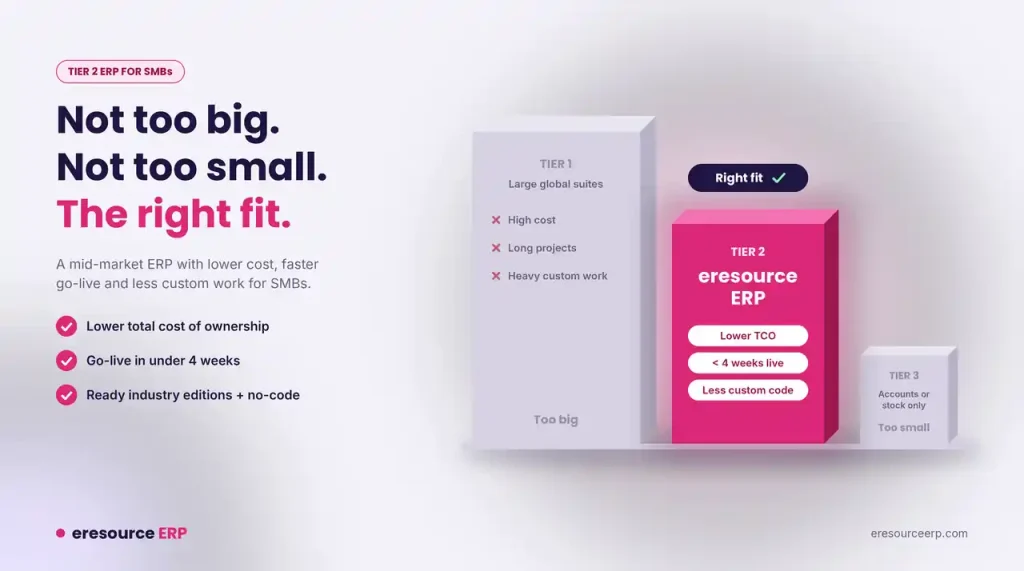
- Tier 1: Large global suites, such as those from SAP and Oracle. They suit big, complex groups with large budgets and IT teams.
- Tier 2: Mid-market systems built for growing firms. They offer strong features, often with ready editions for specific industries.
- Tier 3: Simple tools for very small firms, often covering only accounts or stock.
eresource is a Tier 2 ERP. It scales with your business and comes with editions for many industries.
Why Tier 1 ERP Often Misfits SMBs
Tier 1 systems are powerful, but their vendors designed them for large enterprises. As a result, SMBs often face three problems with them.
First, the cost of the licence, setup and support can stretch a small budget. Second, early Tier 1 systems were rigid, so firms paid for heavy custom work to make them fit. Third, long projects pull staff away from their daily work.
Lower Cost With a Tier 2 ERP
Large firms often spend a big share of their revenue on ERP projects. SMBs, on the other hand, need to spend far less with a Tier 2 ERP like eresource.
Moreover, a low total cost of ownership matters more than the price tag alone. eresource keeps that cost low and still gives you room to grow. See why it counts as a cost-effective ERP.
Faster Go-Live
Implementation cost changes a lot with company size, but timelines vary less. Even so, speed makes a real difference to an SMB. With eresource, the 3X faster implementation method aims for go-live in under four weeks.
In addition, our team studies your business first and agrees the design with you before setup. So the rollout stays on track.
Less Custom Work
Custom changes eat up time and money, and they can hurt a small business badly. eresource reduces this risk in two ways.
Each industry-specific edition already covers the common needs of your sector. Then no-code tools let your team adjust forms and workflows without a developer. As a result, most SMBs need very little custom code. Read our comparison of ERP vs custom software to learn more.
From Best-of-Breed to Best-for-Business
In the past, firms often bought the “best” separate tool for each job. Today, they prefer one system that fits the whole business, with add-ons for planning, business intelligence and knowledge management.
This shift has helped Tier 2 systems like eresource grow fast. Every company mixes standard industry practices with its own unique ways of working. eresource handles both, because it combines standard modules with specific functions for unique processes. In fact, nearly half of eresource implementations are in the SMB segment.
How to Choose the Right Tier 2 ERP
SMBs have more ERP options than large firms. So take your time and keep your long-term strategy in mind. After all, one wrong step can cost you for years.
Use this checklist:
- Industry fit: Does the vendor offer a ready edition for your sector?
- Total cost: Have you added licence, setup, training and yearly fees?
- Go-live time: How many weeks will the rollout take?
- Custom work: Can you make changes without writing code?
- Growth: Can you add modules, users and sites later?
- Support: Does the vendor have a qualified implementation team?
For more help, read our guide to ERP implementation strategy.
See Why SMBs Choose a Tier 2 ERP Like eresource
eresource has served growing SMBs since 2006. For a full overview, read our guide to ERP for SMBs and the ERP ROI for SMEs. Then book a free demo to see the system on your own processes.
Also Read – ERP Software for Construction Industry
FAQs About Tier 2 ERP for SMBs
What is a Tier 2 ERP?
A Tier 2 ERP is a mid-market system built for growing firms. It offers strong features, often with ready editions for specific industries.
What is the difference between Tier 1 and Tier 2 ERP?
Tier 1 suites, such as SAP and Oracle, suit large global groups with big budgets. In contrast, Tier 2 systems focus on growing firms, with lower costs and faster rollouts.
Why do SMBs often choose a Tier 2 ERP?
SMBs need low cost, quick go-live and a ready fit for their industry. A Tier 2 ERP usually delivers all three with less custom work.
Is eresource a Tier 2 ERP?
Yes. eresource is a Tier 2 ERP with editions for many industries. It scales with your business as you add modules, users and sites.
How long does eresource take to go live?
The 3X faster implementation method aims for go-live in under four weeks. However, the exact time depends on your data and processes.