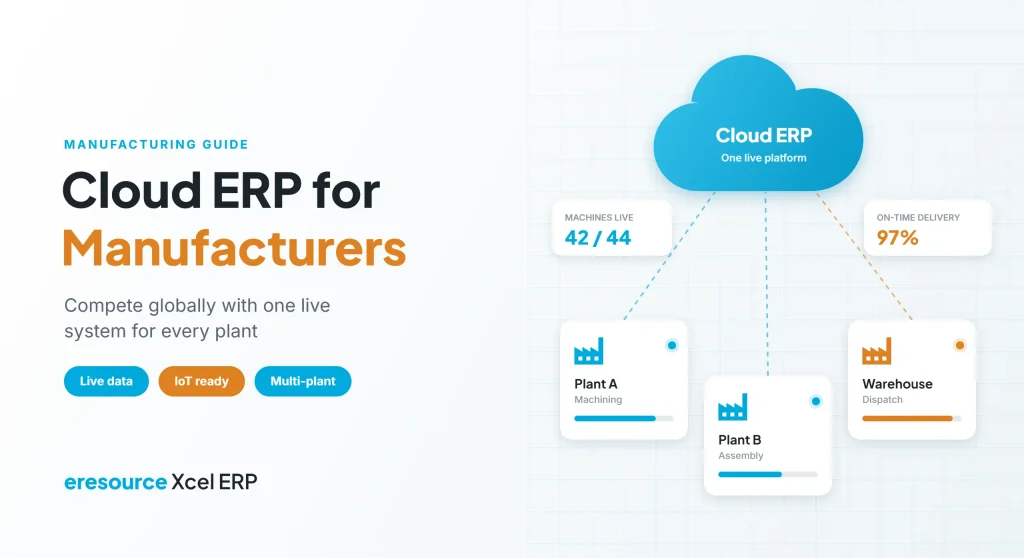
A cloud ERP for manufacturers puts planning, production, stock, quality and finance on one live system that every plant and office can reach. Today, even a mid-sized factory competes with suppliers around the world. At the same time, buyers expect short lead times, steady quality and quick answers about their orders. However, many factories still run on spreadsheets, old desktop software and phone calls. This guide explains what a cloud ERP does for a factory, how it helps you compete globally, and how to move without stopping production.
Key takeaways
- One live system: sales, planning, the shop floor and finance work on the same data.
- Global buyers want proof: on-time delivery, traceable quality and clear order status win repeat business.
- Machines can talk to the ERP: IoT links bring real-time output and downtime data into planning.
- Lower IT load: cloud deployment removes most server upkeep, so your team focuses on production.
What is a cloud ERP for manufacturers?
A cloud ERP for manufacturers is a factory management system that runs on cloud servers and opens in a web browser. Also, it covers the full chain, from enquiry and BOM to production, quality, dispatch and invoicing.
In contrast, an on-premise ERP runs on servers inside your own office. Of course, both can work well. However, cloud ERP is quicker to scale, and it lets every plant, warehouse and sales office share the same live numbers. For a full comparison, see our guide to cloud, on-premise and hybrid ERP.
What global buyers expect from manufacturers
Large customers now compare suppliers across countries. So before they place repeat orders, they usually look for five things:
- On-time delivery: realistic dates at the quote stage, and then dates you actually meet.
- Consistent quality: inspection records and batch or serial traceability for every lot.
- Fast, accurate quotes: prices based on real material and process costs.
- Order visibility: quick answers on where each order stands.
- Clean paperwork: correct invoices, tax documents and currency for each market.
Above all, each of these depends on good data. As a result, a cloud ERP for manufacturers has become a basic tool for any factory that wants to grow beyond its home market.
Spreadsheets vs cloud ERP: what changes on the factory floor
The table below shows how daily work changes when a factory moves from spreadsheets and old tools to a cloud ERP:
| Area | Spreadsheets and legacy tools | Cloud ERP for manufacturers |
|---|---|---|
| Order status | Phone calls to the shop floor | Live status on every order |
| Planning | Manual lists, often out of date | MRP based on orders, BOMs and stock |
| Machines | Output noted at shift end | Real-time data through IoT links |
| Quality | Paper checklists | Stage-wise QC with full traceability |
| Multiple plants | Separate files per site | One view across all plants |
| IT upkeep | Local servers and backups | Light, browser-based access |
7 ways a cloud ERP for manufacturers helps you compete globally
Specifically, here is how the system turns into a real advantage when you sell beyond your home market.
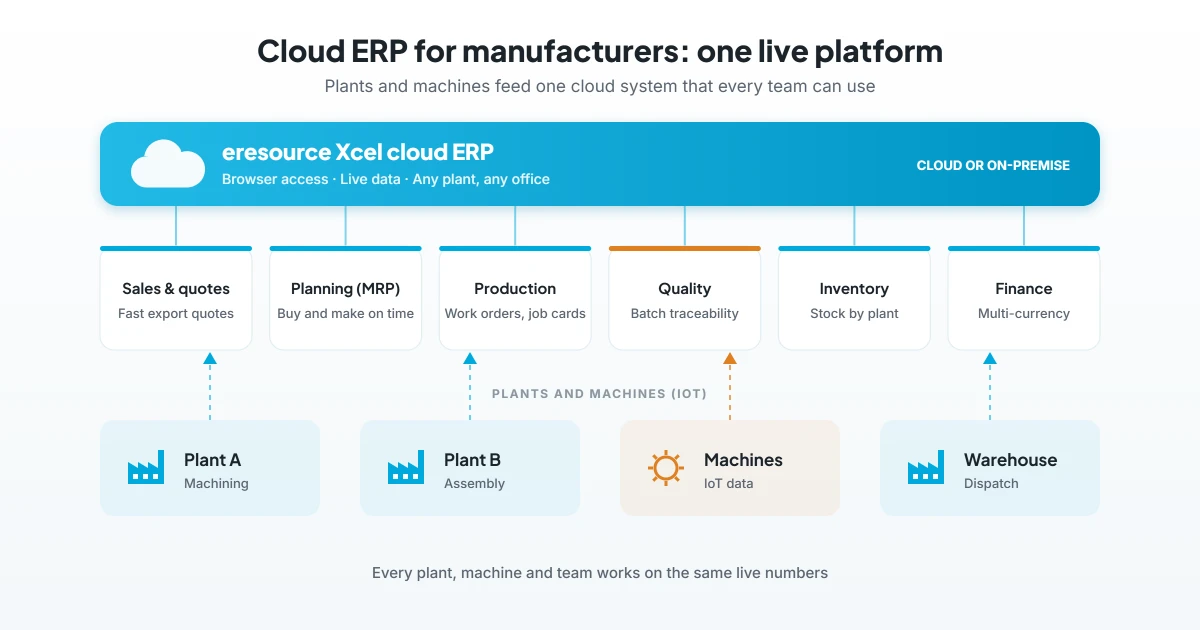
1. One live view of every plant
First, every plant and warehouse records work in the same system. Therefore, managers compare output, stock and costs across sites without waiting for reports.
2. Faster and more accurate quotes
Next, sales teams build quotes from current BOMs, routings and material prices. So you can reply to an overseas enquiry quickly, with a price that protects your margin.
3. Planning that matches real demand
Then MRP reads open orders, forecasts and stock, and it suggests what to buy and make. As a result, you avoid both shortages and excess inventory.
4. Machine data in real time
With industrial IoT links, machines send output, stoppages and performance data straight to the ERP. Meanwhile, supervisors see problems as they happen, not at the end of the shift.
5. Quality and traceability buyers trust
Also, the system records inward, in-process and final inspections against each batch or serial number. So when a customer asks about a lot, you can trace it back in minutes.
6. Multi-currency and local compliance
In addition, a good cloud ERP for manufacturers handles several currencies, price lists and tax rules. This matters especially when you export or open a plant in another country.
7. Lower IT cost and faster upgrades
Finally, the cloud removes most server purchases, backups and manual upgrades. Instead, your team logs in from any browser and always works on the latest version.
Signs your factory is ready for cloud ERP
Indeed, most manufacturers feel the need long before they act. For example, watch for these signs:
- Delivery dates slip because nobody sees material shortages in time.
- Each plant keeps its own files, so group reports take days.
- Customers ask for traceability records that take hours to find.
- Your old software needs a server upgrade or costly support.
- Sales cannot quote quickly for export enquiries.
If several of these sound familiar, a cloud ERP for manufacturers will likely pay back quickly.
How to move your factory to cloud ERP
- Map your core flow: first, follow one order from enquiry to dispatch and note every hand-off.
- Clean your masters: next, fix item codes, BOMs and routings before migration.
- See a demo on your own product: then ask the vendor to run one of your real orders.
- Start with one plant: after that, go live at one site and then roll out to the rest.
- Connect machines later: finally, add IoT links once core processes run smoothly.
For a week-by-week plan, see how to implement ERP in 90 days, and read how to make ERP implementation successful.
Why eresource Xcel is a cloud ERP for manufacturers
eresource Xcel is a discrete manufacturing ERP refined across 400+ factory go-lives and 20+ manufacturing types. It also serves manufacturers in India, the UAE, the GCC and Africa.
- Cloud or on-premise: choose the deployment model that suits your plants.
- Low-code and no-code setup: business users configure the system without a full-time IT team.
- IoT integration: connect machines for real-time data, performance monitoring and predictive maintenance.
- Multi-site and multi-currency: run several plants and export markets on one platform.
- Quick rollout: implementation typically takes 30 to 90 days, depending on scope.
- Unlimited users: one flat license covers every operator, supervisor and manager.
To learn more, read about manufacturing ERP software for SMEs, the make-to-order ERP for SMEs guide, and how an ERP for global business supports expansion. Process manufacturers can also read about the best ERP for process industry.
Frequently asked questions
What is a cloud ERP for manufacturers?
It is a factory management system that runs on cloud servers and opens in a browser. It connects sales, planning, production, quality, stock and finance on one live database.
Is cloud ERP safe for manufacturing data?
Generally, yes, if the vendor uses strong access controls, encryption and regular backups. So ask each vendor how it protects, stores and backs up your data.
Can a cloud ERP connect to shop floor machines?
Yes. Many systems support IoT links. For example, eresource Xcel connects machines for real-time data, performance monitoring and predictive maintenance.
How long does cloud ERP implementation take for a factory?
Overall, it depends on modules and complexity. For instance, eresource Xcel implementation typically takes 30 to 90 days.
Does cloud ERP for manufacturers work across several plants?
Yes. In fact, this is one of its main strengths, because every plant works on the same live data.
Is eresource Xcel available on cloud and on-premise?
Yes. eresource ERP is available in both cloud and on-premise deployment models.
Want to see your own factory on Xcel? Book a free demo, or start with a free ERP assessment.
Also Read – Manufacturing ERP Software India: Why Modern Manufacturers Need ERP