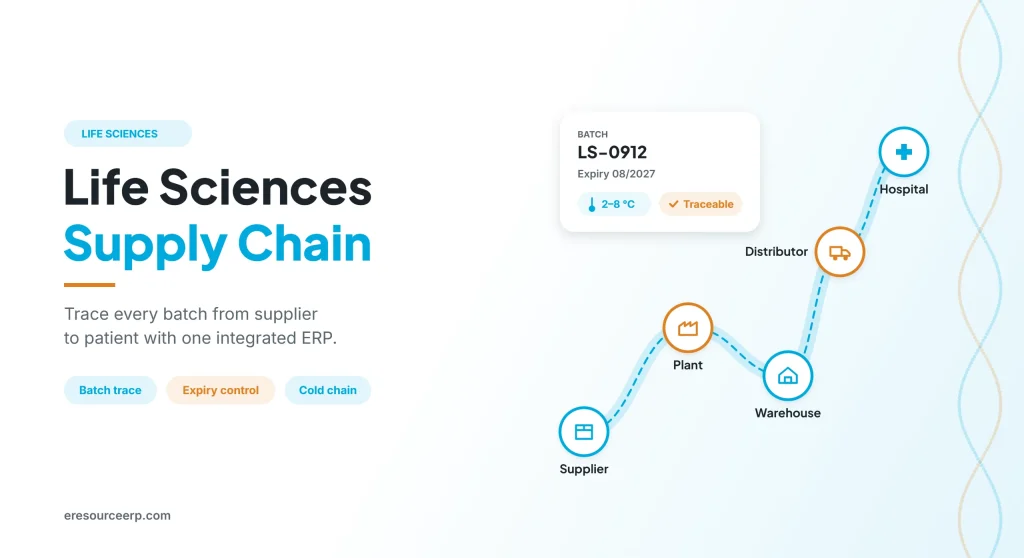
A life sciences supply chain moves raw materials, active ingredients, finished products and samples from suppliers to plants, distributors, hospitals and patients, under strict rules for quality, temperature and traceability. Today, manufacturers in this field turn to the supply chain to cut cycle times, lower inventory and working capital, speed up delivery and reduce distribution costs. However, separate systems for buying, production, stock and sales make that hard. So this guide explains what makes the life sciences supply chain different, how an integrated ERP helps and which numbers to track.
Key takeaways
- Rules shape every step: quality, expiry and traceability apply from supplier to patient.
- One suite beats many tools: also, an integrated ERP links planning, stock, sales and service.
- Customers drive demand: CRM data makes demand plans more accurate.
- Cloud speeds things up: finally, cloud ERP goes live faster with predictable costs.
What makes the life sciences supply chain different?
Of course, every supply chain moves goods. Yet in life sciences, a delay or a mistake can affect patient health. As a result, the life sciences supply chain carries extra demands:
- Strict regulation: first, each step must follow approved processes and keep records.
- Batch traceability: also, firms must trace every batch back to its materials and forward to customers.
- Shelf life: products expire; therefore, old stock must move first.
- Temperature control: moreover, many products need a cold chain from plant to patient.
- Many partners: finally, suppliers, contract makers, distributors and hospitals all share the load.
For a broader view, see this guide to the supply chain ERP system.
Common supply chain challenges in life sciences
Many firms still run best-of-breed tools that do not talk to each other. In contrast, an integrated suite closes the gaps across the life sciences supply chain. The table below shows the most common problems:
| Challenge | Impact | How ERP helps |
|---|---|---|
| Separate systems | Data gaps and slow decisions | One suite for supply chain, production and CRM |
| Long cycle times | Late orders and slow launches | Joint planning for purchase and production |
| Excess or expired stock | Locked cash and write-offs | Expiry alerts and first-expiry, first-out picking |
| Poor demand view | Stock-outs at key customers | Demand plans by customer segment |
| Slow recalls | Risk to patients and reputation | Batch trace in a few clicks |
| High distribution cost | Rush shipments and extra transfers | Planned dispatch and branch transfers |
In short, most problems in the life sciences supply chain come from missing or late information.
How integrated ERP strengthens the life sciences supply chain
Generally, an integrated ERP links six stages into one flow, as the picture below shows:
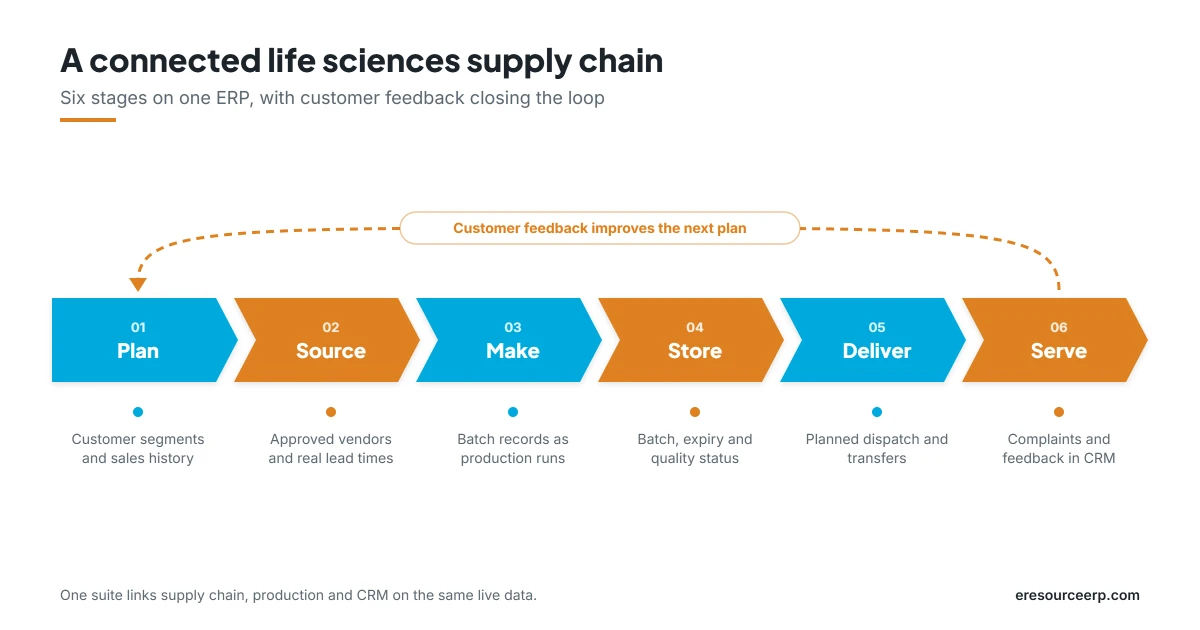
- Plan demand: first, use customer segments and sales history to build a more accurate forecast.
- Source smartly: next, buy from approved vendors, based on real lead times.
- Make to plan: then schedule production and record each batch as it runs.
- Store with control: after that, track batch, expiry and quality status for every item.
- Deliver on time: also, plan dispatch and branch transfers, so orders ship complete.
- Serve and learn: finally, log complaints and feedback in CRM, so the next plan improves.
For more on each stage, read about ERP demand forecasting, the procurement process in ERP and pharma quality control.
Why CRM matters in life sciences
Many manufacturers use CRM only for the basics. However, the medical field has changed. For example, patients are better informed, more connected and have more choices than before. Likewise, doctors, hospitals and distributors expect fast, accurate answers.
Therefore, life sciences firms need to rethink how they use CRM. When CRM sits inside the ERP, sales and service teams see orders, stock, complaints and history on one screen. Moreover, customer data flows straight into demand plans, which keeps the life sciences supply chain closer to real needs. To learn more, read about ERP and CRM integration and CRM in ERP.
Cloud ERP for faster, flexible operations
Forward-looking leaders in life sciences now choose the cloud. In fact, cloud ERP brings faster rollouts, greater agility and predictable costs. In addition, it lets teams at plants, warehouses and branches work on the same live data. For more, see the real cloud ERP benefits.
KPIs for a healthy life sciences supply chain
Above all, track a few clear numbers every month:
- Order cycle time: first, the days from order to delivery.
- Inventory turns: how fast stock moves, since higher turns free up cash.
- Expired stock: also, the value written off each month.
- On-time, in-full: the share of orders delivered complete and on time.
- Forecast accuracy: forecast compared with actual sales.
- Distribution cost per order: finally, freight and handling divided by orders shipped.
As a result, you can see which parts of the life sciences supply chain need attention first.
Life sciences supply chain with eresource
eresource is a web-based, AI-powered and no-code ERP with 37 integrated modules on one platform. It has also served businesses for 20 years, with 3,000+ go-lives. Its process manufacturing edition, eresource Bpro, serves pharma, chemical and food firms. So here is how it supports the life sciences supply chain:
- One integrated suite: supply chain, manufacturing, CRM and finance share the same database.
- Batch and expiry control: batch-wise stock, expiry dates and first-expiry, first-out picking.
- Full traceability: also, trace any batch from material to customer in a few clicks.
- Quality holds: quarantine and release steps keep untested stock out of use.
- Demand planning: forecasts for each item and location feed purchase and production.
- Web and mobile access: in addition, plants, warehouses and sales teams work on live data.
To learn more, read about life science ERP software, explore pharmaceutical ERP software or browse all eresource ERP products.
Frequently asked questions
What is a life sciences supply chain?
In short, it is the network that moves materials and products from suppliers to plants, distributors, hospitals and patients, under strict quality rules.
Why is batch traceability so important?
Because it lets you find every affected batch and customer quickly. So recalls stay small and patients stay safe.
How does ERP reduce expired stock?
First, it tracks expiry dates, raises alerts and picks the oldest stock first. In addition, better forecasts stop over-buying.
Can ERP and CRM share data?
Yes. For instance, in an integrated suite, orders, complaints and customer history flow between sales, service and planning.
Is cloud ERP safe for life sciences firms?
Usually, yes. Good providers use encryption, backups and role-based access. Still, check the security details before you choose.
Does eresource support batch and expiry tracking?
Yes. For example, it tracks stock by batch and expiry, and it supports first-expiry, first-out picking.
Want to see a connected life sciences supply chain in action? Start with a free ERP assessment, or book a free demo.
Also Read – Life Science ERP Software Is Helping Drive the Change