Follow the CRM Route: How CRM in ERP Transforms Customer Relationships
Following the CRM (Customer Relationship Management) route brings several measurable benefits: increased automation, better use of existing resources, better quality of information, faster response times, sharper customer targeting, stronger customer retention, and increased sales. This article explains what the CRM route really involves — and why CRM in ERP delivers it better than a standalone tool.
What CRM Really Is
The eresource CRM application enhances a company’s “front office” — sales, marketing, and customer service. However, truly successful CRM is never a narrowly defined IT application. It works as a combination of people, processes, and systems. Buy the software without changing how your teams work, and the route leads nowhere.
CRM: The Outward-Facing Side of ERP
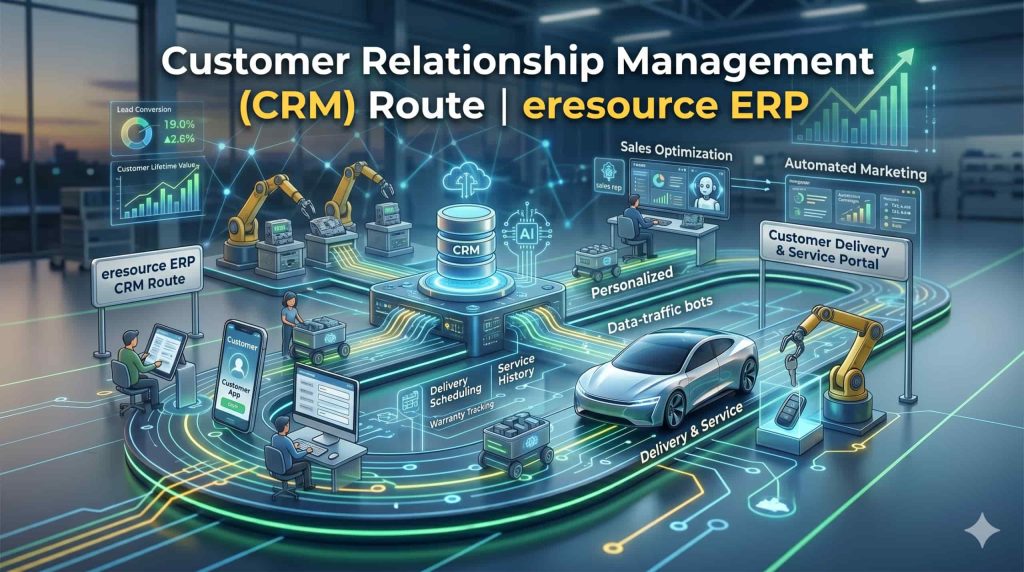
CRM belongs to the new wave of ERP that focuses on outward-facing processes. It ties customer-facing work together with the inside-the-enterprise transaction engine of the original ERP system. In other words, the same platform that runs your orders, stock, and invoices now also runs your relationships — and each side feeds the other.
Personal Relationships at Mass-Production Scale
With the web and web-based ERP, companies operating in a mass-production world can truly personalize customer relationships. This ability has renewed a powerful ambition: earn lifetime value from current customers, and plan strategically to win lifetime value from new customers in new markets. A customer you keep for years is worth far more than the sum of individual orders.
Working the Whole Chain
Companies are also waking up to another source of value. By working creatively with business partners in the distribution chain — and with consumers directly — they reduce product costs and cycle times, and give customers better order-tracking information. Consequently, the relationship improves at every touchpoint, not just at the sales desk.
Loyalty Comes from Integration
Research shows a simple chain: only happy, satisfied customers are truly loyal — and loyal customers keep coming back. Nimble companies strengthen these relationships by integrating sales, product configuration, planning, and design processes with their customers, through existing and new channels.
Consider how far this has come. Since the industrial revolution, companies viewed an order as nothing more than demand for a product, and treated customers with respect mainly in hope of repeat business. Today, in the world of eBusiness, a company can replicate the personal customer relationship that existed before mass markets — using its knowledge of each customer to personalize service while still selling standard products.
Why Choose CRM Inside eresource ERP
A standalone CRM knows your conversations but not your business. CRM inside eresource ERP knows both. The enquiry, the quotation, the order, the dispatch, the invoice, and the service call all live on one database. Therefore, your sales team quotes against real stock, your service team sees the full order history, and management sees the complete customer — from first enquiry to lifetime value — without synchronizing two systems.
Also Read – ERP Software in Nigeria
Frequently Asked Questions
Common questions about CRM in ERP
What are the benefits of following the CRM route?
Increased automation, better use of existing resources, better quality of information, faster response times, improved customer targeting, stronger customer retention, and increased sales.
What is CRM in ERP?
CRM in ERP runs the front office — sales, marketing, and customer service — on the same platform and database that handles orders, inventory, invoicing, and finance, so customer-facing and back-office processes stay connected.
Is CRM just a software application?
No. Successful CRM combines people, processes, and systems. The software enables the change, but teams and workflows must adopt a customer-centred way of working for the route to pay off.
Why choose CRM inside ERP instead of a standalone CRM?
Because one database connects the enquiry, quotation, order, dispatch, invoice, and service history. Sales quotes against real stock, service sees full order history, and nothing needs synchronizing between two systems.