Life Science ERP Software Is Helping Drive Business Change
Life Science ERP software is helping pharmaceutical companies improve compliance, control processes, and manage business growth. It also helps companies keep pace with changing market needs.
For pharmaceutical businesses, quality and compliance are critical. Therefore, companies need a system that can connect operations, quality, production, inventory, and reporting.
Key Questions Faced by Pharmaceutical Companies
Pharmaceutical companies often face several important questions:
How can we avoid quality and compliance oversights?
How can we stay aligned with Good Manufacturing Practices (GMP)?
How can we manage lower R&D budgets and changing pricing rules?
How can we improve profitability in a highly competitive market?
How can we turn new ideas into practical business processes?
How can we support continuous innovation beyond Intellectual Property Rights (IPR)?
These questions affect many pharmaceutical companies.
As a result, pharmaceutical businesses need better control over their processes and data. A well-designed Life Science ERP software solution can help bring these areas together.
Why Life Science ERP Software Matters
Pharmaceutical companies work in a highly regulated environment. Therefore, they must control many processes at the same time.
Quality and compliance depend on accurate data, clear processes, and regular checks. For example, companies need to manage documents, CAPA activities, audits, CRO processes, production records, and quality checks.
Moreover, manual processes can make it harder to track important information. An integrated ERP system can reduce this problem by connecting data across departments.
The result is better visibility, faster access to information, and stronger process control.
Also Read – Construction Management ERP
Key Benefits of Life Science ERP Software
A Life Science ERP system can connect and streamline key business processes. In addition, it can help pharmaceutical companies manage sensitive operations with better control.
1. Better Compliance Management
ERP software helps companies manage processes related to legal and industry requirements. Therefore, teams can maintain better control over compliance activities.
2. Formulation and Recipe Management
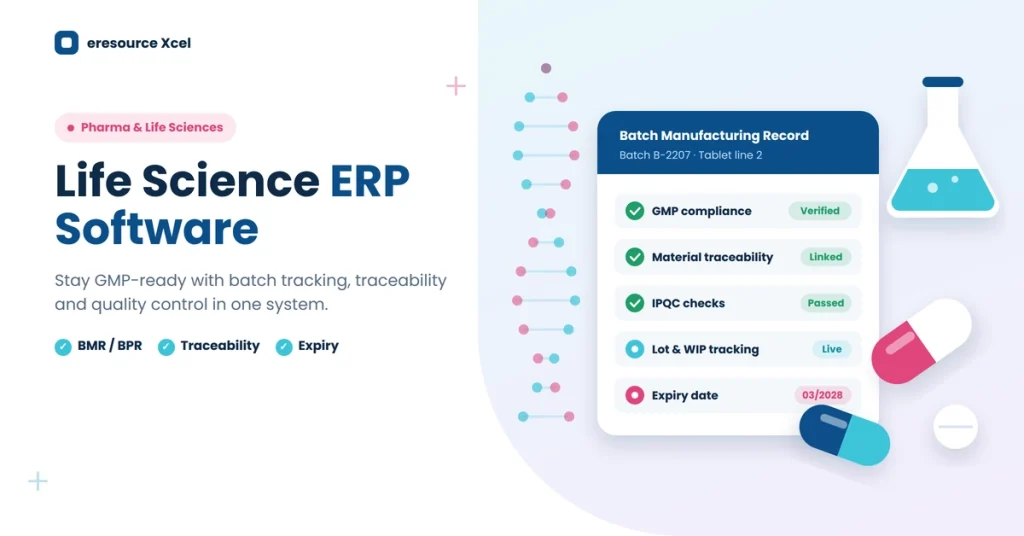
Pharmaceutical production depends on accurate formulations and recipes. With ERP software, companies can manage formulations, recipes, materials, and related production data in one system.
3. Real-Time Material Traceability
Material traceability is important in pharmaceutical manufacturing. ERP software can help teams track materials across different production stages.
As a result, businesses can find material information faster and improve process visibility.
4. Batch and WIP Tracking
Batch tracking helps companies monitor materials and products during production. In addition, ERP software can support work-in-progress tracking and yield reconciliation.
This makes it easier to identify production issues and improve process control.
5. Lot Management
Life Science ERP software can help manage lot information across inventory and production processes. Therefore, teams can improve tracking and reduce errors.
6. BMR and BPR Management
Pharmaceutical companies need proper control over Batch Manufacturing Records (BMR) and Batch Packing Records (BPR).
An ERP system can help manage these records according to relevant GMP processes. Furthermore, centralized data can make record access easier for authorized users.
7. Expiry Management
Expiry management is important when businesses handle materials with limited shelf life. ERP software can help track expiry dates and support better stock planning.
As a result, companies can reduce avoidable wastage and improve inventory control.
8. In-Process Quality Control
Quality checks must continue throughout pharmaceutical production. An ERP system can support In-Process Quality Control (IPQC), inspections, and certificate analysis.
Therefore, quality teams can access the information they need during production.
9. Shorter Production Cycles
Better process visibility can help teams identify delays and improve production planning. Moreover, integrated data can reduce repeated manual work.
As a result, businesses can work toward shorter production cycles while maintaining quality standards.
10. Centralized Business Data
A centralized ERP system brings important business data into one platform. This includes production, inventory, quality, materials, and other operational information.
In addition, centralized data supports clearer reports and faster business decisions.
How Life Science ERP Supports Better Decision-Making
Good decisions depend on reliable information. However, teams may struggle when data sits in different systems or spreadsheets.
Life Science ERP software brings key information into a connected system. Therefore, managers can access updated data and review business performance more easily.
Moreover, better reporting helps teams identify issues earlier. They can then take action based on current business information.
Why Pharmaceutical Companies Need an Integrated ERP System
Pharmaceutical operations involve many connected activities. Production depends on materials. Quality depends on accurate records. Compliance depends on proper processes.
Therefore, these functions should work together.
An integrated ERP system can connect production, inventory, quality, compliance, and reporting. As a result, pharmaceutical companies can improve visibility and maintain better control over daily operations.
Conclusion
Life Science ERP software can help pharmaceutical companies manage complex business processes with greater control. It supports compliance, formulation management, traceability, batch tracking, quality control, expiry management, and reporting.
Furthermore, an integrated ERP system reduces information gaps between departments. It also helps teams access business data faster and make informed decisions.
For pharmaceutical companies, the right ERP solution can support better process control, improved efficiency, and long-term business growth.
Also Read – ERP for electronics