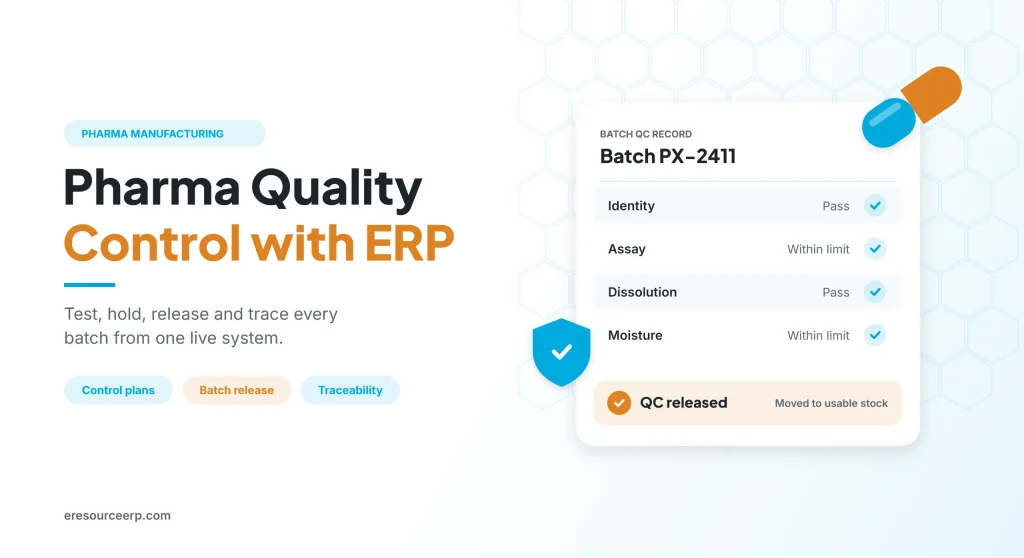
Pharma quality control is the set of tests and checks that make sure every raw material, batch and finished medicine meets its approved specification before it reaches patients. In this industry, a quality slip is not just a cost. Instead, it can harm patients, trigger recalls and damage trust for years. Therefore, many drug makers now run pharma quality control inside their ERP, so every test links to the batch, the supplier and the stock. This guide explains the key checkpoints, how ERP supports each one and how to roll it out smoothly.
Key takeaways
- Check at every stage: quality starts with the vendor and ends only after dispatch.
- Hold until approved: also, stock stays in quarantine until QC releases it.
- Trace every batch: one click shows which materials went into which batch, and where it went.
- Spot drift early: finally, live trends show when a process starts to slip.
Why quality comes first in pharma
Health is the most precious thing a person has. So medicines must be safe, pure and effective every single time. For this reason, regulators expect drug makers to follow good manufacturing practice and keep a clear record of every test.
At the same time, the industry never stands still. New illnesses, new products and new rules arrive every year. As a result, paper logbooks and separate spreadsheets struggle to keep up with pharma quality control. For more, read about cGMP requirements and the main pharmaceutical industry challenges.
QC checkpoints across the pharma process
Good pharma quality control covers the whole chain, not just the lab. The table below shows the main checkpoints:
| Stage | Checks | How ERP helps |
|---|---|---|
| Vendor approval | Approved suppliers and audit status | Orders go only to approved vendors |
| Incoming material | Identity, purity and supplier test reports | Receipt creates an inspection and holds stock |
| In-process | Weight, moisture, hardness and yield | Control plans at each production stage |
| Finished goods | Assay, dissolution and labelling | Batch stays on hold until QC release |
| Dispatch | Batch number and expiry date | First-expiry, first-out picking |
| Complaints | Returns and market feedback | Trace the batch back to its materials |
In short, each checkpoint protects the next one. So pharma quality control is only as strong as its weakest stage.
How ERP supports pharma quality control
Generally, ERP turns pharma quality control into a clear, repeatable flow, as the picture below shows:
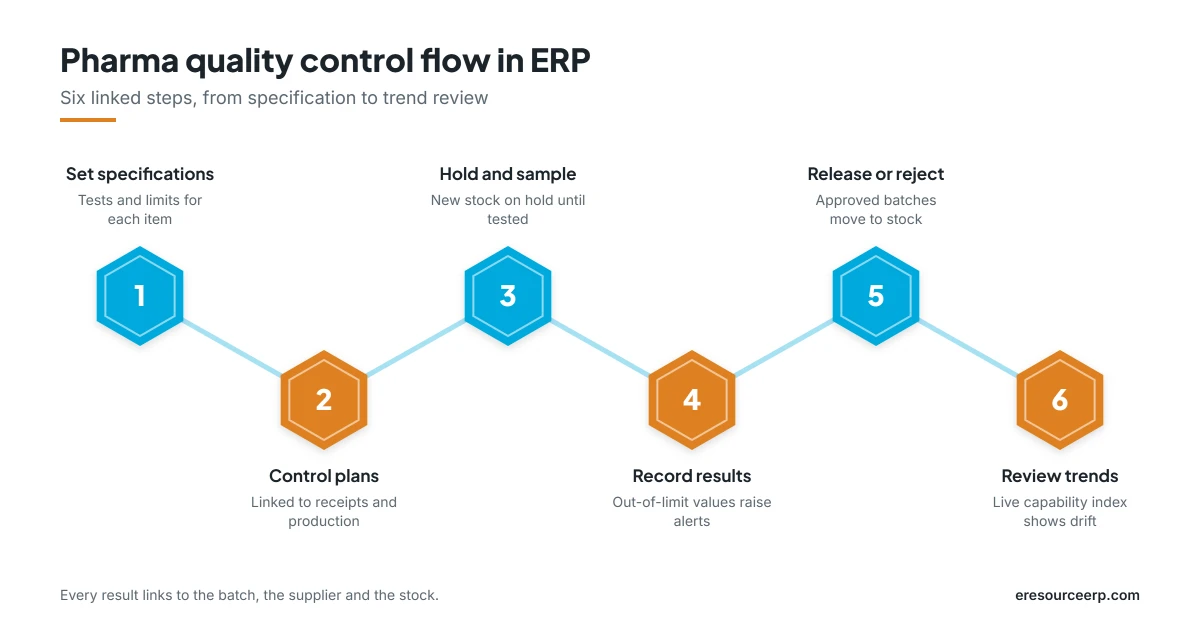
- Set specifications: first, define the tests and limits for each material and product.
- Create control plans: next, link those tests to purchase receipts and to each production stage.
- Quarantine and sample: then the system holds new stock, so nobody can issue it before testing.
- Record results: after that, QC staff enter results, and out-of-limit values raise an alert at once.
- Release or reject: also, approved batches move to usable stock, while rejects go to return or rework.
- Review trends: finally, charts and a live process capability index show when a process starts to drift.
As a result, pharma quality control becomes part of daily work rather than a separate task. To learn more, see how ERP for quality control works and read about total quality management in ERP.
Batch traceability and recalls
Sometimes, a problem only shows up after a batch leaves the plant. In that case, speed matters most. However, with batch tracking in ERP, you can trace backward to the exact materials and suppliers. Likewise, you can trace forward to every customer who received the batch.
So a recall that once took days of searching through files can now take minutes. For pharma quality control, this is one of the biggest gains. In addition, expiry dates and first-expiry, first-out picking cut the risk of old stock reaching the market. For more, read this guide to batch manufacturing software.
Benefits of ERP-led quality control
When pharma quality control runs inside the ERP, the gains reach every team:
- Fewer rejects: early checks catch problems before more work goes into a batch.
- Faster release: also, QC sees pending tests on one screen, so batches wait less.
- Audit-ready records: the system stores every test, approval and change with the user, date and time.
- Less paperwork: similarly, results flow straight into reports instead of logbooks.
- Lower recall risk: in addition, batch tracking limits any recall to the batches involved.
- Better suppliers: finally, rejection data shows which vendors need attention.
For a wider view, read the benefits of ERP in the pharmaceutical industry.
Tips for a smooth rollout
The implementation method matters as much as the software. A structured approach that focuses on people and processes keeps the risk low. So follow these tips when you move pharma quality control into ERP:
- Map today’s process: first, list every test, form and approval you use now.
- Clean the masters: next, fix item codes, specifications and approved vendor lists.
- Start with key products: then go live with high-volume or high-risk products first.
- Train QC staff early: also, run hands-on sessions with real samples before go-live.
- Validate the setup: test the system as your quality policy requires, and keep the records.
- Review every month: finally, check rejects, delays and trends, then refine the plans.
Moreover, a good plan means the team can handle surprises without harm to quality. For more, see how to make ERP software implementation successful and why ERP training matters.
Pharma quality control with eresource
eresource is a web-based, AI-powered and no-code ERP with 37 integrated modules on one platform. It has also served businesses for 20 years, with 3,000+ go-lives. Its process manufacturing edition, eresource Bpro, supports pharma, chemical and food firms. So here is how it helps with pharma quality control:
- Quality control module: control plans that monitor quality in both purchasing and production.
- Live process capability: a real-time process capability index for quick review.
- Batch tracking: batch-wise stock, expiry dates and full trace from material to customer.
- Stock holds: quarantine and release steps, so untested stock stays out of use.
- Approvals and audit trail: role-based approvals, with a log of every action.
- Web and mobile access: QC, production and stores teams work on the same live data.
To learn more, explore pharmaceutical ERP software, read about eresource Bpro for pharma or browse all eresource ERP products.
Frequently asked questions
What is pharma quality control?
In short, it is the testing of materials, in-process samples and finished batches against approved specifications before release.
How is QC different from QA?
QC tests the product. QA, on the other hand, sets and checks the overall system, such as procedures, training and audits.
How does ERP help with batch release?
It holds each batch until all tests pass. Then an authorised user releases it, and the system records who approved it and when.
Can ERP trace a batch during a recall?
Yes. It traces backward to materials and suppliers, and forward to every customer who received the batch.
What is a process capability index?
It is a number that shows how well a process stays within its limits. A falling value is an early sign of drift.
Does eresource have a quality control module?
Yes. For example, it uses control plans in purchasing and production, and it shows a real-time process capability index.
Want to see pharma quality control in a live system? Start with a free ERP assessment, or book a free demo.
Also Read – Benefits of ERP in the Pharmaceutical Industry