cGMP requirements set the minimum standards for how medicines are made, tested, stored and released. In the US, the FDA’s CGMP regulations cover the methods, facilities and controls that drug makers use. The “c” stands for “current”, so manufacturers must keep their systems up to date. This guide explains the main cGMP requirements and shows how an ERP like eresource Bpro helps you meet them every day.
Key takeaways
- cGMP covers the whole plant: people, equipment, materials, production, labs, storage and records.
- Records are central: master and batch records must be complete, and you must keep them for years.
- Paper makes it hard: manual registers lead to gaps, late entries and slow audits.
- ERP builds control in: eBMR, QC, quarantine, traceability and CAPA then sit in one system.
What are cGMP requirements?
cGMP stands for current good manufacturing practice. For drugs, the US rules sit in 21 CFR Part 210 and 21 CFR Part 211. Together, they help ensure that each product is safe and has the strength and quality it claims.
Other regulators follow similar principles. For example, many countries use WHO-GMP, Europe uses EU-GMP, and India uses revised Schedule M. So if your plant meets cGMP requirements well, you are also closer to these standards. To see how India’s rules are changing, read why pharma companies must change their business processes.
The main areas of cGMP requirements
21 CFR Part 211 groups its rules into subparts. The table below shows the main areas and where an ERP helps:
| cGMP area | What it covers | How ERP helps |
|---|---|---|
| Organization and personnel | Quality unit, staff training and duties | Role-based access, and also training records in HRMS |
| Equipment | Cleaning, maintenance and calibration | Maintenance, calibration and validation schedules, so checks never slip |
| Components and containers | Testing and approval of incoming materials | Inward QC, so only approved lots reach production |
| Production and process controls | Written procedures, yields and in-process checks | Approved formulas, and then eBMR and yield tracking |
| Packaging and labeling | Label control and batch identification | Labels printed from the system, so batch and expiry details match |
| Holding and distribution | Storage conditions and stock rotation | Quarantine controls, and also FEFO and batch-wise dispatch |
| Laboratory controls | Testing, specifications and stability | Lab results and stability data, and then COA generation |
| Records and reports | Master, batch and distribution records | Digital records with audit trails, so nothing goes missing |
| Returned and salvaged products | Handling of returned goods | Batch genealogy, so you know where every lot went |
Why paper records make cGMP compliance hard
Records sit at the heart of cGMP requirements. For example, Part 211 asks for master production and control records and for a batch production record for every batch. In addition, you must generally keep batch records for at least one year after the batch’s expiry date.
Paper makes this hard in several ways:
- Operators fill entries late, so records do not match what really happened.
- Pages go missing, and then a whole batch becomes hard to defend.
- Also, tracing a lot means searching many registers by hand.
- Deviations sit in notebooks, so nobody closes them on time.
As a result, audits take longer, and the risk of findings goes up.
How eresource Bpro helps you meet cGMP requirements
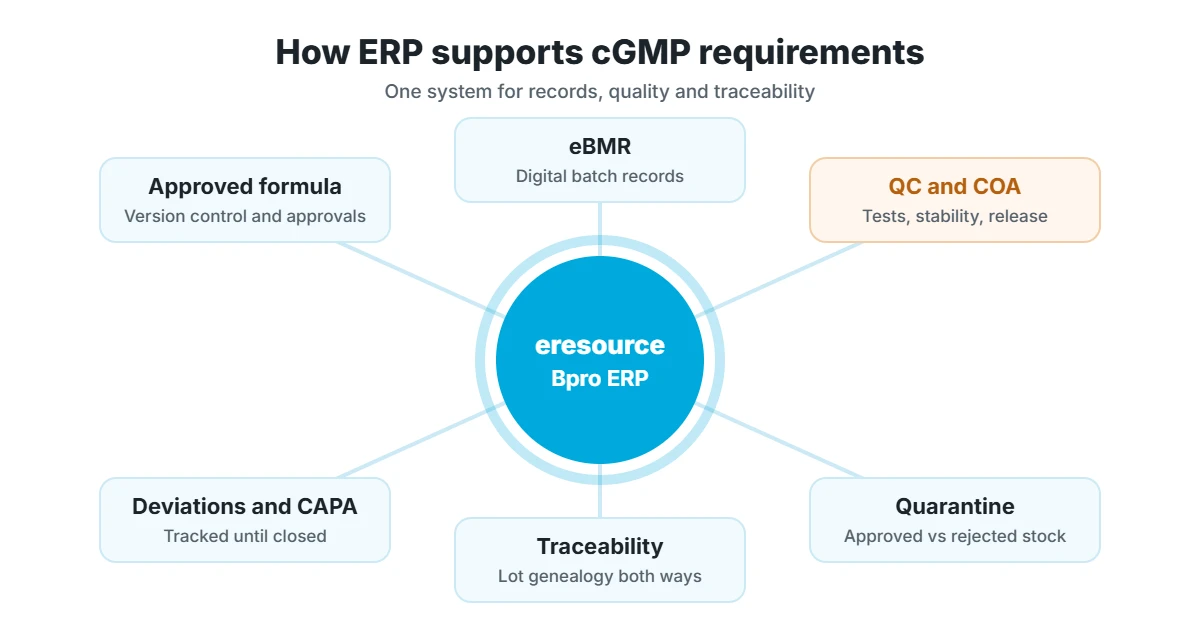
eresource Bpro is a pharmaceutical ERP for API, bulk drug and formulation manufacturers. Here is how it supports each part of your quality system:
1. Approved formulas and master records
Bpro controls formulas with version tracking and approval workflows. So production always uses the latest approved recipe. It also supports multi-level formulas and potency-based adjustments.
2. Electronic batch records
Electronic batch manufacturing records (eBMR) replace paper documents. Then Bpro tracks batch yield, variance and rework as the batch runs. Therefore, supervisors catch problems early, instead of during review.
3. Quality control and COA
QC teams record inward, in-process and finished goods tests in the system. They also record assay results, stability studies and validation data. Finally, Bpro generates the COA and links it to the batch.
4. Quarantine and material release
Bpro keeps approved, rejected and quarantined stock apart. In addition, it manages restricted zones and temperature control. So only released material moves into production or dispatch.
5. Traceability and recall readiness
Bpro tracks APIs, excipients, intermediates and finished goods by lot. As a result, you can trace any batch forward to customers and backward to suppliers within the same system.
6. Deviations, CAPA and equipment
The system tracks production deviations and corrective actions until someone closes them. Meanwhile, it schedules preventive maintenance, calibration and equipment validation, so equipment stays fit for use.
7. Audit trails and compliance support
Bpro supports FDA, WHO-GMP, EU-GMP, MHRA, Schedule M and 21 CFR Part 11 compliance. Also, it logs every validation step, so your documents stay audit-ready.
Because Bpro is part of the eresource process manufacturing ERP, finance, purchase and sales also run on the same data. For a wider view of batch control, see our guide to batch manufacturing software.
Checklist: is your ERP ready for cGMP requirements?
Before you choose a system, ask these questions:
- Does it keep electronic batch records? Otherwise, paper batch records slow every review.
- Can it trace a lot both ways? Then you can reach suppliers and customers in minutes.
- Does QC control material release? Otherwise, unreleased stock may reach production.
- Are formulas version-controlled? In other words, every change should need an approval.
- Does it track deviations and CAPA? So open issues stay visible until someone closes them.
- Does it log changes? After all, audit trails show who changed what, and when.
- Does it plan calibration and maintenance? Otherwise, overdue equipment checks can lead to audit findings.
Want to check your plant against this list? Book a free demo of Bpro, or request a free ERP assessment.
Frequently asked questions
What are cGMP requirements?
cGMP requirements are rules for how drug makers run their methods, facilities and controls. In the US, they sit in 21 CFR Parts 210 and 211, and they cover people, equipment, materials, production, labs, storage and records.
What does the “c” in cGMP mean?
The “c” stands for “current”. It means manufacturers should use up-to-date systems and controls, not only the methods that worked years ago.
Is cGMP the same as GMP?
They share the same goal of safe, consistent medicines. GMP is the general term that WHO and most countries use, while cGMP is the US FDA term.
How long must batch records be kept under cGMP?
Under 21 CFR 211.180, you must generally keep batch production, control and distribution records for at least one year after the batch’s expiry date.
How does ERP help with cGMP requirements?
An ERP keeps formulas, batch records, QC results, quarantine status, lot traceability and CAPA in one system. So records stay complete, and audits move faster.
Does eresource Bpro support 21 CFR Part 11?
Yes. Bpro supports FDA, WHO-GMP, EU-GMP, MHRA, Schedule M and 21 CFR Part 11 compliance, and it logs every validation step.
Also Read – Pharmaceutical Business Process: Why Pharma Companies Must Change Now