When people hear the words “real-time inventory”, some raise an eyebrow. Many ERP systems update stock counts quickly but leave costs behind until month-end. True real-time inventory updates both quantities and costs the moment stock moves. In this post, we explain why that matters, especially for process manufacturers. We also show how eresource values stock and posts changes to your books on its own.
What Real-Time Inventory Really Means
Stock comes in two ways: through purchases and through production. Each movement changes both the quantity on hand and its value.
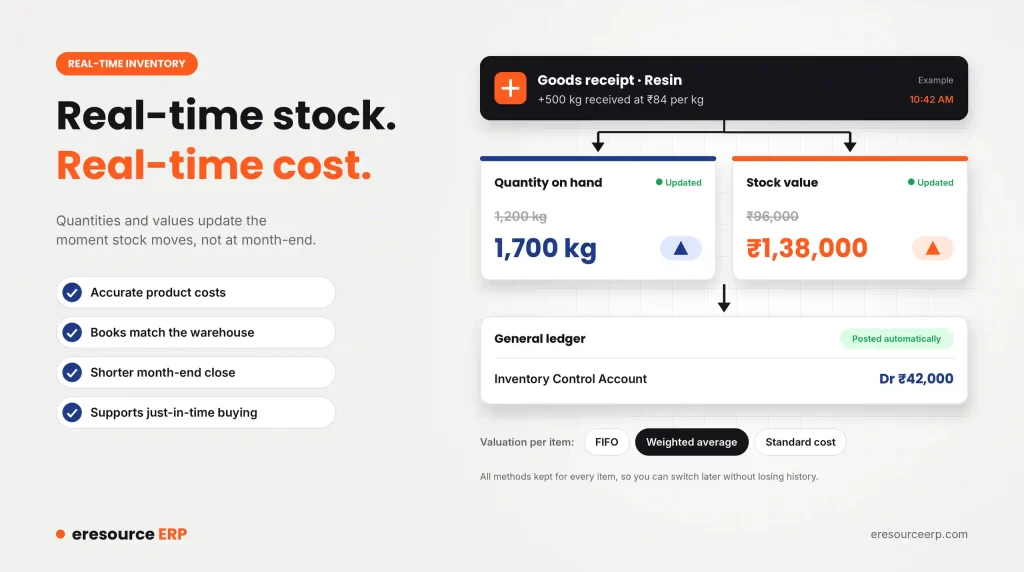
So real-time inventory is only real when it updates costs as well as quantities. Many systems handle the counts but delay the cost updates, and that delay removes much of the benefit. eresource is a genuine manufacturing ERP with a true real-time inventory module. Its store module tracks every receipt, issue and transfer as it happens.
Why Process Manufacturers Need Real-Time Inventory
We built eresource with the needs of process manufacturers in mind. For these firms, receiving raw materials just in time is vital.
Profit also depends on selling products quickly while knowing exactly what they cost. That cost combines the materials used and the value the process adds. Without live figures, firms either guess or wait, and both hurt margins.
Discrete and Process Firms Work to Different Clocks
The right timing differs from one industry to another. For example, a discrete manufacturer that makes large batches for stock has time to record costs. It can do this after the run ends and before delivery.
In contrast, a process manufacturer, such as a food and beverage company, usually makes to order for same-day delivery. There is no time to wait for month-end costing. Such firms need costs the moment goods leave the line.
Cost Control Starts With Live Inventory Costs
Managing costs is one of the most important jobs of any ERP. In fact, it is a key reason firms go through ERP implementation at all.
When cost updates lag, managers lose the control they paid for. eresource gives a more efficient way to manage costs, because stock values change as soon as stock moves. Learn how ERP helps minimise manufacturing costs.
Flexible Inventory Valuation in eresource
Firms value stock in different ways. Common methods include FIFO, weighted average and standard cost.
In eresource, you can set the valuation method for each item or item type on its own. Whatever method you choose, eresource keeps the values for every method for every item. As a result, you can switch an item to a different method later without losing history.
Automatic Postings to the General Ledger
When you change an item’s valuation method, eresource calculates the difference for you. It then posts the adjusting journal to the Inventory Control Account in the general ledger.
Likewise, if you change a standard cost, eresource posts that value change to the ledger too. So your books and your warehouse always agree. See how the integrated finance module ties stock to your accounts.
One Live View for Every User
eresource updates data between related processes and functions instantly. As a result, every user sees the same up-to-the-minute figures for planning and control.
Every branch and plant also sends out the same documents, so customers see one consistent company. Read more about consistent planning and control with ERP and real-time ERP.
Benefits of Real-Time Inventory
When quantities and costs update together, the gains add up:
- Accurate product costs: You know what each batch truly cost.
- Faster pricing decisions: Sales teams quote with confidence.
- Lower stock: Live figures support just-in-time buying.
- Books that match the warehouse: Stock value and the ledger stay in step.
- Shorter month-end close: Fewer cost adjustments pile up at the end.
- Better planning: Production plans use real stock, not old counts.
See Real-Time Inventory in Action
eresource has supported manufacturers with live stock and live costs since 2006. To see how it works on your own items, book a free ERP demo.
Also Read – ERP for Trading Company
FAQs About Real-Time Inventory
What is a real-time inventory system?
A real-time inventory system updates stock the moment goods move in or out. A true system updates both the quantity and the value of stock at the same time, not just the count.
Why do process manufacturers need real-time inventory?
Process manufacturers often make to order for same-day delivery. They cannot wait for month-end costing to know what a batch cost. Live quantities and costs let them price and sell with confidence. Learn more about the process manufacturers.
Which inventory valuation methods can eresource use?
You can set the valuation method for each item or item type on its own. eresource also keeps the values for every method for every item, so you can switch methods later.
What happens in the ledger when I change a valuation method?
eresource calculates the difference and posts an adjusting journal to the Inventory Control Account in the general ledger. It does the same when you change a standard cost.
Can every user see the same stock figures?
Yes. eresource updates data instantly across related processes. So every user, at every branch, sees the same up-to-the-minute stock and cost figures. Learn more about the store module.