Better data visibility means every decision maker sees accurate, up-to-date numbers at the moment they need them. In many growing companies, however, sales, stock, cash and project figures sit in different files and arrive days late. As a result, managers guess, teams re-enter the same data and growth stalls. This guide explains what data visibility is, what poor visibility costs you, and how an ERP helps you grow without piling up admin work.
Key takeaways
- One source of truth: visibility starts when every department works on the same database.
- Live, not month-end: real-time dashboards replace reports that are already out of date.
- Right view for each role: owners, managers and staff each see the numbers they act on.
- Growth without extra admin: less re-entry and fewer manual reports free your team for real work.
What is data visibility in business?
Data visibility is how easily the right people can find, trust and act on business data. For instance, good visibility means a sales manager can check stock before promising a date, and a finance head can see cash today rather than at month-end.
In contrast, poor visibility means data exists but nobody can see it in time. For example, numbers may sit in a branch spreadsheet, a separate billing tool or someone’s inbox.
The hidden cost of scattered business data
Poor data visibility rarely shows up as one big failure. Instead, it leaks money in small ways every day:
- Late decisions: problems appear in month-end reports, long after they could be fixed.
- Stock mistakes: one warehouse runs out while another holds excess of the same item.
- Cash surprises: overdue payments and large bills catch finance off guard.
- Extra admin hours: staff copy data between systems and build reports by hand.
- Compliance risk: GST and e-invoicing data must be pulled together under pressure.
Consequently, companies often respond by hiring more people to chase data. Better data visibility removes much of that work instead.
Before and after ERP: what changes
The table below shows how daily work changes when data becomes visible across the business:
| Area | Low visibility | High visibility with ERP |
|---|---|---|
| Sales | Promises made without stock or production status | Live stock and order status at quote time |
| Inventory | Counts in separate files per location | Stock by item and location in one view |
| Finance | Cash position known at month-end | Receivables, payables and cash today |
| Operations | Delays found after the fact | Production or project progress in real time |
| Management | Reports compiled by hand | Dashboards with drill-down to each entry |
6 ways ERP improves data visibility
An ERP is the most direct way to fix visibility, because it puts every transaction in one place. Here is how it helps.
1. One database for every department
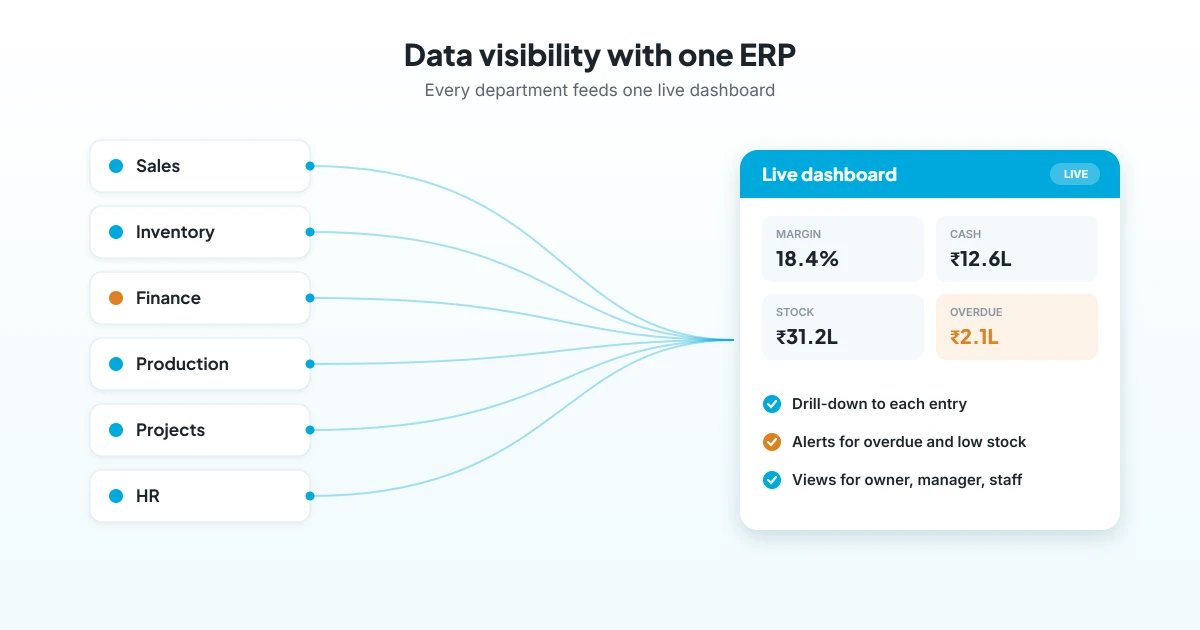
First, sales, purchase, stock, production, finance and HR record their work in the same system. Therefore, an order entered by sales updates stock, production and billing at once, without re-entry.
2. Real-time dashboards
Dashboards read live data, so the numbers you see are the numbers right now. Also, owners can track the few key performance indicators that matter most, such as margin, cash and on-time delivery.
3. Role-based views
Of course, a store keeper, a sales head and a CFO need different numbers. So a good ERP gives each role its own view, which keeps screens simple and protects sensitive data.
4. Drill-down to the source
When a figure looks wrong, you should be able to click through to the invoice or entry behind it. As a result, teams spend less time arguing about numbers and more time fixing problems.
5. Alerts and AI insights
However, nobody can watch every dashboard all day. Instead, alerts and AI can flag overdue payments, low stock or projects that drift off budget.
6. Access from anywhere
Similarly, a web-based ERP lets managers check numbers from a site, a branch or a phone. Meanwhile, branches and group companies roll up into one consolidated view.
How data visibility helps you grow without adding headcount
Generally, growth brings more orders, more items and more locations. Without good data visibility, each step adds people whose job is to collect and reconcile numbers. With an ERP, however, the system does that work:
- Reports build themselves from live data, so nobody compiles them by hand.
- Data entered once flows to every department, which cuts re-entry and errors.
- Managers spend their time on decisions instead of chasing updates.
- New branches join the same system, so head office sees them from day one.
In short, the same team can handle a much bigger business. Then your people move from data collection to work that grows revenue.
How to improve data visibility in 6 steps
- Pick your key numbers: first, agree on the five to ten measures that drive your business.
- Clean your master data: next, fix duplicate items, customers and vendors.
- Bring departments onto one system: then retire the side spreadsheets and separate tools.
- Set role-based dashboards: after that, give each role the view it needs.
- Review every week: use the dashboards in regular meetings, so they become a habit.
- Act on alerts: finally, assign an owner to each type of alert, so issues get fixed quickly.
How eresource delivers data visibility
eresource is a web-based, AI-powered ERP with 37 modules on one platform. So finance, inventory, sales, production, projects and HR all share the same live data.
- Multi-dimensional reporting: analyse results by customer, project, location or department.
- Dashboard Studio: users can customise modules, screens and forms without code.
- AzaaleaGPT AI: it works on your live ERP data and flags what needs attention.
- Group view: consolidated MIS across entities for companies with several branches or countries.
- Unlimited users: one flat license lets everyone who needs data see it.
To see more, read why a modern ERP system beats legacy software, how an ERP for global business gives one group view, and which key ERP modules you need. Industry editions such as Xcel, Nfra and eTrade add sector dashboards out of the box.
Frequently asked questions
What is data visibility?
It is how easily the right people can find, trust and act on business data. Good data visibility means live, accurate numbers for each role, in one place.
Why is data visibility important for business growth?
Above all, it lets managers spot problems and chances early, and it cuts the manual work of collecting reports. As a result, the business can grow without adding people just to chase data.
How does ERP improve data visibility?
Generally, an ERP keeps every department on one database and turns that data into live dashboards. It also adds role-based views, drill-down and alerts.
What is the difference between reports and dashboards?
A report is usually a fixed snapshot at a point in time. In contrast, a dashboard reads live data and updates as work happens.
Can small businesses get real-time data visibility?
Yes. In fact, a web-based ERP gives small and mid-sized firms the same live view that large companies use, without extra servers.
Does eresource offer dashboards?
Yes. eresource offers multi-dimensional reporting, Dashboard Studio for no-code changes and AzaaleaGPT AI insights on live data.
Want to see your own numbers in one place? Book a free demo, or start with a free ERP assessment.
Also Read – Cost-Effective ERP That Replaces Legacy Systems