Benefits of ERP for Construction: How One Builder Took Control of 60 Live Projects
Cost estimation is one of the biggest challenges for any construction company. It is also where the benefits of ERP for construction show most clearly. A good estimate helps you control overheads and expenses. However, most projects run for years, so the planned cost and the actual cost drift apart. Large projects and huge volumes make the problem even harder.
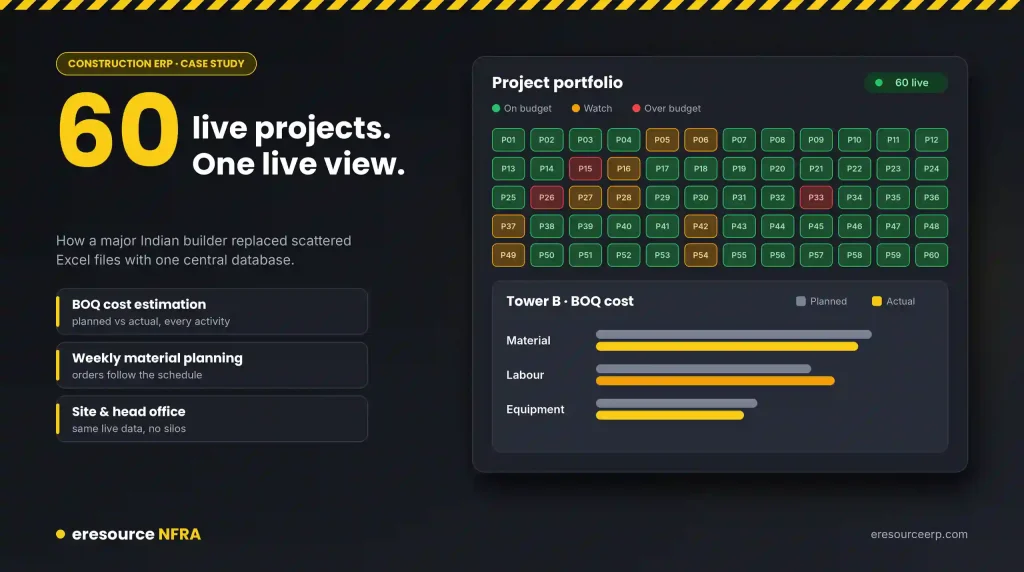
In this post, we look at those benefits through one real example. A major Indian builder used eresource ERP to bring 60 live projects under control.
Why the Benefits of ERP for Construction Start With Cost Control
Every construction project has thousands of moving parts. Materials, labour, equipment and subcontractors all add to the cost. Meanwhile, prices and plans keep changing on site.
If you track these costs in spreadsheets, problems surface late. In fact, many firms spot budget variance 60 to 90 days after it starts. By then, the money has already gone.
The Challenge: 60 Live Projects and Scattered Data
One of the major construction companies in India faced exactly this problem. At any time, it ran 50 to 60 projects at once. Yet each department kept its data in its own Excel files.
The accounts team used separate software, but it had no link to materials or purchase. Moreover, much of the data sat in site offices with no connection to the head office.
So every enquiry turned into a manual hunt. Each department had to pull out its figures, and someone then combined them into a report. As a result, decisions slowed down. Information also stayed in the hands of a few people, which created power centres inside the company. Above all, real-time cost estimation for each project was almost impossible.
The Solution: One Central Database
The company asked eresource for an ERP for construction that could link every function and project to one central database. eresource delivered and implemented the system within a short time.
In the first phase, the company went live with these modules:
- Finance and accounts
- Material management
- Marketing and sales
- Project planning and control
Our team also tailored the solution to the needs of a large builder. Now every department works from a single source of truth instead of scattered files.
Accurate Cost Estimation With BOQ
The bill of quantities (BOQ) module sits at the heart of cost estimation. It breaks each project down into activities. Then it splits each activity into the material, labour and equipment it needs.
Because of this, the company can price every activity in detail. It can also compare planned and actual costs at any stage. For a deeper look at this method, read how to rebuild your work breakdown structure.
Material Planning by Month and Week
Another module plans material needs from the work schedule. For example, it uses the work planned for a given month or week to work out what to order.
Therefore, materials reach each site on time, and stock does not pile up. Buyers also stop placing rush orders at high prices.
Marketing and Sales in the Same System
This builder also sells its projects to home buyers. So the marketing module plays a key role. Whenever the company launches a new project, it can send details to all its customers straight from the database.
The module also tracks every pre-sale and sale activity, from the first customer query to the final closing. In turn, demand planning and forecasting became much easier. Purchase, materials and stores now align their plans with these forecasts. Learn more about ERP for real estate developers.
Key Benefits of ERP for Construction
This project shows what a connected system can do. The main gains were:
- Real-time cost estimates: Managers see planned and actual costs for every project.
- Faster decisions: Reports come from the system instead of manual collection.
- No information silos: Data belongs to the company, not to a few people.
- Better material planning: Orders follow the actual work schedule.
- Connected sites: Site offices and the head office share the same live data.
- Aligned teams: Sales forecasts guide purchase, stores and project plans.
To see how live data helps on site, read about real-time progress tracking in construction.
See the Benefits of ERP for Construction in Your Business
eresource NFRA has served contractors for over 20 years, and more than 500 contractors now run on it. To see how it fits your projects, book a free demo. You can also take the free ERP assessment to find gaps in your current setup.
Also Read – ERP system for automotive industry
FAQs About the Benefits of ERP for Construction
What are the main benefits of ERP for construction?
ERP gives construction firms real-time cost estimates, faster decisions and better material planning. It also connects site offices with the head office through one live database.
How does ERP help with construction cost estimation?
A BOQ module breaks each project into activities. Then it splits each activity into material, labour and equipment. So you can compare planned and actual costs at any stage.
Can ERP handle many construction projects at once?
Yes. In this example, one builder runs 50 to 60 projects at the same time on eresource. All their data sits in one central database.
Does eresource construction ERP include sales and marketing?
Yes. The marketing module sends project launch details to customers and tracks every sale from first query to closing.
Which construction businesses can use eresource NFRA?
eresource NFRA suits builders, real estate developers, civil, EPC and MEP contractors, and road, bridge and infrastructure firms.