Table of Contents
The Invisible Cost Nobody Talks About
98% of construction projects experience delays. On average, they run 37% longer than originally scheduled. Yet most project leaders can’t explain why. They have theories. Excuses. But not answers.
Here’s what I have learned after working with dozens of EPC and construction firms across India and West Africa: the delays are not random. They are not inevitable. They are structural.
A ₹47.5 crore project slips by two weeks. Labor float burns. Crews sit idle. Change orders cascade. Rework compounds. By the time the finance team sees the impact, it is too late. Six percent of margin—₹2.85 crore—is gone. Some firms never recover from a single slip like this.
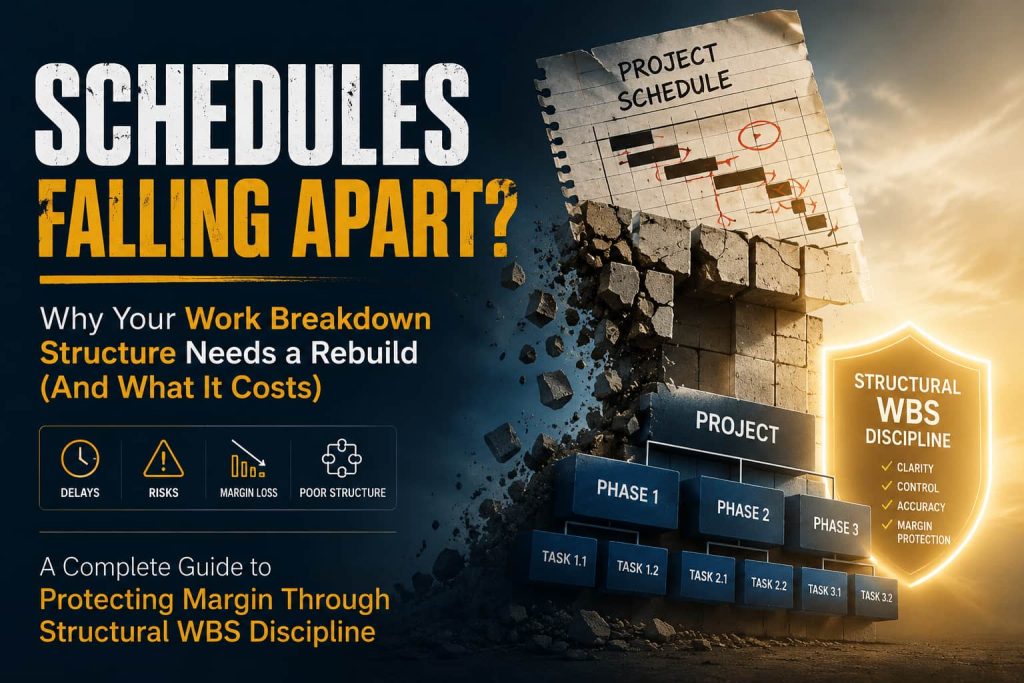
The root cause? An incomplete Work Breakdown Structure. This is not sexy. It does not make headlines. But it is killing your profitability right now.
Why Your Schedule Slips (And Why You Don't See It Coming)
Let me paint a picture. You are a Program Manager for an EPC firm. Your ₹47.5 crore infrastructure project is in month 3. On your schedule, everything looks green. Milestones are tracking. Tasks are progressing. You feel confident.
Then month 4 arrives. A task that was supposed to finish on time hits a dependency nobody documented. The upstream task is not done. Your crew cannot start. They sit idle. Labor costs mount.
By month 5, the problem has cascaded. What was a two-week slip is now bleeding into other work packages. Change orders pile up. Rework begins. Crews are being pulled from other tasks to accelerate recovery. Overtime costs spike.
The finance team closes month 5. They see it now—margin is down. But it is too late to course-correct. The slip has compounded.
Why did not anyone see this coming? Because your Work Breakdown Structure—the foundation of your schedule—does not surface dependencies until they break. Tasks are organized by phase, not by dependency chains. Critical path risks are assumed, not tracked. Change impacts do not flow through the system until crews hit the blockage.
You are flying blind. Reacting instead of preventing.
The Real Cost of Schedule Slips: Number That Should Terrify You
Let me be specific about what a two-week slip actually costs.
On a ₹47.5 crore project with 10% target margin, you expect to make ₹4.75 crore. Here is how a two-week slip destroys that:
| Cost Category | Actual Cost |
|---|---|
| Labor Float Burn (crews on standby, reroutes) | ₹1.42 crore |
| Rework (dependencies missed, earlier work revisited) | ₹95 lakh |
| Schedule Compression Penalties (overtime, expedited materials) | ₹47.5 lakh |
| Total Margin Impact | ₹2.85 crore (60% of target margin) |
That is not a rounding error. That is your year. Gone in two weeks.
Most firms do not experience one two-week slip. They experience three. Four. Some firms see five separate slips spread across different work packages. When you compound those, you are looking at 8-12% margin erosion. On a firm targeting 12-15% margins, that erases profitability.
This is not the cost of doing business in construction. This is the cost of an incomplete WBS. It is preventable. Completely preventable.
Also Read: ERP for Construction Industry
The Three Structural Failures That Kill Your Margin
If your firm is experiencing margin erosion from schedule slips, one (or all) of these is happening right now. Look for them. Honestly.
Missing Task Dependencies
Your schedule looks organized. Tasks are grouped by phase. Durations are estimated. Looks good on paper.
But nobody has documented which tasks MUST finish before others can start. Task A feeds into Task B. Task B feeds into Task C. But those relationships are assumptions, not documented facts. They live in your PM’s head.
When Task A slips, nobody in the system knows to alert Task B and C. The delay cascades invisibly until crews assigned to Task B are blocked. By then, labor is already committed. Rework is already scheduled. Margin is already bleeding.
No Change-Impact Modeling
Scope change arrives. Owner wants an additional power station. Or additional compliance requirements hit mid-project. It happens every single project.
The change gets approved at the executive level. Time estimate gets updated. Budget gets adjusted. But nobody models the dependency impact. Which downstream tasks does this affect? How much does the critical path shift? What happens to labor float?
Two weeks later, you realize the change created a four-week delay in the critical path. Too late to prevent it. Too early to recover from it.
Disconnected Data Systems
Your schedule lives in one tool. Your budget lives in another. Your resource allocation lives in a third. Contractor timelines come in via email.
When the schedule changes, the budget does not automatically update. When resources are pulled to another project, the schedule does not know. The schedule says you need 10 crews for month 4. The resource plan only allocated 6.
Nobody connects the dots until month 4 arrives and the crews are not available. That is when the chaos begins.
How High-Margin Firms Actually Do This: The WBS Discipline
I have worked with firms that consistently protect margin. They are not genius-level smart. They do not work 80-hour weeks. They are simply disciplined.
Here is exactly how they structure their WBS to surface every task, dependency, and risk upfront:
Discipline 1: Hierarchical Task Decomposition
Every task has a documented parent. Top-level deliverables break into phases. Phases break into work packages. Work packages break into tasks (typically 40-80 hours each).
At each level, the decomposition is complete. No orphaned tasks hiding in spreadsheets. No ambiguity about what belongs where. Everyone knows the structure because it is enforced in the system, not left to assumption.
Discipline 2: Explicit Dependency Documentation
For every task, the predecessor and successor are documented in the system. The critical path is identified. Float is calculated. Risk is visible.
When a task in the critical path slips, the system alerts everyone downstream. That is the difference between reactive management (discovering the slip when crews are blocked) and proactive management (knowing about the slip before it impacts execution).
Discipline 3: Mandatory Change-Impact Analysis
Before ANY scope change is approved, it goes through a change control gate. The gate requires schedule impact analysis: How does this change affect the dependency chain? What is the new critical path? What is the impact on float? Only after that analysis is the change approved.
This prevents the shocking discovery that a “small” change actually adds four weeks to the project timeline.
Discipline 4: Integrated Data Systems
Schedule, budget, and resources talk to each other. When you change the schedule, budget forecasts update automatically. When you commit resources to the schedule, the resource plan is updated. There is one source of truth, not multiple conflicting versions.
This is not complexity. This is sanity.
The anchor principle: Structure creates visibility. Visibility creates accountability. Accountability creates on-time delivery.
High-margin firms understand this. They invest in the discipline upfront. They get paid back in margin protection, every single project.
The 5-Step Audit: Diagnose Your WBS Right Now
Do not wait for a consultant to tell you where your WBS is broken. You can diagnose it this week. Here is the framework:
Step 1: Map Your Task Hierarchy
Look at your current schedule. Pull a random work package. Can you trace it back to its parent deliverable? Are the tasks at a consistent level of detail (40-80 hours each)? Or are they 2-week tasks next to 4-week tasks? If you see tasks that are 4-6 weeks long, your WBS is too high-level. Dependencies are hiding.
Step 2: Trace Your Critical Path
What is your critical path? How long is it? Can your PM answer this in 30 seconds, or does it take an hour of analysis? If it takes an hour, your dependencies are not documented. High-margin teams can tell you their critical path and the key risk points in seconds because the structure is explicit.
Step 3: Audit Your Last 5 Changes
Pull your last 5 approved scope changes. For each one: was the schedule impact modeled before approval? Or did it get approved at the executive level and THEN you realized the timeline was off by weeks? If it is the latter, you do not have change-impact modeling. You have crisis management.
Step 4: Validate Resource-Schedule Alignment
Take one current phase of a project. What does your schedule say for crew count? What does your resource plan say? Do they match? If the schedule assumes 10 crews but you only planned to staff 6, you have a hidden slip waiting to happen.
Step 5: Check Your Float Tracking
Do you actively track task float? Do you have alerts when float drops below 10%? Or does float just exist as a number nobody watches until it is too late? If nobody is actively managing float, it is being burned without your knowledge.
If you are failing 2 or more of these steps, your WBS is incomplete. That is not criticism. That is just data. It means margin is leaking.
The good news? All of this is fixable. You do not need to overhaul everything overnight. You need a structured rebuild process.
Why This Matters: The ROI of WBS Discipline
Let me translate this into business terms: Why should you care? What is the actual return on rebuilding your WBS?
Simple. You protect margin.
Research from 2025 shows that firms implementing structured ERP systems with integrated project management see average ROI of 52% within three years. They recover their software investment in 16 months. More importantly, they see 5-10% improvement in project margin within the first 12 months of implementation.
That is not theory. That is documented, repeatable outcome.
On a ₹950 crore annual revenue firm with 10% target margin, a 5% margin improvement is ₹47.5 crore additional profit. That is not incremental. That is transformational.
And the interesting part? Most of that comes from preventing slips you would have had anyway. You are not finding new margin. You are protecting margin that was being lost silently.
This is why companies invest in ERP platforms and WBS discipline. Not because it is trendy. Because the financial return is clear and measurable.
The Rebuild Roadmap: How to Do This Without Shutting Down Operations
You do not overhaul your entire WBS overnight. You would create chaos. Instead, you rebuild methodically, learning as you go.
Here is the three-phase roadmap:
Phase 1: Audit & Design (Weeks 1-2)
- Audit your current WBS on one active project
- Document the hierarchical structure (what level of detail is working, what is missing)
- Map all critical path dependencies
- Identify orphaned tasks and disconnected data
- Design the new WBS structure based on what you learned
Phase 2: Build & Implement (Weeks 3-6)
- Define deliverables and phases for one pilot project
- Break each deliverable into work packages (4-8 per deliverable)
- Break each work package into tasks (40-80 hours each)
- Document every predecessor-successor relationship
- Establish change control gate with schedule impact requirement
- Set up float tracking and alerts
Phase 3: Integrate & Operationalize (Weeks 7-12)
- Integrate schedule with budget and resource systems
- Train PM teams on new WBS structure and change-control process
- Run pilot project, capture lessons learned
- Refine process based on pilot results
- Roll out to next 3-5 projects with confidence
This is not a big-bang implementation. This is methodical, learning-based improvement. By month 6, you have a working system. By month 12, you have a competitive advantage.
One critical principle: process first, tool second. Many firms buy expensive PM software expecting it to fix their WBS. It does not. The tool reinforces your process. If your process is broken, an expensive tool just makes it broken faster. Fix the process. Then invest in tools that support it.
Why eresource NFRA Is Different (And Why It Matters)
Here is what makes eresource NFRA different from generic manufacturing ERPs trying to serve construction:
1. Built for Construction & EPC, Not Manufacturing
eresource NFRA understands your business. Manufacturing ERPs do not. In manufacturing, the schedule is relatively stable. Processes repeat. In construction and EPC, every project is unique. Scope changes constantly. Dependencies are complex and interdependent. eresource NFRA is architected for that complexity. Your PM systems, project controls, and schedule management are built for projects that look like yours, not for repetitive manufacturing runs.
2. WBS Hierarchy Is Enforced, Not Optional
In spreadsheets and generic tools, hierarchical structure is a suggestion. People skip it. Tasks end up at weird levels. Dependencies get missed. In eresource NFRA, the WBS hierarchy is enforced at the system level. You cannot create a task without a parent. You cannot approve a schedule without documented dependencies. This removes the friction and human error from the process.
3. Change-Impact Modeling Is Built In
When a scope change is proposed in eresource NFRA, the system automatically models the impact: Which downstream tasks are affected? How much does critical path shift? What is the new float situation? That analysis is done in seconds, not hours. The decision maker sees the consequences immediately. That is when you make good decisions.
4. Schedule, Budget, and Resources Talk to Each Other
This is the big one. In eresource NFRA, when you change the schedule, budget forecasts update automatically. When you commit resources to tasks, the resource plan is updated. There is one source of truth. No more spreadsheet reconciliation. No more discovery that the schedule says 10 crews but you only allocated 6.
5. Float Tracking and Alerts Happen Automatically
You do not have to manually calculate float on every task. The system does it. You get alerts when a task drops below critical float thresholds. You know exactly where risk is hiding. That visibility is what prevents slips.
These are not features. These are disciplines that are too important to leave to human memory or spreadsheet discipline.
That is why eresource NFRA exists. To make WBS discipline automatic, built into your operation, not dependent on spreadsheet discipline or heroic PM effort.
What You Actually Get (Be Specific About This)
Let me be clear about what you get by rebuilding your WBS with eresource NFRA:
Immediate (First 30 Days)
- Visibility into your actual WBS maturity (the audit framework reveals where you are broken)
- Documented critical path for your current projects (no more assumptions)
- Change-control process in place (scope changes now require schedule impact analysis)
Medium-Term (First 90 Days)
- Pilot project delivering on time with better cost control
- Team trained on new WBS discipline and change-control gate
- Real data on float tracking and risk alerts preventing slips
Long-Term (First 12 Months)
- 5-10% improvement in project margin (the research-backed number)
- Reduction in schedule slips from 37% average overruns to 10-15%
- Teams shifting from reactive crisis management to proactive risk management
- Predictable, repeatable project outcomes
That is what you get. Not buzzwords. Not features. Real business outcomes: better margin, better schedule performance, better team capability.
Why You Should Believe Us
I know you are hearing sales talk. Let me be honest about why you should consider this seriously:
First, the numbers are real. 98% of projects delay. 37% average overrun. 5-10% margin impact. These are documented research findings, not marketing claims. Check them. They hold up.
Second, the solution is not new. High-margin EPC firms have been running structured WBS for decades. The discipline is proven. We are not inventing something speculative. We are automating and enforcing something that works.
Third, eresource NFRA was built by people who have worked in construction and EPC. Not manufacturing software engineers trying to understand your business. The system reflects real project management discipline because the team has lived it.
Fourth, the implementation is not a guessing game. We have a structured playbook. Phase 1-3, audit framework, change control gate, integration roadmap. You know what you are getting. You can measure progress.
And fifth—this is important—you do not have to bet everything on us. Start with a diagnostic. Audit one project. Identify your specific gaps. Then decide if a full implementation makes sense for your firm. We are confident enough in the value that we can start with that conversation.
The Next Step
Your schedule looks fine today. You know the story from the beginning of this article.
The question is: will you wait until month 6 when margin is down, or will you diagnose your WBS now?
We have built a practical diagnostic tool: the Free Schedule Health Check. It takes one of your current projects and runs it through the 5-step WBS audit. You get back a report showing exactly where your WBS is breaking down. What is missing. What is working. What needs to change.
No obligation. No sales pitch. Just data about your specific situation.
After that, you will be in a position to make an informed decision. Maybe you rebuild your WBS internally. Maybe eresource NFRA is the right platform. Maybe you decide to wait. But at least you will know what the problem actually is, not wonder why margin keeps eroding every project.
Request your Free Schedule Health Check now.

Schedules Falling Apart? Your WBS Needs a Rebuild
Register for Free Webinar
The Bottom Line
Incomplete work schedules are hiding ₹2.85 crore in margin erosion on your next major project. Not maybe. Right now. In the projects you are executing today. This is not future risk. This is current cost. High-margin firms have figured out how to surface that risk upfront and prevent it. They structure their WBS. They document dependencies. They model change impacts. They integrate their systems. They track float. It is disciplined. It is proven. It works. eresource NFRA makes that discipline automatic. You do not have to reinvent the wheel. You do not have to hope your team remembers to follow process. The system enforces it. The margin is there. Waiting to be protected. The question is not whether WBS discipline matters. The question is when you will put it in place. Start with the diagnostic. See what you are actually facing. Then decide. We are ready when you are.