ERP Software for Construction and Infrastructure Industry
The construction and infrastructure industry manages complex projects, multiple sites, large teams, materials, subcontractors, equipment, and financial transactions. Each project also has its own budget, schedule, contract terms, and execution requirements.
Managing these activities through spreadsheets and disconnected applications can create data gaps. It can also make project cost control and progress tracking more difficult.
ERP software for construction and infrastructure industry brings these processes together on one integrated platform. It connects tendering, estimation, project planning, procurement, inventory, site operations, subcontractors, billing, accounting, and reporting.
With the right construction ERP system, companies can improve project visibility and make better decisions using centralized and timely information.
What Is ERP Software for Construction and Infrastructure Industry?
ERP software for construction and infrastructure industry is an integrated business management solution designed for project-based organizations.
A construction ERP system connects multiple departments and project activities through a centralized database.
It can manage:
Tender and bid management
BOQ management
Quantity estimation
Rate analysis
Project budgeting
Project planning
Procurement
Material management
Site activities
Labour management
Subcontractor management
Work orders
Progress measurement
Client billing
Subcontractor billing
Project accounting
Equipment and asset management
Quality management
Document management
Financial reporting
This integrated approach gives management a complete view of project operations.
Why Construction and Infrastructure Companies Need ERP
Construction projects involve many activities that must work together.
A project may move through the following stages:
Tender → Estimation → Contract Award → Planning → Procurement → Site Execution → Progress Measurement → Billing → Project Completion
Each stage generates important information.
If teams maintain separate spreadsheets, emails, and applications, information can become difficult to track.
A construction ERP system connects these activities and creates a common source of business information.
Common Challenges in Construction and Infrastructure
Construction companies commonly face challenges such as:
Project cost overruns
Delayed project completion
Poor material visibility
Complex subcontractor management
Manual billing processes
Difficult budget tracking
Multiple project locations
Labour management issues
Procurement delays
Incomplete site information
Limited project profitability visibility
Large volumes of documents
ERP software helps construction companies organize these processes within one connected system.
Key Features of Construction ERP Software
1. Tender and Bid Management
Tender management is an important part of construction business development.
ERP software can help teams manage:
Tender opportunities
Tender documents
BOQ files
Bid preparation
Vendor quotations
Tender estimates
Approval workflows
Bid status
A structured tender process helps companies maintain better control over bidding activities.
2. BOQ and Estimation Management
The Bill of Quantities is central to many construction projects.
ERP software can manage BOQs and connect them with estimation, budgeting, procurement, execution, and billing.
The system can support:
BOQ preparation
Quantity take-off
Rate analysis
Material estimation
Labour estimation
Cost estimation
Budget preparation
BOQ revisions
This creates a better connection between the tender and project execution stages.
3. Project Budgeting and Cost Control
Project profitability depends on effective cost management.
A construction ERP system can track costs related to:
Materials
Labour
Subcontractors
Equipment
Transportation
Site expenses
Overheads
Other project activities
Managers can compare actual costs with approved budgets.
This helps identify cost variations earlier.
4. Project Planning and Scheduling
Construction projects require coordinated planning.
ERP software can help project teams manage:
Project milestones
Work schedules
Activity planning
Resource allocation
Material requirements
Labour requirements
Project deadlines
Project teams can monitor planned and actual progress.
5. Procurement and Purchase Management
Construction projects depend on the timely availability of materials.
ERP software connects project requirements with procurement activities.
It can manage:
Purchase requisitions
RFQs
Vendor quotations
Purchase orders
Material receipts
Supplier records
Purchase invoices
Vendor payments
This helps purchasing teams align procurement with project requirements.
6. Construction Material Management
Materials represent a major project cost.
Construction ERP software can track materials across warehouses and project sites.
It can provide visibility into:
Opening stock
Material receipts
Material issues
Site transfers
Material consumption
Material returns
Wastage
Closing stock
Better material visibility can support cost control and reduce unnecessary procurement.
7. Site Activity Management
Construction companies operate across multiple locations.
Site teams need a simple way to record daily activities and progress.
ERP software can help capture:
Daily work progress
Labour deployment
Material consumption
Equipment usage
Site expenses
Work completion
Site issues
Project photographs and documents
This information can flow to project management and head-office teams.
8. Subcontractor Management
Many construction projects depend on subcontractors.
ERP software can manage subcontractor activities from work order to final payment.
It can support:
Subcontractor registration
Work orders
BOQ-based work allocation
Quantity measurement
Progress certification
Subcontractor bills
Retention
Deductions
Back charges
Payment tracking
This helps companies maintain better control over subcontractor costs.
9. Progress Billing and Client Invoicing
Construction billing often depends on measured work and project milestones.
ERP software can connect project progress with billing.
The system can support:
Progress measurement
Running Account bills
Milestone billing
Quantity certification
Retention calculation
Advance recovery
Deduction management
Invoice generation
Modern construction ERP platforms also support BOQ-driven billing and retention-based workflows.
10. Project Accounting
Project accounting connects financial transactions with individual projects.
ERP software can track:
Project revenue
Project expenses
Material costs
Labour costs
Subcontractor costs
Advance payments
Receivables
Payables
Project profitability
Management can use these reports to understand the financial position of each project.
11. Labour Management
Construction projects require effective labour planning.
ERP software can help track:
Labour allocation
Attendance
Contractor labour
Work performed
Labour costs
Site-wise labour deployment
This provides better visibility into project resource utilization.
12. Equipment and Asset Management
Construction and infrastructure companies use equipment such as:
Cranes
Excavators
Loaders
Concrete equipment
Vehicles
Generators
Other site machinery
ERP software can help manage equipment allocation, operating costs, maintenance, and utilization.
13. Quality Management
Quality control is important throughout the project lifecycle.
ERP software can maintain records for:
Material inspections
Site inspections
Quality tests
Non-conformance
Corrective actions
Approval records
Inspection reports
This creates a structured quality management process.
Benefits of ERP for Construction and Infrastructure Industry
Better Project Visibility
ERP connects project data across planning, procurement, execution, billing, and finance.
Management can view project information from one platform.
Improved Cost Control
The system connects budgets with actual project costs.
This helps teams identify cost variations.
Better Material Control
ERP tracks material movement from purchase to site consumption.
This can improve inventory planning and reduce unnecessary stock.
Faster Billing
Integrated progress and billing workflows can reduce manual calculations and repeated data entry.
Better Subcontractor Control
Project teams can track subcontractor work orders, measurements, bills, deductions, and payments.
Improved Multi-Site Management
Construction companies can manage information from multiple project locations through a centralized ERP platform.
Better Financial Reporting
Project accounting provides financial information related to revenue, costs, receivables, payables, and profitability.
Reduced Manual Work
Integrated workflows reduce duplicate data entry between departments.
ERP for Infrastructure Projects
Infrastructure projects can involve roads, bridges, industrial facilities, railways, utilities, power projects, and large public or private developments.
These projects often involve:
Multiple contractors
Large BOQs
Heavy equipment
Large material volumes
Long project durations
Multiple locations
Complex contracts
Milestone-based billing
An infrastructure ERP system helps connect these activities.
For industrial and infrastructure projects, eresource Nfra currently covers areas such as BOQ management, RA and milestone billing, steel tracking, concrete planning, heavy equipment, site operations, and project financial control.
ERP for Civil Contractors
Civil contractors manage several activities from tendering to project completion.
A suitable ERP system can support:
Tender management
BOQ
Rate analysis
Project estimation
Material procurement
Site inventory
Labour management
Subcontracting
Progress measurement
Client billing
Project accounting
eresource Nfra is positioned specifically for civil contractors and construction businesses, with capabilities around BOQ, material tracking, contractor billing, project accounting, and compliance.
ERP for EPC Companies
Engineering, Procurement and Construction companies manage complex projects involving engineering, procurement, construction, vendors, contractors, and clients.
ERP software can connect:
Engineering → Procurement → Material Management → Construction → Quality → Billing → Project Accounting
This helps EPC companies maintain better control over project costs and schedules.
ERP for Multiple Construction Sites
Large construction businesses may manage several projects at the same time.
Each site may have its own:
Materials
Labour
Contractors
Equipment
Expenses
Project schedules
Billing requirements
A centralized ERP system helps management monitor information across all sites.
The existing eresource Nfra system is designed to consolidate business information across multiple project locations and divisions.
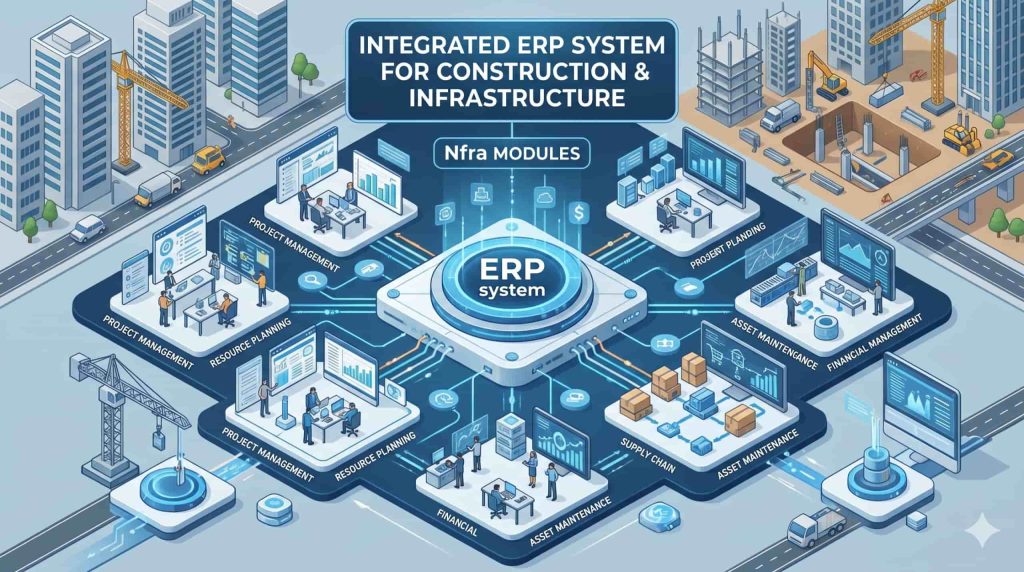
Important Modules in Construction ERP
| ERP Module | Main Purpose |
|---|---|
| Tender Management | Manage tenders and bids |
| Estimation | Prepare project cost estimates |
| BOQ Management | Manage quantities and rates |
| Project Management | Plan and monitor projects |
| Procurement | Manage purchasing and suppliers |
| Inventory | Track construction materials |
| Site Management | Record site activities |
| Subcontracting | Manage subcontractor work |
| Billing | Manage progress and milestone billing |
| Finance | Manage project accounting |
| Labour | Track labour and site resources |
| Equipment | Manage construction assets |
| Quality | Manage inspections and quality records |
| Reporting | Monitor project performance |
How to Select ERP Software for Construction Industry
Selecting the right ERP requires a clear understanding of business processes.
Consider the following factors.
Industry-Specific Features
Check whether the system supports construction workflows such as BOQ, estimation, project costing, subcontracting, progress billing, and site management.
Project Cost Control
The ERP should connect budgets, commitments, actual costs, and project revenue.
Multi-Site Capability
If your business manages multiple projects, the system should provide centralized and site-level visibility.
Procurement and Material Integration
Purchase and inventory should connect directly with project requirements.
Billing Flexibility
Check whether the ERP supports milestone billing, progress billing, retention, deductions, and other contract requirements.
Reporting and Dashboards
Managers need timely information about project costs, progress, billing, procurement, and profitability.
Implementation and Support
ERP implementation requires process mapping, configuration, data migration, user training, testing, and ongoing support.
Why Choose eresource Nfra ERP?
eresource Nfra is a construction-focused ERP platform developed for construction, contracting, EPC, and infrastructure businesses.
The platform currently covers tendering, BOQ and estimation, work orders, variation orders, quantity take-off, budgeting, site activities, subcontractor management, progressive invoicing, procurement, project accounting, asset management, and material and labour management.
Its construction-specific product pages also position Nfra for civil contractors, EPC and MEP projects, infrastructure development, roads and bridges, government contractors, metro and railway projects, and other project-based businesses.
Frequently Asked Questions About Construction ERP
What is ERP software for construction and infrastructure industry?
ERP software for construction and infrastructure industry is an integrated platform for managing projects, BOQ, procurement, materials, subcontractors, site activities, billing, accounting, and reporting.
How does ERP help construction companies?
ERP connects project and business processes in one system. It helps companies manage costs, materials, procurement, subcontractors, billing, project accounting, and site information.
Can construction ERP manage multiple projects?
Yes. Construction ERP can manage multiple projects, locations, departments, contractors, budgets, and financial transactions from a centralized system.
Can ERP manage BOQ and estimation?
Yes. Construction ERP can manage BOQs, quantities, rate analysis, estimates, budgets, revisions, and project costing.
Can ERP manage subcontractors?
Yes. ERP can manage subcontractor work orders, measurements, progress, bills, deductions, retention, and payments.
Can ERP track construction materials?
Yes. ERP can track material procurement, receipts, transfers, issues, consumption, returns, and site inventory.
Can ERP manage project billing?
Yes. Construction ERP can support progress billing, milestone billing, quantity-based billing, retention, advances, deductions, and invoice management.
Is ERP suitable for infrastructure companies?
Yes. Infrastructure companies can use ERP to manage large projects, BOQs, procurement, site operations, subcontractors, equipment, billing, and project financials.
What is the difference between generic ERP and construction ERP?
A generic ERP manages common business functions. Construction ERP adds project-specific workflows such as BOQ, estimation, subcontracting, site management, progress measurement, and construction billing.
Conclusion
Construction and infrastructure companies manage complex projects with multiple teams, sites, contractors, materials, equipment, and financial activities.
ERP software for construction and infrastructure industry connects these processes through one integrated platform.
It can help businesses manage tendering, BOQ, estimation, procurement, project planning, site execution, material management, subcontracting, billing, accounting, and reporting.
A construction-focused ERP also gives management better visibility into project progress and costs.
With eresource Nfra ERP, construction, contracting, EPC, civil, and infrastructure businesses can manage project operations through an integrated construction ERP platform.
For companies managing multiple projects or sites, an integrated ERP system can provide a structured way to connect project execution with financial and operational management.