Skip to content


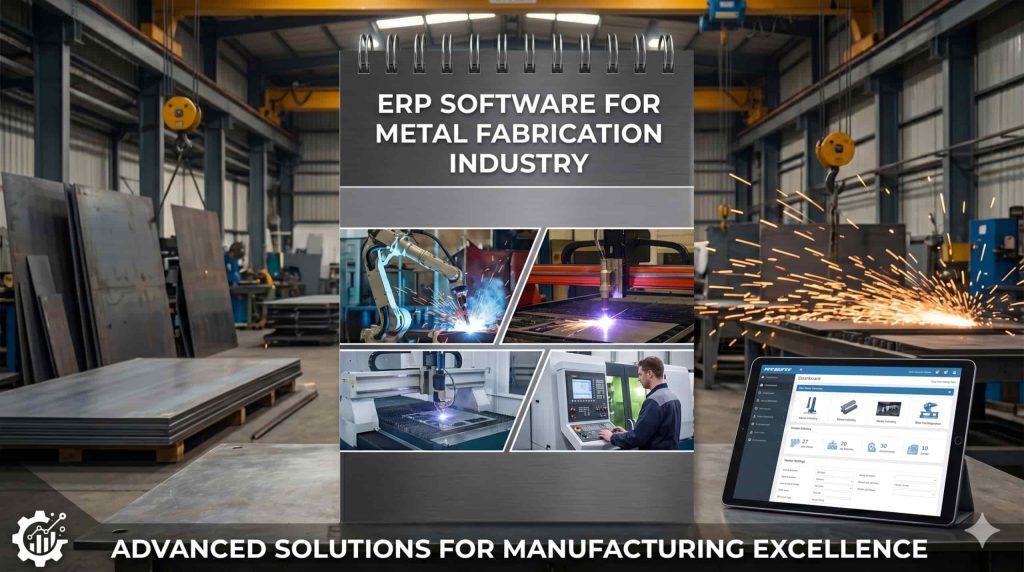
ERP Software for Fabrication Industry
The fabrication industry handles complex production processes, changing customer requirements, multiple materials, and strict delivery schedules. Fabrication companies often manage cutting, bending, welding, machining, assembly, finishing, inspection, and dispatch.
Managing these activities through spreadsheets and separate systems can reduce visibility. It can also make material tracking, job costing, production planning, and delivery management more difficult.
ERP software for fabrication industry brings these operations together on one integrated platform. It connects sales, estimation, engineering, procurement, inventory, production, quality, finance, and dispatch.
With the right fabrication ERP software, businesses can improve operational visibility, control material usage, track production progress, and manage job costs more effectively.
What Is ERP Software for Fabrication Industry?
ERP software for fabrication industry is an integrated business management system designed for fabrication and engineering manufacturing companies.
It connects important business functions through a centralized database.
A fabrication ERP system can manage:
Enquiry and quotation management
Estimation and job costing
Bill of Materials (BOM)
Engineering and drawing revisions
Production planning
Work orders and job cards
Raw material procurement
Inventory and warehouse management
Material issue and consumption
Cutting and fabrication operations
Welding and assembly
Subcontracting and job work
Quality inspection
Sales and dispatch
Finance and accounting
Management reporting
This integrated approach gives management better visibility into each job.
Why Fabrication Companies Need ERP Software
Fabrication businesses often work on customized or project-based orders. Each order may require different materials, drawings, processes, and production schedules.
A single job can pass through several stages before dispatch.
For example:
Enquiry → Estimation → Quotation → Order → Engineering → Procurement → Cutting → Fabrication → Welding → Assembly → Inspection → Dispatch
Manual systems can make it difficult to track this complete workflow.
ERP software connects these stages and gives teams access to updated information.
Common Challenges in Fabrication Industry
Fabrication companies commonly deal with:
Changing customer specifications
Multiple material types and sizes
Material wastage and scrap
Complex production schedules
Multiple production stages
Subcontracting activities
Drawing and BOM revisions
Job-wise costing requirements
Quality inspection requirements
Delivery commitments
Inventory shortages
Limited production visibility
A fabrication ERP system helps organize these processes in one system.
Key Features of Fabrication ERP Software
1. Enquiry and Quotation Management
Fabrication orders often begin with customer enquiries.
ERP software can record enquiries and maintain customer requirements. Teams can prepare estimates using material, labour, process, and overhead costs.
The system can also maintain quotation revisions.
This helps businesses compare estimated costs with actual job costs.
2. Estimation and Job Costing
Accurate costing is important for fabrication businesses.
Fabrication ERP software can calculate estimated costs based on:
Raw materials
Labour
Machine operations
Subcontracting
Consumables
Transportation
Overheads
The system can compare estimated costs with actual costs.
This helps management understand job profitability.
3. Bill of Materials Management
Fabrication jobs can contain multiple components and materials.
ERP software maintains detailed Bills of Materials for each product or job.
It can support:
Multi-level BOMs
Component quantities
Material specifications
BOM revisions
Alternate materials
Production linkage
Cost calculation
A centralized BOM also helps production and procurement teams work with the correct information.
4. Engineering Drawing and Revision Control
Fabrication projects often involve engineering drawings.
Customer requirements may change during production.
An ERP system can maintain drawing revisions and engineering changes.
This helps teams identify the latest approved design before production begins.
It can also reduce errors caused by outdated documents.
5. Production Planning and Scheduling
Fabrication production includes several dependent activities.
ERP software helps planners schedule jobs according to:
Material availability
Machine capacity
Workforce availability
Production priority
Delivery date
Work centre capacity
Production teams can monitor planned and actual progress.
This improves control over production schedules.
6. Work Order and Job Card Management
ERP software can generate work orders and job cards for fabrication activities.
Each job can include:
Job number
Customer details
Product information
BOM
Required materials
Production operations
Assigned work centre
Planned quantity
Production timeline
Supervisors can use job status information to monitor work progress.
7. Raw Material and Inventory Management
Fabrication companies handle plates, sheets, pipes, sections, rods, welding consumables, fasteners, and other materials.
ERP software helps track these materials from purchase to production.
It can provide visibility into:
Available stock
Reserved stock
Material issued to jobs
Material consumption
Material returns
Scrap
Work-in-progress
Finished goods
Some fabrication ERP systems also support material traceability and lot-specific information.
8. Material Consumption and Scrap Tracking
Material utilization directly affects fabrication costs.
ERP software can record material issued against individual jobs.
It can also track:
Actual consumption
Expected consumption
Scrap quantity
Material returns
Wastage
Offcuts
This helps businesses identify material losses and improve production control.
9. Subcontracting and Job Work Management
Fabrication companies may outsource processes such as:
Machining
Heat treatment
Galvanizing
Painting
Surface treatment
Specialized fabrication
ERP software can track subcontracting activities from material issue to receipt.
The system can record vendor details, job quantities, challans, costs, and received quantities.
10. Quality Management
Quality checks are important at different fabrication stages.
ERP software can support:
Incoming material inspection
In-process inspection
Final inspection
Test records
Rejection tracking
Rework management
Quality reports
This helps quality teams maintain consistent inspection records.
11. Purchase and Vendor Management
Fabrication production depends on timely material availability.
ERP software connects purchase requirements with production planning.
The system can manage:
Purchase requisitions
RFQs
Purchase orders
Vendor information
Material receipts
Purchase invoices
Vendor performance
This helps purchasing teams plan material requirements more efficiently.
12. Sales and Dispatch Management
After production and inspection, finished products must reach customers on schedule.
ERP software connects sales orders with production and dispatch.
Teams can track:
Customer orders
Dispatch schedules
Pending quantities
Delivery status
Shipping documents
Invoices
This creates better coordination between sales, production, stores, and finance.
Benefits of ERP for Fabrication Industry
A properly implemented ERP system can provide several operational benefits.
Better Production Visibility
Managers can view job status across different production stages.
They can identify pending jobs and production delays faster.
Improved Material Control
ERP software provides better control over material receipts, issues, consumption, returns, and scrap.
This supports better inventory planning.
More Accurate Job Costing
Fabrication ERP software connects material, labour, subcontracting, and other costs with individual jobs.
This gives management better visibility into actual job profitability.
Better Production Planning
Production planners can consider materials, machines, manpower, and delivery dates while scheduling work.
Reduced Manual Data Entry
Integrated workflows reduce the need to enter the same information into multiple systems.
This can reduce duplication and data-entry errors.
Improved Quality Tracking
Digital inspection records help teams track quality checks and production issues.
Better Coordination
ERP connects engineering, production, stores, purchase, sales, quality, and finance.
This improves information flow between departments.
ERP Software for Metal Fabrication
Metal fabrication companies require strong control over materials and production operations.
Common processes include:
Sheet metal fabrication
Structural steel fabrication
CNC cutting
Plasma cutting
Laser cutting
Bending
Welding
Machining
Assembly
Painting
Galvanizing
Surface finishing
An ERP system can connect these activities with procurement, inventory, production, quality, costing, and dispatch.
Industry-specific ERP solutions also focus on material traceability, work orders, job cards, scrap tracking, and multi-stage production.
ERP for Engineering and Fabrication Companies
Many engineering companies combine design, machining, fabrication, welding, and assembly.
These businesses need control over engineering changes and production execution.
An ERP system can connect:
Enquiry → Estimation → Engineering → BOM → Procurement → Production → Quality → Dispatch → Costing
eresource Xcel is designed for engineering goods manufacturers and supports CNC, fabrication, welding, job work, multi-level BOMs, drawing revisions, job costing, and production tracking.
How ERP Improves Fabrication Production Management
Fabrication ERP software creates a connected workflow between departments.
For example, when a customer order is confirmed, the system can link the order with the required BOM and production requirements.
The purchase team can review material requirements.
The production team can create work orders.
Stores can issue materials against the job.
Supervisors can update production progress.
Quality teams can record inspections.
Finance can review actual costs.
Management can monitor the complete job from one system.
Important ERP Modules for Fabrication Businesses
A complete fabrication ERP solution may include:
| ERP Module | Key Purpose |
|---|---|
| CRM | Customer enquiry and relationship management |
| Estimation | Cost estimation and quotation preparation |
| Sales | Customer orders and invoicing |
| Engineering | BOM and drawing management |
| Production | Planning and work order management |
| Inventory | Raw material and finished goods control |
| Purchase | Procurement and vendor management |
| Quality | Inspection and rejection management |
| Subcontracting | External process and job work tracking |
| Finance | Accounting and cost management |
| Reporting | MIS and business analysis |
How to Choose ERP Software for Fabrication Industry
Before selecting an ERP system, fabrication companies should evaluate their actual workflows.
Consider these factors:
Industry-Specific Functionality
Check whether the ERP supports fabrication processes such as BOM management, work orders, material consumption, job costing, subcontracting, and quality inspection.
Production Flexibility
The system should support customized and make-to-order production where required.
Material Traceability
Check whether the ERP can track material movement from purchase through production and dispatch.
BOM and Revision Control
Engineering teams should be able to manage BOM changes and drawing revisions.
Integration
The ERP should connect sales, purchase, inventory, production, quality, and finance.
Scalability
The system should support business growth, additional users, plants, products, and production volumes.
Implementation and Support
Successful ERP implementation requires proper configuration, user training, data migration, testing, and ongoing support.
Why Choose eresource ERP for Fabrication Industry?
eresource ERP provides manufacturing ERP solutions for engineering and industrial manufacturing businesses.
Its manufacturing platform, eresource Xcel, supports engineering and fabrication workflows with features such as multi-level BOMs, engineering change control, production planning, fabrication and welding tracking, job costing, inventory, quality, job work, and dispatch.
The platform is also positioned for discrete manufacturing environments where businesses need integrated control from production planning through quality and dispatch.
For businesses that manufacture complex machinery and equipment, eresource Xcel also supports fabrication, machining, assembly, project-based production, component tracking, quality testing, procurement, and integrated job costing.
Frequently Asked Questions About ERP for Fabrication Industry
What is ERP software for fabrication industry?
ERP software for fabrication industry is an integrated system that manages production, inventory, procurement, engineering, quality, costing, sales, and finance.
How does ERP help fabrication companies?
ERP helps fabrication companies connect their business processes. It can improve production visibility, material control, job costing, procurement, quality tracking, and delivery management.
Can ERP manage custom fabrication jobs?
Yes. A suitable ERP can support make-to-order and customized fabrication jobs with flexible BOMs, work orders, production routing, costing, and job tracking.
Can fabrication ERP track material consumption?
Yes. ERP systems can track material receipts, issues, consumption, returns, scrap, and job-wise material usage.
Can ERP manage subcontracting?
Yes. ERP software can manage subcontract purchase orders, material issues, job-work challans, received quantities, vendor costs, and related transactions.
Does fabrication ERP support BOM management?
Yes. Fabrication ERP software can maintain BOMs, component quantities, revisions, and production requirements.
Can ERP track fabrication production stages?
Yes. ERP can track multiple production stages such as cutting, bending, machining, welding, assembly, finishing, inspection, and dispatch.
Is ERP suitable for small fabrication companies?
Yes. ERP can support small and growing fabrication companies when the system matches their processes and business requirements.
Conclusion
Fabrication businesses need strong control over materials, production, costing, quality, and delivery.
ERP software for fabrication industry connects these functions through one integrated platform. It helps businesses manage enquiries, estimates, BOMs, procurement, inventory, production, subcontracting, quality, costing, sales, and dispatch.
For fabrication and engineering manufacturers, an industry-focused ERP can provide better visibility across every stage of a job.
With eresource Xcel, fabrication and engineering businesses can connect engineering, procurement, production, quality, inventory, job costing, and finance through an integrated manufacturing ERP platform.
If your fabrication business is growing, an ERP system can provide the operational structure needed to manage more jobs, materials, production stages, and customer requirements from one platform.