Many companies already run software for accounts, stock, sales and payroll. So when we talk about ERP, they often ask a fair question: why do we need it? The answer lies in integration. An integrated ERP system connects every function through one database, which separate tools cannot do. In this post, we explain the difference and show how one order flows through the business. We also show how integration leads to a better return on investment.
Why Clients Ask If They Need ERP
Clients often share their doubts about ERP during our talks. We cannot blame them. Their companies usually have software that already handles many of the functions an ERP covers.
In this case, it is our job to explain how a web-based ERP works. Above all, we need to show what makes it different from a set of standalone systems.
Integrated ERP System vs Standalone Software
Standalone and custom-built tools each keep their own data. Linking them is hard and expensive, so most firms never fully manage it. An integrated ERP gives you a level of interoperability that separate tools rarely reach.
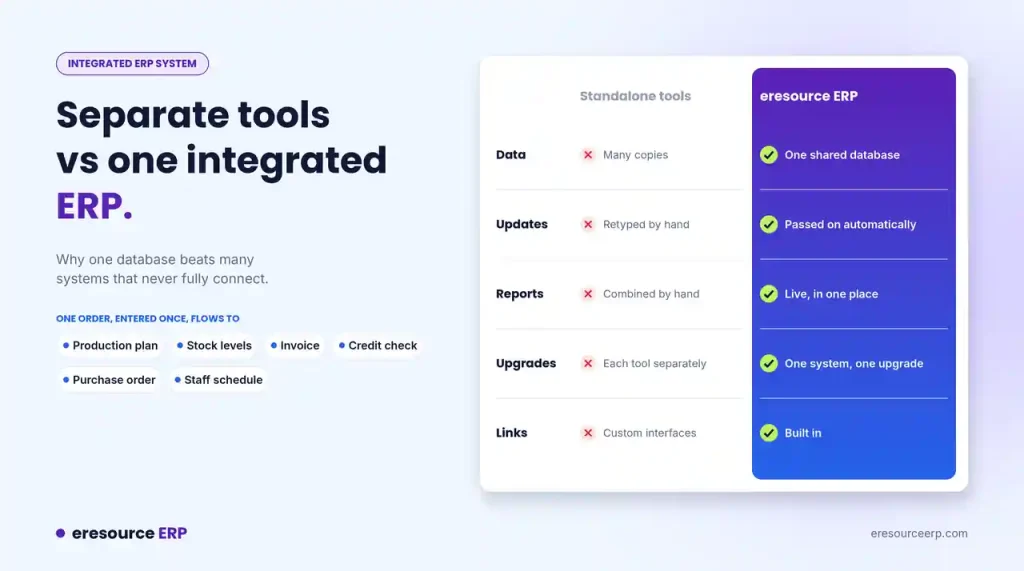
Here is how the two compare:
- Data: Standalone tools hold many copies, while ERP keeps one shared database.
- Updates: Staff retype data between tools, whereas ERP passes it on automatically.
- Reports: Someone must combine figures by hand, but ERP shows them live.
- Upgrades: Each tool needs its own upgrade, while ERP upgrades as one system.
- Links between tools: These need custom interfaces, but ERP builds them in.
For a deeper look, read our guide to ERP vs custom software.
What an Integrated ERP System Covers
eresource serves many industries and functional areas in one system. It automates work across:
- Supply chain and purchasing: Supplier records, quotes and orders.
- Inventory control: The store module tracks stock at every site.
- Manufacturing: The production module handles scheduling and production.
- Sales and customer relations: Sales support plus eresource CRM.
- Finance and costing: The integrated finance module covers financial and cost accounting.
- Human resources: The HRMS solution runs payroll and attendance.
How One Order Flows Through the Business
Here is a simple example. A salesperson enters an order in the field, perhaps through the mobile ERP app. The order then flows at once to other areas, both inside and outside the firm.
For instance, it might change production plans, stock levels or staff schedules. It might also create invoices, run a credit check on the customer or raise purchase orders for suppliers. With standalone tools, each of these steps would need someone to retype the data.
Why Integration Drives ROI
For most companies, ERP is one of the largest IT items in the capital budget. So the return matters.
Integration is where much of that return comes from. When data goes in once, you cut double entry, errors and delays. In turn, staff spend more time on work that adds value. Learn how ERP software delivers return on investment and why you should treat it as an investment, not a cost.
Web-Based ERP for Indian SMBs
Web-based ERP is now common in almost every major industry. It is also gaining wide acceptance among Indian small and medium businesses.
eresource is one of the most affordable options in India, so its use keeps growing. Read why it ranks among the best ERP software in India and the most affordable ERP systems in India.
Choose the Right Fit for Your Industry
Your type of business plays a big part in choosing the right ERP. It also shapes how smoothly the project goes.
eresource offers ready editions for major industrial segments, such as manufacturing. Each edition fits the typical processes of its sector. Learn more about industry-specific ERP and what makes ERP for business success.
How to Get the Best ROI From an Integrated ERP System
Follow these steps to make integration pay:
- List your current tools: Note where staff retype the same data.
- Set measurable goals: For example, lower stock or a faster month-end close.
- Move core functions first: Start with sales, stock and accounts.
- Retire old tools: Remove side spreadsheets once the ERP takes over.
- Measure results: Track your goals every quarter. See how to measure ERP ROI for SMEs.
See an Integrated ERP System in Action
To see real results, read how a leading transportation firm counts on eresource ERP. Then book a free ERP demo to see how one system can replace your separate tools.
Also Read – ERP System for Construction Industry
FAQs About an Integrated ERP System
What does an integrated ERP system do?
An integrated ERP system runs all your core functions on one shared database. These include sales, stock, production, finance and HR. Data entered in one area is instantly available to every other area.
How does an integrated ERP differ from standalone software?
Standalone tools each keep their own data, so staff retype information between them. An integrated ERP keeps one set of data and passes updates on automatically. As a result, reports are live and errors drop.
Why does integration improve ERP ROI?
When data goes in once, you cut double entry, errors and delays. Staff then spend more time on work that adds value, and managers decide faster with live figures. Read more about ERP ROI.
Can we keep some of our existing software?
Yes. eresource can connect with other tools through open APIs. So you can move core functions first and bring the rest across later.
Can small businesses afford an integrated ERP?
Yes. eresource runs on the web, so you need less hardware. You also pay only for the modules you need, and you can add more as you grow.