


Many companies still run on registers, Excel sheets or old in-house software. That works for a new business, but only until growth begins. Then, when they finally choose ERP, a new risk appears: a project that stalls or fails. Most ERP implementation failure starts with people, not software. In this post, we explain the warning signs and the most common causes. We also show how decision-makers can steer the project to success.
When Paper and Spreadsheets Stop Working
Even today, some firms manage their business with books, registers and spreadsheets. Others use standalone software that their own staff or an outside vendor built.
For a new business, these tools help up to a point. However, as the business expands, the amount of data grows fast. Financial transactions, stock, production, vendor records, employee details and even emails all pile up. Managing this flood of data becomes the real challenge. See why an integrated ERP system beats standalone tools.
The Cost of Poorly Managed Data
When data sits in the wrong place, the damage spreads quickly:
- Wrong invoices: Customers pay late, and tax issues follow.
- Wrong stock levels: Production teams run short of materials.
- Overstock: Extra stock locks up working capital you need elsewhere.
- Poor schedules: Staff waste hours, and deliveries run late.
- Unhappy customers: Late or wrong orders hurt your reputation.
Over time, all of this slows the growth of the business. Learn how to reduce errors with ERP.
Indecision: A Leading Cause of ERP Implementation Failure
Indecision among leaders is one of the most common problems in ERP projects. Sometimes senior managers cannot agree. In other cases, staff at different levels pull in different directions.
Either way, the project drifts. Meanwhile, teams wait for answers, and deadlines slip. This kind of analysis paralysis can sink a project before it even starts. So leaders must make clear decisions on time and stand by them.
Poor Training Leads to Poor Use
Training matters just as much. After all, without it, staff use the system wrongly or not at all.
That is why choosing the right ERP and the right training method both matter for success. For this reason, every eresource project includes hands-on training sessions for users. Good training also supports smooth ERP change management.
No Single Reason Behind Success or Failure
ERP is not a magic mantra. Different companies have different experiences with it, for many reasons.
In fact, no single cause decides whether an ERP project succeeds or fails. Therefore, companies must evaluate the planned system carefully before they begin. With a thorough review, there will be few reasons left for failure. Learn the characteristics of effective ERP implementation.
Common Causes of ERP Implementation Failure
Watch out for these warning signs:
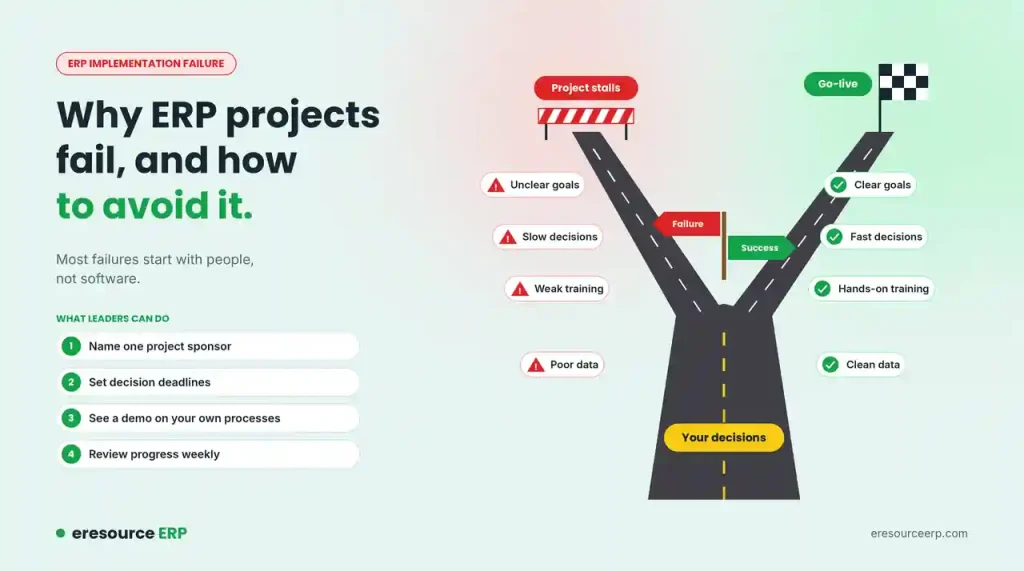
- Unclear goals: Nobody agrees on what the project should achieve.
- Slow decisions: Key choices wait for weeks.
- Weak training: Users learn the system only days before go-live.
- Poor data: Old records go in without cleaning.
- Too much customization: Read why you should not customize your ERP too often.
- Wrong fit: The system does not match how your industry works.
How Decision-Makers Can Prevent ERP Implementation Failure
Leaders can avoid most of these risks. Follow these steps:
- Agree on goals: Write down three to five results you expect.
- Name one sponsor: Give a senior person the power to decide.
- Set decision deadlines: Agree on how quickly each question gets an answer.
- Evaluate properly: See a demo built around your own processes.
- Budget for training: Plan time for every user group.
- Review progress weekly: Fix small problems before they grow.
For a full plan, read our guide to ERP implementation strategy. You can also check a typical ERP implementation timeline.
What Success Looks Like
When companies get these decisions right, the gains are real. eresource customers often improve efficiency through automation. Tasks such as customer quotations, multi-tax invoices and account reconciliations run much faster.
The system also lets you standardise processes across every location. Read more about consistent planning and control with ERP and the advanced features of web-based ERP.
Avoid ERP Implementation Failure With eresource
The right decision starts with the right information. To see where ERP can help most, start with a free ERP assessment or book a free ERP demo.
Also Read – ERP for Plastic Industry
FAQs About ERP Implementation Failure
Why do ERP implementations fail?
Most failures come from people and planning, not software. Common causes include unclear goals, slow decisions, weak training and poor data. Too much customization and a poor industry fit also play a part.
How does indecision affect an ERP project?
When leaders cannot agree, teams wait for answers and deadlines slip. The project loses momentum and can stall before it starts. Naming one sponsor with the power to decide prevents this.
How important is training in ERP implementation?
Training is one of the biggest drivers of success. Without it, staff use the system wrongly or avoid it. Plan time to train every user group before go-live. Read more about ERP change management.
How can decision-makers prevent ERP implementation failure?
Agree on clear goals, name one sponsor and set deadlines for decisions. Then evaluate the system with your own processes, budget for training and review progress every week.
How can we check if an ERP fits our business?
Ask for a demo built around your real processes. A free ERP assessment can also show where ERP will help you most.


