ERP Change Management: How to Help Your Team Embrace a New System
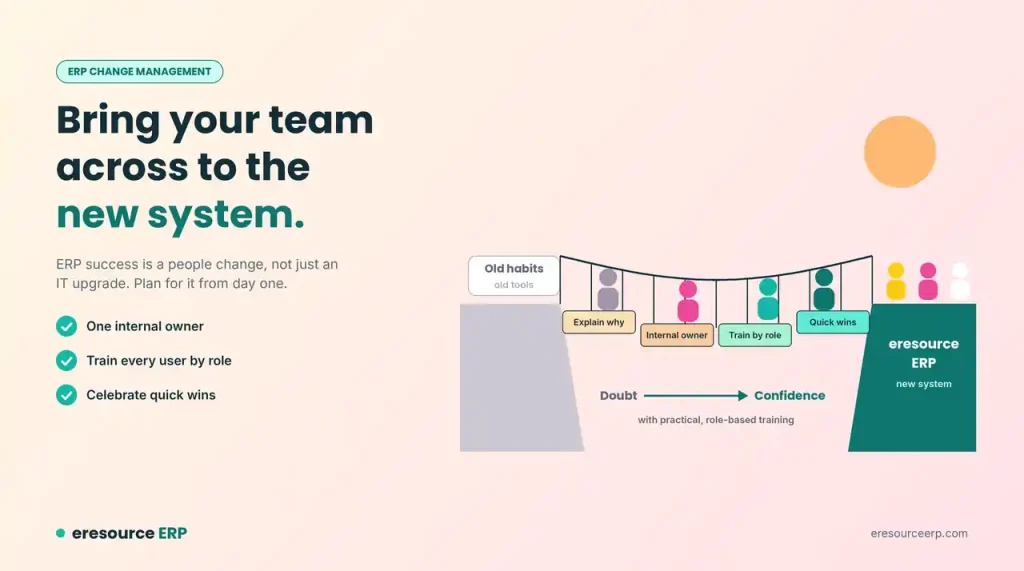
It is always hard to convince people about the benefits of a new system. Usually, the problem is not the software itself. Instead, people who have used an old system for years simply resist change. That is why ERP change management matters as much as the technology. When you plan for the human side, your team adopts the new system faster and your project succeeds.
In this post, we explain why people push back and how training helps. We also share a simple checklist to guide your team through the change.
Why ERP Change Management Starts With People
Most staff know their old tools inside out. So a new system can feel like extra work at first, even when it will save time later.
Some people also worry that they will make mistakes or lose control of their tasks. As a result, they hold on to old habits. Good change management addresses these fears early, before they slow the project down.
Training Turns Doubt Into Confidence
Regular training helps users see the real benefits of the new ERP. Once they understand it, their daily work becomes much easier. In turn, they spend more time on their actual job and less time struggling with routine tasks.
eresource training sessions are practical and easy to follow. With a little help from your in-house IT staff, everyone soon feels at home in the new system. An easy-to-use ERP also shortens the learning curve.
ERP Success Is an Organisational Change
Every ERP project changes some of your processes. Therefore, you should treat it as a change for the whole company, not just an IT upgrade.
It is a mistake to think success depends only on your ERP vendor. In fact, if the company does not commit from the start, the project will likely fail. Leaders, managers and users all need to play their part. For more on this, read about business process changes during ERP.
Appoint a Strong Internal Owner
Every ERP project needs one person inside the company who owns it. This internal owner plays a vital role:
- Makes decisions: Settles questions quickly so work does not stall.
- Connects teams: Links the vendor, managers and users.
- Tracks progress: Keeps tasks on schedule and flags problems early.
- Champions the change: Shows staff why the new system matters.
Why the Effort Pays Off: One Integrated System
The key to eresource is integration. It brings data and processes from every part of the company into one place. As a result, people find what they need quickly, and work flows smoothly from one team to the next.
Most ERP systems do this through one single database with many modules. So when you set up eresource, every part of the business works in harmony. You also need fewer separate software tools, and productivity rises. Learn how enterprise ERP connects the whole company.
Choose a Committed ERP Partner
Your choice of vendor also shapes the change. Work with a partner that stays involved and wants your project to succeed. That way, your investment does not go to waste.
eresource Infotech takes an active part in every project. Moreover, our 3X faster implementation method aims for go-live in under four weeks. A short rollout means less disruption and a quicker return. See also how to make ERP implementation successful.
ERP Change Management Checklist
Use these steps to guide your team through the change:
- Explain the why: Share the goals of the project with every team.
- Name an internal owner: Give one person the authority to drive the project.
- Involve key users early: Ask them to help design the new processes.
- Train by role: Give each group training that matches its daily tasks.
- Celebrate quick wins: Share early results to build confidence.
- Listen and adjust: Collect feedback and fix problems fast.
- Retire old tools: Switch off old systems once the new one runs smoothly.
For a wider view, this overview of change management is a good place to start.
Start Your ERP Change Management Plan With eresource
eresource has helped teams move to new systems smoothly since 2006. To see how our training and rollout work, book a free ERP demo. You can also read how a modular ERP lets you change one step at a time.
Also Read – ERP for Civil Engineering
FAQs About ERP Change Management
What is ERP change management?
ERP change management is the work of helping people adopt a new system. It covers communication, training and support, so staff move from old habits to new processes.
Why do employees resist a new ERP?
People who have used an old system for years know it well. So a new system can feel like extra work, and some fear mistakes or loss of control.
How does training help ERP adoption?
Regular training shows users the real benefits of the new system. Once they understand it, their daily work becomes easier and faster.
Why does an ERP project need an internal owner?
An internal owner makes decisions, links the vendor with your teams and tracks progress. Without one, projects often stall.
How long does an eresource rollout take?
The 3X faster implementation method aims for go-live in under four weeks. A short rollout means less disruption for your team.