Real-Time ERP: How Live Data Has Made Real-Time Business Cost-Effective
Cost control is always a tough job for small and medium-sized businesses (SMBs). An ERP system plays a big part in it. Yet the real gains come when your ERP works in real time. With a real-time ERP, you see what is happening now, not what happened last month. As a result, you can act before small problems turn into big costs.
In this post, we explain what real-time business means and why it is now within reach. We also show how eresource brings live data to every part of your company.
Why Fast Decisions Drive Cost Control
In fact, good cost control depends on quick, accurate decisions. If a manager waits weeks for a report, the chance to act has often passed.
That is why eresource builds business intelligence and analytics tools into the ERP itself. So managers get clear answers faster, and they can make better choices on spending, stock and pricing.
Go Beyond Basic Reports
Your ERP holds a huge amount of useful data, after all. However, basic reports only show a small part of it. To get the full value, companies now add advanced reporting, analysis and decision support to their ERP.
When these tools work inside the same system, the data flows straight into charts and dashboards. For example, Dashboard Studio lets your team build its own dashboards without code. Learn more about ERP with business intelligence.
What Real-Time Business Means
Almost all modern technology aims at one goal: cutting the time between a question and an answer. That includes the time to get information, learn from it, decide, act and use your resources.
When action and response happen at the same moment, you are working in real time. Imagine the edge this gives you:
- Faster launches: You bring new products to market sooner.
- Quicker ideas: Teams test and improve new ideas at a faster pace.
- Leaner production: Plants respond to demand as it changes. See how this helps you reduce cycle time.
- Closer customers: Staff give each customer a personal reply at every point of contact.
Why Real-Time ERP Is Now Cost-Effective
To work this way, you must spot key facts and act on them as they happen. Until recently, that kind of setup cost too much for most firms.
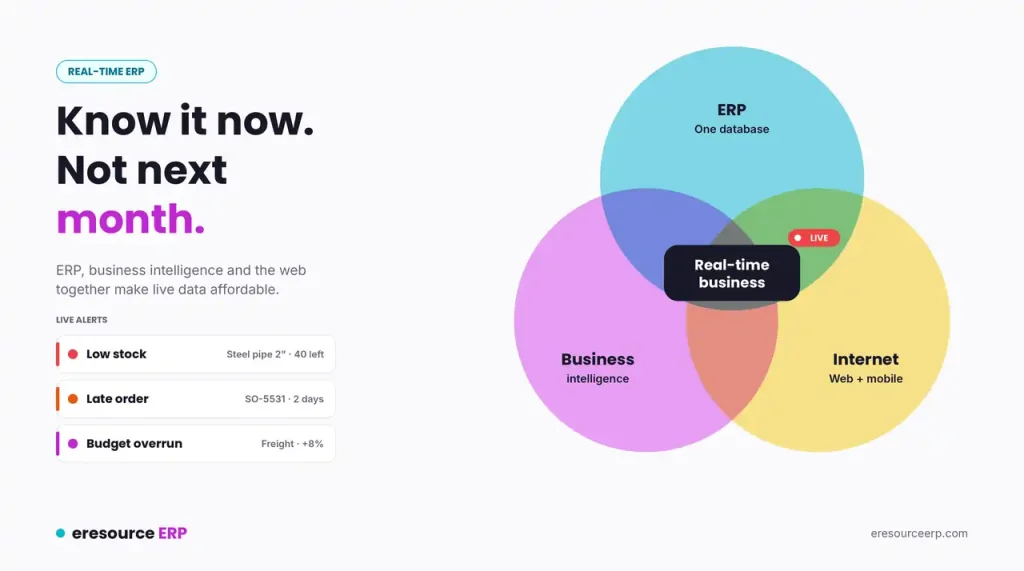
Today, three things have come together: ERP, business intelligence and the internet. Because they now work as one, real-time business has finally become affordable. Read why eresource counts as a cost-effective ERP.
Why Real-Time ERP Must Run on the Web
However, linking ERP to reporting tools is only half the job. To get the full value from your investment, the system must also run on the web.
Once your reports and dashboards sit behind a web interface, the internet becomes a shared source of business facts. Employees, partners, suppliers and customers can all reach the information they need. Moreover, the mobile ERP app puts these facts on every phone. To show each person only what matters to them, see how personalized ERP works.
Benefits of a Real-Time ERP
When live data reaches every team, the gains add up:
- Lower costs: You spot waste and overspending early.
- Faster decisions: Managers act on today’s numbers, not last month’s.
- Better service: Staff answer customer questions with current facts.
- Tighter stock control: You order based on real demand.
- Stronger teamwork: Everyone shares one version of the truth.
How to Move Toward Real-Time ERP
To start, follow these steps to bring live data into your business:
- Put core data in one system: Move sales, purchase, stock and finance into one ERP.
- Choose key numbers: Decide which figures each manager needs every day.
- Build live dashboards: Show those numbers on screens that update on their own.
- Open web and mobile access: Let staff and partners check data from anywhere.
- Act on alerts: Set warnings for low stock, late orders and budget overruns.
See Real-Time ERP in Action
eresource has helped businesses run on live data since 2006. To see real-time dashboards on your own processes, book a free ERP demo. You can also explore our cloud ERP options.
Also Read – ERP Software for Manufacturing Industry
FAQs About Real-Time ERP
What does real-time ERP mean?
Real-time ERP shows what is happening in your business right now. So managers can act on today's numbers instead of waiting for month-end reports.
Why has real-time business become cost-effective?
ERP, business intelligence and the internet now work as one. As a result, live data no longer needs costly separate systems.
How does real-time ERP help cost control?
It shows waste, overspending and stock problems early. Then managers can fix them before they turn into big costs.
Why should real-time ERP run on the web?
A web-based system lets employees, partners, suppliers and customers reach the facts they need from anywhere.
Can we build our own dashboards in eresource?
Yes. Dashboard Studio lets your team build dashboards without writing code.