Enterprise ERP: How One Connected System Drives Your Business Forward
Business today is complex, fast and focused on the customer. It needs processes that are strict yet flexible, and systems that reach across the globe in real time. Above all, every process must connect. An enterprise ERP makes this possible by joining every department into one system. As a result, the whole company moves forward together.
In this post, we look at why older ERP systems fell short. We also show how eresource delivers on the original promise of ERP.
Why Today’s Business Needs Integration
Every part of a modern company faces pressure to deliver measurable results. Sales, purchase, production, finance and service all need clear goals and live numbers.
However, results suffer when each team works in its own system. Information gets stuck, decisions slow down and customers wait. So integration is no longer optional. Instead, it forms the base of every competitive business.
Where Traditional ERP Fell Short
ERP set out to do one big job: unify the enterprise and turn it into one smoothly running machine. Yet many traditional systems never got there.
In many firms, ERP stayed inside a few departments, such as accounts or stores. Other teams kept their own tools and spreadsheets. As a result, the company still ran on separate islands of data.
Beyond the Buzzwords
Over the years, the market saw new buzzwords, such as lean manufacturing. These ideas promised greater efficiency, and many of them have real value. In practice, though, their gains often depended on what ERP set out to deliver all along. That means clean data, connected processes and fast information flow.
Learn how manufacturers in the UAE use eresource Xcel to put these ideas into practice.
How eresource Connects the Whole Enterprise
eresource takes a different approach. Its web-based ERP links team messages, work steps, customer data and supplier details in one central system. Everything in it focuses on moving the business forward.
From the start, eresource helped firms manage data and put it to good use. For example, it organised customer data so each department could work more efficiently. It also streamlined production, which helped manufacturers cut costs and ship products faster. Today, more firms see the benefits as they extend ERP to every part of their organisation.
Enterprise ERP Plus CRM, SCM and BI
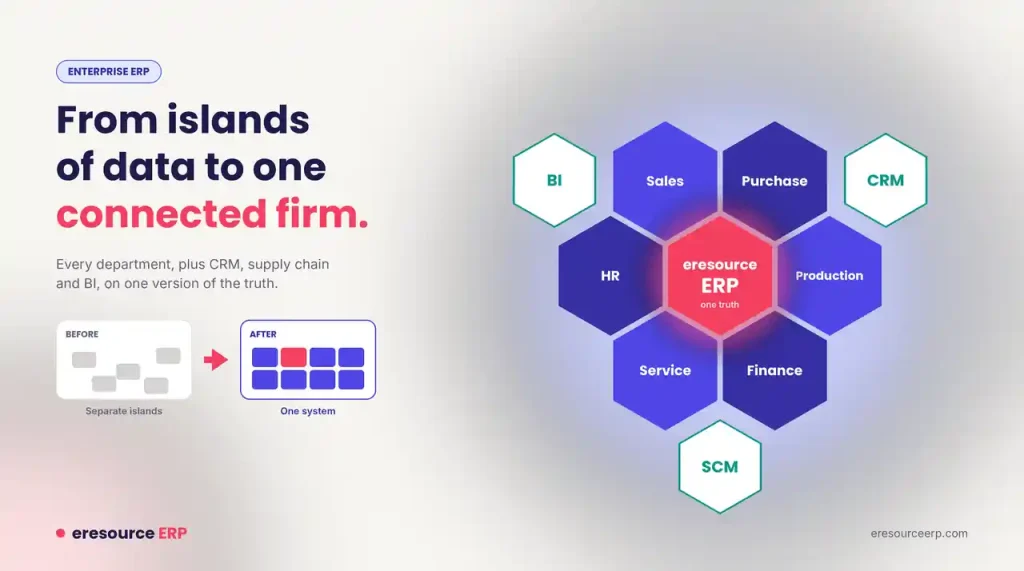
eresource delivers the original idea of ERP: one system for the entire enterprise. Company data no longer sits in departmental silos. Instead, it lives in one place that every authorised user can reach.
This creates a new level of teamwork. Most barriers between departments disappear, so information flows smoothly. Moreover, eresource connects ERP with customer relationship management (CRM), supply chain tools and business intelligence. Together, they let your company work at internet speed with high efficiency.
Benefits of an Enterprise ERP
When the whole company runs on one system, the gains add up:
- One version of the truth: Every team works from the same live data.
- No more silos: Information moves freely between departments.
- Faster processes: Orders, purchases and payments flow without hand-offs.
- Better service: Staff answer customer questions with complete, current data.
- Measurable results: Each department tracks its own goals on live dashboards.
- Room to grow: You can add companies, sites and currencies as you expand.
How to Extend Enterprise ERP Across Your Business
You do not have to switch everything on at once. Instead, follow these steps:
- Start with the core: Begin with finance, sales, purchase and stock.
- Add teams in phases: Bring in production, HR and service one by one.
- Connect customers and suppliers: Link CRM and supply chain tools to the core.
- Open up access: Let staff use the system on the web and the mobile app.
- Measure the results: Review dashboards each month and fine-tune your processes.
This phased, modular ERP approach keeps costs and risk under control.
See eresource Enterprise ERP in Action
eresource has helped businesses connect every department since 2006. To see how it fits your company, book a free ERP demo. You can also take the free ERP assessment to find gaps in your current setup.
Also Read – ERP for Trading company
FAQs About Enterprise ERP
What is an enterprise ERP?
An enterprise ERP is one system that connects every department, from sales and purchase to production, finance and service. So the whole company works from the same live data.
Why did traditional ERP systems fall short?
Many older systems stayed inside a few departments, such as accounts or stores. Other teams kept their own tools, so data stayed in separate silos.
How does enterprise ERP remove information silos?
It keeps all company data in one central database that every authorised user can reach. As a result, information flows freely between teams.
Can eresource connect with CRM and business intelligence?
Yes. eresource links ERP with CRM, supply chain tools and business intelligence dashboards in one platform.
Do we need to roll out every module at once?
No. Most firms start with finance, sales, purchase and stock. Then they add other teams in phases.