


Business Agility With ERP: Why Speed Needs a Plan
Agility is the watchword for business today. Customers want speed, quality and global reach, and markets change without warning. Yet speed alone is not enough. True business agility with ERP comes from planning, clear processes and fast execution working together.
In this post, we explain what agility really means for a business. We also show how an ERP system turns speed into lasting results.
Every Business Runs a Production Process
Production is not only about factories. In fact, every business makes something, whether it is a product or a service.
For example, a hospital produces meals, surgeries, X-rays, therapy sessions, clean rooms and bills. A supermarket manages stock, pricing, shelving and packing. Meanwhile, government offices issue permits, collect taxes and run public services. Contractors build and demolish structures, while banks process loans, cheques and deposits.
Not All Processes Are Equal
Each of these jobs differs in size and time. They also need different tools, machines and skills. Building a car, for instance, takes thousands of steps across many teams. Typing a letter, on the other hand, takes one person a few minutes.
So an ERP system must handle both simple and complex work. Above all, it must show where time and money go at every step.
Why Business Agility With ERP Matters Now
Future competition will turn on time, speed, quality and global reach. As a result, customers will judge firms by how fast they react to sudden shifts in demand. This is especially true for manufacturers, who must adjust plans, materials and capacity quickly.
To respond at that pace, you need an ERP that tracks time and activity. It must also put the customer at the centre of each choice.
Speed Without a Plan Is Not Agility
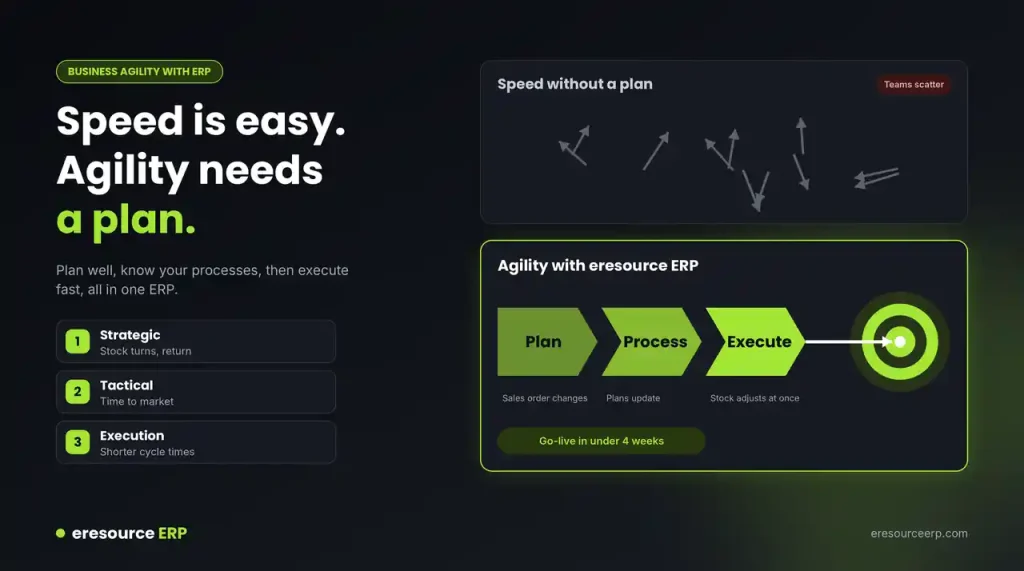
Agility without a good ERP gives you speed without purpose. Teams rush, but they often rush in different directions.
Every ERP rests on three things: joined-up planning, clear processes and fast execution. For decades, closed-loop material requirements planning (MRP) has stressed the same idea. First, you plan well. Then, you understand your processes. Only then can you execute fast without losing control.
Three Levels of Business Agility With ERP
ERP builds agility at three levels of the business:
- Strategic planning: Better stock turns, more output per person and a stronger return.
- Tactical business processes: Happier customers, shorter time to market and a larger market share.
- Execution: Shorter cycle times, quality checks at every step, steady gains and quick fixes when a process drifts.
Together, these gains make a strong case for one ERP across the whole business. Read why ERP is a must-have system for every business.
How eresource Keeps Your Business Agile
eresource links planning, processes and execution in one system. For example, a change in a sales order updates production plans, purchase needs and stock at once.
In addition, no-code tools let your team change forms and workflows as the business changes. The mobile ERP app also keeps approvals moving when managers are away from their desks. Finally, the 3X faster implementation method aims for go-live in under four weeks.
How to Build Business Agility With ERP
Follow these steps to turn speed into results:
- Plan with live data: Link your sales forecast to production and finance through sales and operations planning.
- Standardise processes: Give every team one clear way to work.
- Cut cycle times: Find and remove the slowest steps in each process.
- Build in quality: Add checks at each stage instead of only at the end.
- Keep improving: Review your numbers every month and adjust your plans.
See eresource in Action
eresource has helped businesses plan, react and grow since 2006. To see how it fits your processes, book a free ERP demo. You can also email our team at sales@eresourceinfotech.com.
Also Read – Operational Efficiency With ERP and eBusiness
FAQs About Business Agility With ERP
What is business agility?
Business agility means you can react fast when demand, markets or customer needs change. However, true agility also needs good planning and clear processes.
How does ERP improve business agility?
ERP links planning, processes and execution in one system. So a change in one area updates every related plan at once.
Why does speed alone fall short?
Speed without a plan sends teams in different directions. An ERP gives that speed a clear purpose, because everyone works from the same data.
At which levels does ERP build agility?
ERP builds agility in strategic planning, tactical business processes and daily execution. Each level brings its own gains, from better stock turns to shorter cycle times.
How can we see eresource in action?
Book a free ERP demo, and a consultant will show the system on your own processes. You can also email sales@eresourceinfotech.com.


