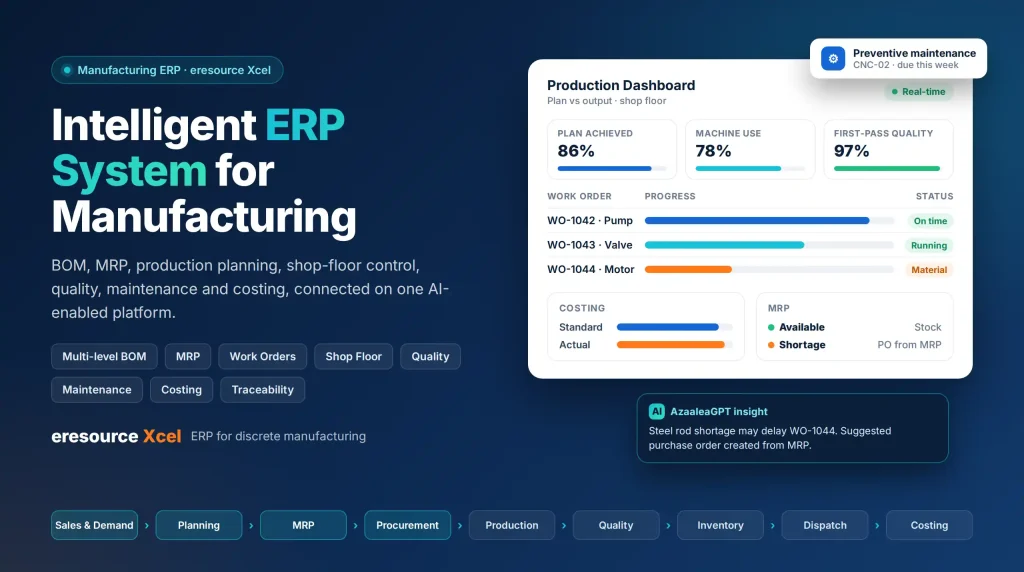
Intelligent ERP System for Manufacturing
Manufacturing businesses manage many connected activities every day. These activities include product design, procurement, inventory, production planning, shop-floor operations, quality control, maintenance, sales, and finance.
When these processes operate in separate systems, manufacturers may struggle with data duplication, production delays, inventory issues, and limited cost visibility.
An intelligent ERP system for manufacturing connects these activities through one integrated platform. It helps manufacturers plan production, manage materials, monitor operations, control costs, and make decisions using real-time business information.
eresource Xcel is a manufacturing-focused ERP solution designed for discrete manufacturing businesses. Its current capabilities include BOM management, MRP, production planning, shop-floor control, quality, inventory, maintenance, purchasing, costing, and manufacturing analytics.
What Is an Intelligent ERP System for Manufacturing?
An intelligent ERP system combines traditional enterprise resource planning with automation, analytics, connected operational data, and intelligent decision support.
For manufacturers, this means the ERP does more than record transactions.
It can connect:
Sales orders
Production planning
Bill of Materials
Material requirements
Purchasing
Inventory
Work orders
Shop-floor activities
Quality inspections
Machine maintenance
Costing
Finance
Dispatch
This connected approach helps manufacturers move from fragmented operations to a more integrated manufacturing environment.
Why Manufacturers Need an Intelligent ERP
Modern manufacturing requires accurate information and faster decisions.
A manufacturing company may need to answer questions such as:
What should we produce today?
Do we have enough raw materials?
Which purchase orders are pending?
Which production orders are delayed?
How much material has been consumed?
Which machines are available?
What is the current production output?
Which products have quality issues?
What is the actual production cost?
Are customer deliveries on schedule?
Without connected data, answering these questions can require manual reports.
An intelligent manufacturing ERP brings relevant information together and provides a common operational view.
Common Manufacturing Challenges
Manufacturers often face several operational challenges as production volume and product complexity increase.
1. Fragmented Business Data
Production, inventory, purchasing, sales, and finance may use separate systems or spreadsheets.
This creates duplicate data entry and inconsistent information.
2. Production Planning Problems
Production schedules depend on customer demand, material availability, machine capacity, labour, and existing orders.
Manual planning becomes difficult when these variables change frequently.
3. Inventory Mismatch
Excess inventory increases working capital requirements.
At the same time, material shortages can stop production.
Manufacturers therefore need accurate inventory visibility.
4. BOM Errors
Incorrect or outdated Bills of Materials can create material shortages, excess consumption, and production errors.
5. Limited Shop-Floor Visibility
Management may receive production updates only after a shift or at the end of the day.
This delays corrective action.
6. Quality Problems
Manufacturers need to track inspections, non-conformances, rework, and corrective actions.
Without connected quality information, recurring problems can remain difficult to identify.
7. Poor Cost Visibility
Production costs can change because of material prices, labour, machine time, scrap, and overheads.
Manufacturers need accurate product and production costing.
Key Features of Intelligent Manufacturing ERP
An effective manufacturing ERP software platform should connect the complete production cycle.
Bill of Materials Management
The Bill of Materials defines the components and quantities required to manufacture a product.
Modern manufacturing ERP software can support:
Multi-level BOMs
BOM revisions
Alternate materials
Component quantities
BOM costing
Production linkage
Engineering changes
eresource Xcel currently highlights multi-level BOM structures, revisions, costing, production linkage, approvals, and material substitution.
Production Planning and Scheduling
Production planning helps manufacturers determine what to produce, when to produce it, and which resources are required.
The ERP can consider:
Customer demand
Production orders
Material availability
Machine capacity
Work-center capacity
Labour availability
Production priorities
This creates a more structured production schedule.
Material Requirements Planning
MRP helps manufacturers calculate material requirements based on production demand and inventory availability.
An ERP system can help identify:
Required materials
Available stock
Shortages
Purchase requirements
Planned production
Expected receipts
This helps procurement teams respond to production requirements more effectively.
Work Order Management
Work orders convert production plans into executable manufacturing activities.
Teams can track:
Planned quantity
Produced quantity
Pending quantity
Material consumption
Operations
Labour
Machine usage
Scrap
Production status
This creates better visibility from planning to execution.
Shop-Floor Management
Shop-floor control connects production planning with actual manufacturing activities.
Supervisors can monitor work orders, production progress, machine utilization, downtime, and operational issues.
The current Xcel manufacturing platform highlights real-time shop-floor visibility and machine-related data integration.
Inventory and Warehouse Management
Manufacturing ERP software should provide real-time inventory visibility.
Important capabilities include:
Multi-location inventory
Warehouse management
Bin tracking
Stock transfers
Material receipts
Material issues
Stock adjustments
Inventory valuation
Barcode and QR code integration
Xcel currently lists real-time stock visibility, multi-location inventory, bin-wise tracking, stock movements, barcode, and QR-code capabilities.
Purchase Management
Procurement directly affects production continuity.
An integrated ERP can connect purchase requirements with MRP and inventory information.
Key activities include:
Purchase requisitions
Supplier quotations
Vendor comparison
Purchase orders
Goods receipts
Purchase invoice matching
Vendor performance
Purchase analytics
The current Xcel platform also supports purchase order creation from MRP and supplier-related analytics.
Quality Management
Quality control should operate alongside production rather than as a separate process.
Manufacturing ERP software can help manage:
Incoming inspection
In-process inspection
Final inspection
Quality parameters
Non-conformance
Rework
Rejection
Corrective actions
Quality records
This helps manufacturers create stronger quality controls.
Maintenance Management
Machine downtime can affect production schedules and delivery commitments.
An intelligent ERP can connect maintenance activities with production planning.
Maintenance functions may include:
Preventive maintenance
Breakdown maintenance
Maintenance requests
Spare parts
Machine history
Maintenance costs
Service schedules
The current Xcel platform includes maintenance tracking, spare-parts management, machine history, performance tracking, and maintenance cost analysis.
AI-Powered Manufacturing ERP
Artificial intelligence can add another layer of intelligence to ERP systems.
Instead of only displaying historical information, an AI-enabled ERP can identify patterns and highlight potential operational problems.
For example, intelligent manufacturing systems can help identify:
Potential material shortages
Production delays
Machine downtime risks
Quality trends
Cost deviations
Resource constraints
The current eresource Xcel platform promotes AzaaleaGPT as an AI layer for manufacturing operations and describes use cases involving material shortages, production delays, machine downtime, and quality information. These are product claims from eresource.
Real-Time Manufacturing Visibility
Real-time information helps manufacturers respond faster.
A connected ERP dashboard can bring together information about:
Production output
Production plan
Pending work orders
Machine utilization
Inventory
Quality
Procurement
Sales orders
Dispatch
Financial performance
Management can therefore monitor operations without waiting for manually prepared reports.
Manufacturing Costing
Costing is one of the most important functions of a manufacturing ERP.
Manufacturers need to understand the cost of producing each product.
Manufacturing costs can include:
Raw materials
Direct labour
Machine costs
Subcontracting
Production overheads
Scrap
Rework
Other production expenses
An integrated ERP can compare standard and actual costs.
This helps management identify cost variances and improve production decisions.
The current Xcel platform includes standard-versus-actual costing and variance analysis as part of its manufacturing capabilities.
Engineering Change Management
Manufacturing products often change during their lifecycle.
Engineering teams may revise:
Product designs
Components
Specifications
Materials
Manufacturing processes
BOM structures
ERP software with revision control helps ensure that production teams use approved information.
This reduces the risk of manufacturing products using outdated specifications.
Traceability in Manufacturing
Traceability becomes important when manufacturers need to identify the source and movement of materials or products.
ERP systems can connect:
Purchase → Material Receipt → Inventory → Production → Quality → Finished Goods → Dispatch
This creates a more complete product history.
Traceability is particularly useful for industries with strict quality, compliance, or customer requirements.
How Intelligent ERP Improves Manufacturing Operations
An intelligent ERP system can connect the major stages of the manufacturing lifecycle.
Step 1: Sales and Demand
Customer orders and demand information enter the ERP.
Step 2: Production Planning
Production teams convert demand into production plans.
Step 3: MRP
The system evaluates material requirements and available inventory.
Step 4: Procurement
Purchase requirements are converted into procurement activities.
Step 5: Production
Work orders are released to the shop floor.
Step 6: Quality
Materials, processes, and finished products undergo quality checks.
Step 7: Inventory
Finished products move into inventory.
Step 8: Dispatch
Products are dispatched according to customer requirements.
Step 9: Costing and Finance
Production and financial data are connected for costing and reporting.
This creates an integrated order-to-production-to-dispatch workflow.
Benefits of Intelligent ERP for Manufacturing
1. Better Production Planning
Integrated demand, inventory, and capacity information supports more structured production planning.
2. Improved Inventory Control
Real-time stock information helps reduce both shortages and excess inventory.
3. Better Production Visibility
Managers can monitor production progress and pending work orders.
4. Reduced Manual Work
Automation reduces repetitive data entry across departments.
5. Better Quality Control
Connected quality information makes it easier to identify and manage production issues.
6. Improved Machine Utilization
Machine data and maintenance information can support better resource utilization.
7. Faster Decision-Making
Management can access operational information without waiting for manual reports.
8. Better Cost Control
Actual production costs can be compared with planned or standard costs.
9. Improved Delivery Planning
Production and inventory visibility helps teams manage customer delivery commitments.
10. Scalable Operations
An integrated ERP can support additional products, users, locations, and manufacturing complexity as the business grows.
Industries That Can Use Manufacturing ERP
Manufacturing ERP is not limited to one type of factory.
An intelligent manufacturing ERP can support industries such as:
Automotive components
Engineering goods
Machinery and equipment
Electronics
Electrical products
Metal fabrication
Valves and pumps
Rubber products
Plastics
Textiles
Medical devices
Defence and aerospace
Heavy engineering
The current eresource Xcel platform identifies more than 20 discrete manufacturing types, including automotive components, engineering goods, machinery, electronics, metal fabrication, valves, rubber products, and others.
Discrete Manufacturing ERP vs Generic ERP
A generic ERP may provide basic manufacturing functions.
However, discrete manufacturers often require deeper production controls.
| Area | Generic ERP | Manufacturing-Focused ERP |
|---|---|---|
| BOM | Basic | Multi-level and revision controlled |
| MRP | Limited | Integrated material planning |
| Production | Basic orders | Detailed work-order management |
| Shop Floor | Limited | Production execution visibility |
| Quality | Basic | Integrated inspection and control |
| Costing | General | Manufacturing-specific costing |
| Traceability | Limited | Lot and serial tracking |
| Maintenance | Optional | Integrated maintenance |
| Engineering Changes | Limited | Revision and change management |
| Production Analytics | General | Manufacturing-focused |
Why Choose eresource Xcel?
eresource Xcel is positioned specifically for discrete manufacturing rather than as a generic ERP with manufacturing added later.
The current manufacturing platform covers production planning, BOM, MRP, shop-floor control, quality, inventory, purchase, maintenance, costing, and engineering change management.
The current eresource site also states that Xcel has more than 20 years of manufacturing ERP experience and is live across 400+ factories. These are company-reported figures.
Xcel is also positioned as an AI-enabled manufacturing platform with AzaaleaGPT, mobile factory capabilities, IoT integration, and no-code customization. These capabilities are described by eresource on its current manufacturing page.
Key Modules of Manufacturing ERP Software
| Module | Main Function |
|---|---|
| BOM Management | Product structure and component control |
| Production Planning | Production requirements and scheduling |
| MRP | Material requirement planning |
| Work Orders | Production execution |
| Shop Floor | Real-time production monitoring |
| Quality | Inspection and quality control |
| Inventory | Stock and warehouse management |
| Purchase | Supplier and procurement management |
| Maintenance | Machine and equipment maintenance |
| Costing | Product and production cost control |
| Engineering | Product revision management |
| Sales | Customer order management |
| Dispatch | Finished goods delivery |
| Finance | Accounting and financial control |
| Analytics | Operational and management reporting |
How to Choose an Intelligent Manufacturing ERP
Before selecting an ERP system, manufacturers should evaluate the software against their actual production processes.
Check Manufacturing Depth
Make sure the ERP supports your production model and product complexity.
Evaluate BOM and MRP
Check multi-level BOM, revisions, material planning, and production requirements.
Review Shop-Floor Features
Look for work-order tracking, production updates, machine information, and real-time visibility.
Check Quality Management
Make sure quality checks can connect with production and inventory.
Evaluate Costing
The system should provide meaningful production and product cost information.
Check Integration
Manufacturing, purchasing, inventory, sales, and finance should work from connected data.
Review Scalability
The ERP should support your future growth across products, plants, warehouses, and users.
Evaluate AI and Automation
If intelligent capabilities are important to your business, check whether AI features provide practical value in areas such as planning, production, inventory, quality, and maintenance.
Conclusion
An intelligent ERP system for manufacturing can connect production planning, BOM, MRP, procurement, inventory, shop-floor operations, quality, maintenance, costing, and finance.
For manufacturers, this integrated approach can provide better operational visibility and help reduce dependence on disconnected spreadsheets and systems.
eresource Xcel is positioned as a manufacturing-focused ERP for discrete manufacturers, with capabilities spanning production, inventory, quality, maintenance, costing, shop-floor operations, and intelligent manufacturing features.
As manufacturing becomes more data-driven, an integrated ERP can provide the foundation for better planning, stronger process control, and more informed operational decisions.
Frequently Asked Questions
Common questions about intelligent ERP for manufacturing
What is an intelligent ERP system for manufacturing?
An intelligent ERP system for manufacturing combines ERP functions with automation, analytics, connected operational data, and intelligent decision support. It helps manufacturers manage planning, production, inventory, quality, maintenance, costing, and finance.
What is manufacturing ERP software?
Manufacturing ERP software is an integrated business management system designed to manage manufacturing processes such as BOM, MRP, production, inventory, procurement, quality, costing, and finance.
How does ERP help manufacturing companies?
ERP connects manufacturing activities in one system. It can improve production visibility, inventory control, procurement, quality management, costing, and reporting.
Can manufacturing ERP manage BOM and MRP?
Yes. Manufacturing ERP systems commonly support BOM management and material requirements planning. The current Xcel platform supports multi-level BOMs, revisions, and MRP-related production planning.
Can ERP track production in real time?
Manufacturing ERP can provide real-time or near-real-time production visibility when production systems and shop-floor data are properly integrated. Xcel currently promotes real-time shop-floor and machine data capabilities.
Can ERP manage machine maintenance?
Yes. Manufacturing ERP can connect preventive and breakdown maintenance with equipment history, spare parts, maintenance requests, and production operations.
Is intelligent ERP useful for discrete manufacturing?
Yes. Discrete manufacturers often require detailed BOMs, production orders, material planning, quality checks, traceability, and shop-floor control. A manufacturing-focused ERP can bring these processes together.
What is the difference between ERP and manufacturing ERP?
ERP is a broad category of business management software. Manufacturing ERP adds specialized capabilities for production planning, BOM, MRP, work orders, shop-floor operations, quality, costing, and maintenance.