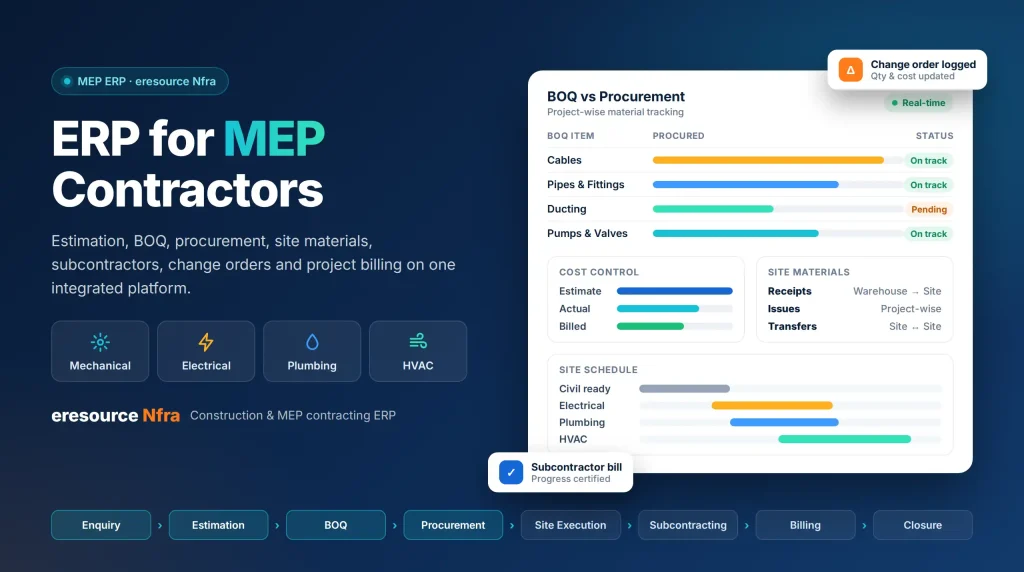
ERP for MEP Contractors
Mechanical, Electrical, and Plumbing (MEP) contractors manage complex projects with multiple activities, materials, vendors, subcontractors, engineers, and site teams. Each project also has its own budget, schedule, scope, and customer requirements.
ERP for MEP contractors helps businesses manage these activities through one integrated system. It connects project estimation, BOQ, procurement, inventory, scheduling, site operations, subcontracting, billing, accounting, and reporting.
With the right MEP ERP software, contractors can reduce manual work, improve project visibility, control costs, and manage project information more efficiently.
What Is ERP for MEP Contractors?
ERP for MEP contractors is a business management system designed to support the specific requirements of mechanical, electrical, plumbing, and HVAC contracting companies.
MEP projects involve several interconnected activities. For example, a contractor may need to estimate quantities, purchase materials, allocate workers, coordinate subcontractors, track site progress, and raise invoices.
An integrated ERP system connects these activities.
Instead of managing information through separate spreadsheets, emails, documents, and accounting systems, teams can work with centralized project data.
The current eresource Nfra solution is positioned for MEP and construction contractors and supports project documentation, scheduling, tasks, logs, change orders, reporting, estimation, and cost accounting.
Why Do MEP Contractors Need ERP Software?
MEP projects can become difficult to control when project information is spread across different systems.
Common challenges include:
Complex project estimation
BOQ and quantity management
Material procurement delays
Multiple suppliers and vendors
Subcontractor coordination
Site-level material tracking
Labour and resource planning
Project schedule management
Change order tracking
Progress billing
Cost overruns
Delayed project reporting
Large Excel files and manual records
An ERP system for MEP contractors brings these processes together.
This gives project managers, finance teams, procurement teams, and management access to consistent project information.
Major Challenges Faced by MEP Contractors
1. Complex Project Estimation
MEP projects require detailed estimates for materials, labour, equipment, subcontracting, and other costs.
A small estimation error can affect the project budget and final margin.
An ERP system can organize estimates by project, activity, work package, or cost category.
2. BOQ and Quantity Management
Bill of Quantities plays an important role in MEP projects.
Contractors need to track quantities for items such as:
Pipes
Cables
Electrical equipment
Pumps
Valves
Ducting
Fittings
Fixtures
HVAC equipment
Plumbing materials
ERP software can connect BOQ quantities with procurement and project execution.
3. Material Procurement
MEP projects depend heavily on timely material availability.
Procurement teams need to identify required materials and purchase them according to project schedules.
An MEP ERP system can connect purchase requirements with project budgets and material needs.
4. Site Material Management
Materials may be received at warehouses, project sites, or other locations.
Without proper tracking, contractors may face shortages, excess stock, or material losses.
ERP software provides better visibility into project-wise material receipts, issues, transfers, and consumption.
5. Subcontractor Management
MEP contractors often work with specialized subcontractors.
These subcontractors may handle electrical, HVAC, fire protection, plumbing, or other activities.
ERP software can help manage subcontractor work orders, costs, progress, certifications, and payments.
6. Project Schedule Management
MEP work must often follow a specific sequence.
For example, electrical and plumbing work may depend on civil or structural progress.
Project scheduling helps teams coordinate activities and identify delays.
7. Cost Control
MEP project profitability depends on controlling material, labour, equipment, subcontractor, and overhead costs.
An ERP system can compare estimated costs with actual project expenses.
This helps management identify cost deviations earlier.
Key Features of MEP ERP Software
A specialized MEP ERP software solution should cover the complete project lifecycle.
Project Estimation
The ERP should support detailed project estimates.
Teams can calculate material, labour, subcontracting, equipment, and other project costs.
Approved estimates can then support project budgeting and execution.
BOQ Management
BOQ management helps contractors control quantities and project requirements.
The ERP can connect BOQ data with procurement, inventory, billing, and project costing.
Project Planning
Project planning allows teams to define activities, schedules, responsibilities, and milestones.
Managers can monitor planned and actual progress.
Work Scheduling
MEP projects involve multiple activities.
Scheduling helps teams coordinate engineers, technicians, materials, subcontractors, and site activities.
Procurement Management
Procurement management can include:
Purchase requisitions
Supplier quotations
Purchase orders
Goods receipts
Purchase invoices
Vendor evaluation
Project-wise purchasing
This provides better control over project procurement.
Inventory Management
An MEP contractor may manage materials across multiple warehouses and project sites.
ERP software can track:
Opening stock
Material receipts
Material issues
Site transfers
Material returns
Project consumption
Stock balances
Subcontractor Management
The ERP can track subcontractor activities against project requirements.
It can also help monitor work orders, progress, costs, and payments.
Site Management
Site teams can update project activities and reports from the field.
Centralized information helps office teams stay updated with project progress.
The current eresource Nfra page highlights access to daily reports, project tasks, correspondence, schedules, logs, and change orders.
Change Order Management
MEP project requirements can change during execution.
Changes may affect:
Material quantities
Project costs
Labour requirements
Project schedules
Subcontractor work
Customer billing
ERP software can help record and track these changes.
Project Cost Accounting
Project accounting helps contractors understand the actual financial performance of each project.
Costs can be tracked across:
Materials
Labour
Subcontractors
Equipment
Expenses
Overheads
This creates better project cost visibility.
Billing and Invoicing
MEP contractors may bill customers based on milestones, progress, quantities, or contract terms.
ERP software can connect project progress with billing activities.
This can help reduce billing delays.
How ERP Helps Electrical Contractors
Electrical contractors manage materials, installations, manpower, vendors, and site activities.
An ERP system can help manage:
Electrical project estimates
Cable and equipment requirements
BOQ
Procurement
Material consumption
Labour allocation
Site progress
Subcontractors
Project billing
Cost accounting
This creates a connected workflow from estimation to project completion.
How ERP Helps Plumbing Contractors
Plumbing projects involve pipes, fittings, valves, fixtures, pumps, and other materials.
ERP software can help contractors manage quantities and material consumption.
Teams can also track procurement, site inventory, labour, subcontractors, and project costs.
This improves control over plumbing project execution.
How ERP Helps HVAC Contractors
HVAC contractors manage equipment, ducting, piping, electrical connections, installation, testing, and commissioning.
An HVAC ERP software solution can help connect:
HVAC estimates
Equipment requirements
BOQ
Procurement
Inventory
Installation schedules
Site activities
Subcontractors
Testing and commissioning
Billing
Project costs
This helps teams coordinate multiple HVAC project activities.
Project Documentation Management
Documentation is an important part of MEP contracting.
Projects can generate large numbers of documents, including:
Contracts
Drawings
BOQs
Estimates
Purchase orders
Work orders
Site reports
Change orders
Correspondence
Invoices
Completion documents
An ERP system can provide a centralized location for project information.
The current eresource Nfra article states that project documentation, schedules, tasks, events, project logs, and change orders can be stored in one location.
MEP Project Reporting
Project reporting helps management understand what is happening at each site.
Useful reports can include:
Project progress reports
Budget vs actual reports
Material consumption reports
Procurement reports
Subcontractor reports
Labour reports
Project expense reports
Billing reports
Receivable reports
Project profitability reports
Real-time reporting can help management make decisions using current project information.
Benefits of ERP for MEP Contractors
1. Centralized Project Information
Teams can access project information from one integrated system.
2. Better Cost Control
Managers can compare planned project costs with actual expenses.
3. Improved Material Management
Project-wise material tracking helps reduce shortages and unnecessary purchases.
4. Faster Procurement
Integrated procurement helps teams identify and process project requirements faster.
5. Better Subcontractor Control
Contractors can track subcontractor work, costs, and progress more systematically.
6. Improved Project Scheduling
Project schedules help teams coordinate activities and monitor delays.
7. Reduced Manual Work
ERP automation reduces repetitive data entry and spreadsheet-based processes.
8. Faster Project Reporting
Management can access reports without collecting data manually from different departments.
9. Better Billing Control
Project progress and contract information can support timely billing.
10. Improved Project Visibility
Management gets a broader view of project costs, progress, procurement, and financial performance.
MEP ERP Workflow
A typical MEP contractor ERP workflow can follow these stages:
Enquiry → Estimation → BOQ → Quotation → Contract → Project Planning → Procurement → Material Management → Site Execution → Subcontracting → Progress → Billing → Accounting → Project Closure
This integrated workflow reduces information gaps between departments.
MEP ERP Modules
| ERP Module | Purpose |
|---|---|
| CRM | Enquiry and customer management |
| Estimation | Project cost estimation |
| BOQ | Quantity and item management |
| Project Management | Project planning and monitoring |
| Scheduling | Activity and milestone planning |
| Procurement | Project purchasing |
| Inventory | Material and stock management |
| Subcontracting | Subcontractor work management |
| Site Management | Site activities and reporting |
| Document Management | Project document control |
| Change Management | Change order tracking |
| Billing | Progress and project billing |
| Finance | Accounting and project costing |
| Reporting | Project performance analysis |
How to Choose an ERP System for MEP Contractors
Before selecting an ERP system for MEP contractors, evaluate the system against your actual project workflow.
Check Project Management Features
The system should support project planning, schedules, tasks, milestones, and progress tracking.
Check BOQ and Estimation Capabilities
Make sure the ERP can handle detailed MEP estimates and quantities.
Evaluate Procurement Integration
Procurement should connect with project requirements and budgets.
Check Material Tracking
The ERP should track materials across warehouses and project sites.
Review Subcontractor Management
Check whether the system can manage subcontractor work orders, progress, costs, and payments.
Check Cost Accounting
The system should provide project-wise cost visibility.
Evaluate Reporting
Project dashboards and reports should help management identify delays and cost deviations.
Check Multi-Project Support
If your company handles several projects, the ERP should provide centralized visibility across projects.
Why Choose eresource Nfra for MEP Contractors?
eresource Nfra is positioned as a construction and contracting ERP solution that also supports MEP and HVAC project requirements.
The current eresource page highlights MEP work management, work scheduling, real-time information, centralized project documentation, daily reports, project tasks, correspondence, and change orders.
The solution also highlights project estimation, contracting project management, cost accounting, and job information reporting as key capabilities for MEP contractors.
For businesses managing MEP projects, these capabilities can connect project operations with procurement, materials, finance, and reporting.
Frequently Asked Questions
What is ERP for MEP contractors?
ERP for MEP contractors is an integrated software system that helps manage MEP projects, estimation, BOQ, procurement, materials, scheduling, subcontractors, billing, accounting, and reporting.
What does MEP ERP software manage?
MEP ERP software can manage project estimation, BOQ, procurement, inventory, site activities, scheduling, subcontractors, project costs, billing, and financial reporting.
Can ERP manage electrical and plumbing projects?
Yes. A suitable ERP can manage electrical, plumbing, mechanical, and HVAC projects through project-specific workflows.
Can ERP track MEP project costs?
Yes. ERP software can track material, labour, subcontractor, equipment, and other project-related costs.
Can MEP ERP manage subcontractors?
Yes. MEP ERP systems can help manage subcontractor work orders, progress, costs, certifications, and payments.
Does ERP help with MEP project scheduling?
Yes. Project scheduling features can help teams plan activities, assign responsibilities, monitor progress, and identify delays.
Can ERP manage MEP project documents?
Yes. An integrated ERP can centralize project documents, schedules, tasks, reports, correspondence, and change orders.
Is MEP ERP useful for HVAC contractors?
Yes. HVAC contractors can use ERP software to manage estimates, BOQ, equipment, procurement, installation, subcontracting, project costs, and billing.
Conclusion
ERP for MEP contractors provides a centralized platform for managing complex mechanical, electrical, plumbing, and HVAC projects.
From estimation and BOQ management to procurement, material tracking, scheduling, subcontracting, billing, and project accounting, an integrated ERP can connect the major activities of an MEP contracting business.
For contractors handling multiple projects, centralized project information can improve visibility and reduce dependence on spreadsheets and disconnected systems.
A specialized MEP ERP solution can therefore support better project coordination, cost control, reporting, and overall operational management.