ERP Software for Project Based Industry
Project-based businesses manage unique projects with different scopes, budgets, resources, timelines, and customer requirements. Unlike repetitive manufacturing or trading operations, every project can have a different cost structure and delivery plan.
ERP software for project based industry helps businesses manage the complete project lifecycle from estimation and planning to procurement, execution, billing, accounting, and closure.
A project-focused ERP connects project teams, finance, procurement, inventory, resources, and management on one platform. As a result, businesses can track project costs, control budgets, monitor progress, and improve project profitability.
What Is ERP Software for Project-Based Businesses?
ERP software for project-based businesses is an integrated business management system designed around the project as the primary unit of work.
It connects project estimation, work breakdown structure (WBS), budgeting, procurement, resource planning, timesheets, expenses, billing, and accounting.
A project ERP also helps management compare:
Estimated project cost
Approved project budget
Actual project cost
Committed costs
Project revenue
Work in progress
Expected project margin
This provides better visibility throughout the project lifecycle.
Modern project ERP platforms can support project-driven companies across EPC, engineering, turnkey projects, custom machinery, fabrication, solar EPC, and other specialized businesses.
Why Do Project-Based Businesses Need ERP?
Project businesses often manage several activities at the same time. Each project can have its own budget, purchase requirements, team, subcontractors, milestones, and billing schedule.
Without an integrated system, project information may remain across spreadsheets, emails, accounting software, and separate operational systems.
This can create several problems:
Limited project cost visibility
Delayed project reporting
Uncontrolled expenses
Procurement delays
Poor resource utilization
Missed billing milestones
Difficult subcontractor tracking
Budget overruns
Inaccurate project profitability
Duplicate data entry
A project-based ERP brings these processes together. Therefore, management can monitor project performance using connected operational and financial data.
Key Challenges in Project-Based Businesses
Every project business faces different operational challenges. However, some problems are common across industries.
1. Complex Project Estimation
Project estimates must often include materials, labour, equipment, subcontracting, overheads, and other expenses.
An ERP system can organize these cost components and maintain different estimate versions.
2. Difficult Budget Control
Project costs can change during execution. Managers need to compare the original budget with actual and committed costs.
This helps identify cost deviations before they become major problems.
3. Procurement Delays
Projects depend on timely procurement. Delayed materials can affect schedules and increase project costs.
Project-wise procurement helps connect purchase requirements with specific projects and work packages.
4. Resource Management
People and equipment may work across multiple projects. Poor allocation can create resource conflicts and idle time.
ERP software helps businesses plan and track resource utilization.
5. Delayed Billing
Many project businesses invoice customers after completing milestones or achieving defined progress.
If completed work is not billed on time, cash flow can suffer.
6. Difficult Profitability Tracking
Company-level financial reports do not always show the actual profitability of individual projects.
Project accounting provides a more detailed view of revenue, costs, commitments, and margins.
Project ERP vs Generic ERP
A generic ERP can manage finance, sales, purchasing, and inventory. However, project-driven businesses require additional project controls.
| Area | Generic ERP | Project-Based ERP |
|---|---|---|
| Cost management | Company or department level | Project and WBS level |
| Budgeting | General budgets | Project budgets |
| Procurement | Purchase focused | Project-wise procurement |
| Resources | Employee records | Project resource allocation |
| Billing | Standard invoices | Milestone and progress billing |
| Cost tracking | Accounting entries | Project cost and committed cost |
| Profitability | Company level | Project and portfolio level |
| WIP | General accounting | Project-specific WIP |
| Timesheets | Optional | Activity and WBS based |
| Project reporting | Limited | Detailed project dashboards |
Project Estimation and Cost Planning
Project estimation is the foundation of successful project execution.
A project ERP can help create detailed estimates using material, labour, equipment, subcontracting, and overhead costs.
Businesses can maintain multiple versions of an estimate before final approval.
Once a project is awarded, the approved estimate can become the project budget.
This creates a continuous link between:
Estimate → Budget → Procurement → Execution → Cost → Billing → Profitability
This connection reduces manual work and improves project cost control.
Work Breakdown Structure (WBS) Management
A Work Breakdown Structure divides a project into manageable phases, activities, and work packages.
For example, an engineering project may include:
Engineering and design
Procurement
Fabrication
Assembly
Testing
Installation
Commissioning
ERP software can associate budgets, purchases, labour, expenses, and progress with WBS activities.
This gives project managers more detailed control over project performance.
Project Budget vs Actual vs Committed Cost
One of the most important capabilities of project based ERP software is cost visibility.
A project manager needs to know more than the amount already spent.
They also need to know the cost committed through open purchase orders, subcontractor orders, and other commitments.
Therefore, an ERP system can help compare:
Budget → Actual Cost → Committed Cost → Forecast Cost
This provides an early warning when a project is moving beyond its approved budget.
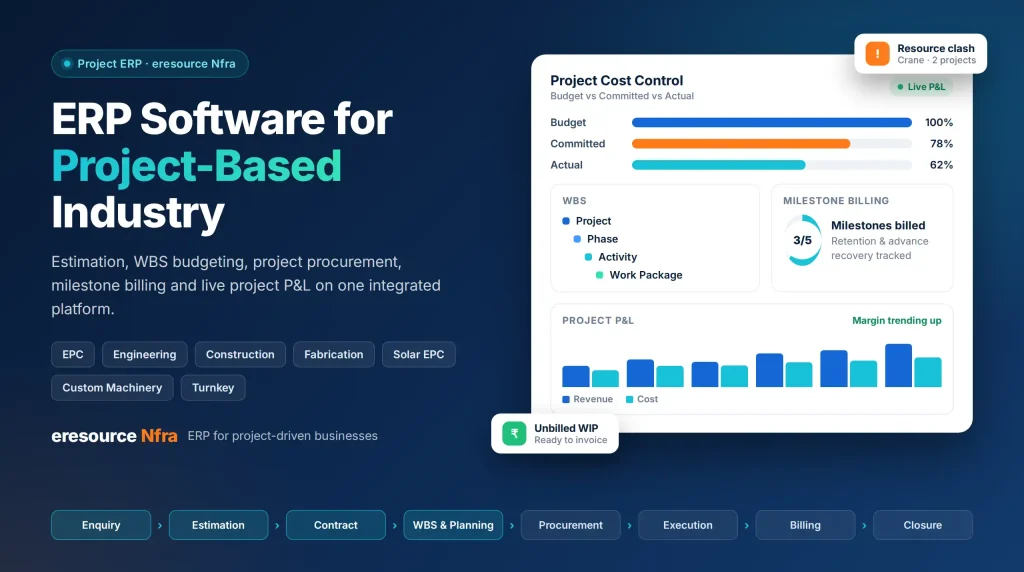
The current eresource project ERP solution specifically highlights budget-versus-actual-versus-committed tracking at WBS level.
Project Procurement Management
Procurement plays an important role in project delivery.
Project ERP software can connect purchase requirements with the relevant project and WBS activity.
Key procurement activities can include:
Purchase requisitions
Vendor quotations
Purchase orders
Goods receipt
Purchase invoices
Material issues
Material returns
Project-wise purchase tracking
Committed cost tracking
This helps project teams understand how procurement decisions affect project budgets.
Project Material and Inventory Management
Materials must reach the right project at the right time.
An ERP system can track project-specific inventory from receipt to consumption.
Businesses can monitor:
Project stock
Material receipts
Material issues
Material transfers
Material returns
Material consumption
Stock valuation
Project-wise material costs
This improves inventory visibility and reduces unnecessary material purchases.
Resource Planning and Timesheets
People are a major cost component in many project-based businesses.
Project ERP software can help allocate employees and other resources to projects.
Employees can record their working hours against specific projects, tasks, or WBS activities.
Timesheet information can then contribute to project costing.
Managers can use this information to identify:
Resource utilization
Overloaded teams
Idle resources
Project labour costs
Activity-level effort
Resource requirements
Equipment and Asset Cost Tracking
Some projects require machinery, tools, vehicles, or specialized equipment.
The ERP system can track equipment usage and allocate related costs to projects.
This may include:
Equipment deployment
Usage hours
Fuel expenses
Maintenance costs
Rental charges
Depreciation
Project allocation
This creates a clearer picture of the actual cost of project execution.
Project Expense Management
Project teams incur expenses during execution.
These expenses can include travel, accommodation, transportation, site expenses, and other project-related costs.
With ERP software, expenses can be recorded against the appropriate project and cost category.
Managers can then compare project expenses with the approved budget.
Project Progress Tracking
Project progress needs to be monitored continuously.
A project ERP can connect planned activities with actual progress.
Managers can monitor:
Planned completion
Actual completion
Pending activities
Milestone status
Cost performance
Resource utilization
Delays
Project risks
This helps management identify problems earlier.
Milestone and Progress Billing
Many project businesses receive payments based on milestones or project progress.
For example, billing may happen after:
Engineering completion
Material delivery
Installation
Testing
Commissioning
A project ERP can connect achieved milestones with billing activities.
The current eresource project ERP platform highlights milestone billing, retention, advance recovery, and unbilled WIP tracking.
Unbilled Work-in-Progress
Completed project work does not always become an invoice immediately.
This creates unbilled work-in-progress.
If businesses do not monitor unbilled WIP, completed work can remain outside the billing cycle.
Project ERP software can help identify completed but unbilled work.
This gives finance and project teams better visibility into potential billing and cash flow.
Subcontractor Management
Many project-based companies depend on subcontractors.
ERP software can help manage subcontractor work orders, progress, certifications, payments, retention, and related costs.
Businesses can track subcontractor performance against project budgets.
This is particularly useful for EPC, construction, engineering, fabrication, and turnkey businesses.
Project Accounting
Project accounting connects operational activities with financial information.
Instead of viewing accounting only at company level, businesses can analyze financial performance by project.
Project accounting can cover:
Project revenue
Project expenses
Material costs
Labour costs
Subcontractor costs
Equipment costs
Overheads
Receivables
Payables
Project WIP
Project profitability
This gives management a clearer financial view of every project.
Project Profitability Management
Project profitability depends on more than revenue.
A project may generate strong revenue but still deliver a low margin because of material price increases, resource costs, procurement commitments, or scope changes.
Project ERP software helps compare revenue with actual and expected costs.
Managers can therefore identify margin pressure earlier.
The current eresource Nfra project solution provides live project P&L and portfolio-level visibility.
Change and Scope Management
Project scope can change after work begins.
Client variations can affect:
Project budget
Materials
Labour
Resources
Timeline
Procurement
Billing
Profitability
An ERP system can help document project changes and connect approved variations with budgets and costs.
This improves control over scope-related financial impact.
Benefits of ERP Software for Project-Based Industry
Implementing a project-focused ERP can provide several benefits.
1. Better Project Cost Control
Managers can monitor project costs against budgets and commitments.
2. Improved Project Visibility
Project information becomes available through connected dashboards and reports.
3. Faster Project Reporting
Teams spend less time collecting data from different systems.
4. Better Resource Utilization
Project managers can allocate people and equipment more effectively.
5. Improved Procurement Control
Project-wise purchasing reduces uncontrolled procurement.
6. Faster Billing
Milestone and progress information can support timely invoicing.
7. Better Cash Flow Visibility
Unbilled work and receivables become easier to monitor.
8. Improved Project Profitability
Managers can identify cost deviations and margin risks earlier.
9. Better Collaboration
Project, finance, procurement, and management teams work with connected information.
10. Scalable Project Management
Businesses can manage multiple projects through a common ERP platform.
Industries That Can Use Project-Based ERP
Project-based ERP software can support many industries where each customer order or contract becomes a unique project.
EPC Companies
EPC companies manage engineering, procurement, construction, commissioning, and complex project costs.
Engineering Companies
Engineering firms can manage projects, resources, timesheets, expenses, milestones, and billing.
Construction Companies
Construction businesses can use project ERP for estimation, budgeting, procurement, subcontracting, site operations, and billing.
For construction-specific requirements, eresource also provides a dedicated construction and contracting ERP solution.
Custom Machinery Manufacturers
Businesses producing customized machinery can connect engineering, procurement, production, installation, and project costing.
Fabrication Companies
Fabrication businesses can manage project estimates, materials, production, subcontracting, dispatch, and project costs.
Turnkey Businesses
Turnkey companies can coordinate multiple activities from design and procurement through execution and handover.
Solar EPC Companies
Solar EPC businesses can manage project estimation, procurement, installation, commissioning, billing, and project profitability.
Engineering Services
Engineering service providers can manage client projects, employee hours, expenses, deliverables, and billing.
The current eresource project-business solution specifically identifies EPC, engineering, turnkey, custom machinery, fabrication, solar EPC, and engineering services among its target project-driven segments.
Project-Based ERP Workflow
A typical project ERP workflow can follow these stages:
Enquiry → Estimation → Proposal → Contract → WBS → Budget → Procurement → Execution → Progress → Billing → Accounting → Handover → Closure
This creates a connected project lifecycle.
The current eresource Nfra project solution presents an eight-stage lifecycle covering enquiry and estimation through warranty and support.
Key Modules in Project Management ERP Software
| ERP Module | Main Purpose |
|---|---|
| Project Management | Project planning and monitoring |
| Estimation | Project cost estimation |
| WBS | Activity and work-package control |
| Budgeting | Project budget management |
| Procurement | Project-wise purchasing |
| Inventory | Material tracking |
| Resource Management | People and equipment allocation |
| Timesheets | Project activity hours |
| Expense Management | Project expense tracking |
| Subcontracting | Subcontractor management |
| Billing | Milestone and progress billing |
| Finance | Project accounting |
| Reporting | Project performance analysis |
| Document Management | Project document control |
How to Choose ERP Software for Project-Based Business
Before selecting an ERP system, businesses should evaluate the platform against their project workflow.
Consider these factors:
Project Costing
Check whether the ERP can track project costs at detailed levels.
WBS Support
The system should support project phases, activities, and work packages.
Budget Control
Check whether the platform compares budget, actual, committed, and forecast costs.
Procurement Integration
Project purchasing should connect with project budgets and requirements.
Resource Management
The ERP should support resource allocation and timesheets.
Billing Flexibility
Check support for milestone, progress, retention, advance, and tax requirements.
Project Accounting
The system should provide project-level revenue, expenses, WIP, and profitability.
Reporting
Project dashboards should provide timely information for management decisions.
Scalability
The ERP should support multiple projects, locations, companies, and users as the business grows.
Why Choose eresource Nfra for Project-Based Businesses?
eresource Nfra is positioned by eresource as an ERP platform built specifically for project-driven businesses rather than as a generic ERP with an added project module.
Its current project-focused solution covers estimation and WBS budgeting, milestone billing, project procurement, committed cost, resources, timesheets, and project P&L.
The platform also identifies project lifecycle stages from enquiry and estimation through execution, billing, handover, and warranty support.
According to eresource, its project ERP has more than 20 years of project ERP experience and is used by 600+ project-driven companies across India, the UAE, and 25+ countries. These are company-reported figures.
Conclusion
ERP software for project based industry helps businesses manage the complete project lifecycle from estimation to final billing and closure.
It connects project budgets, WBS, procurement, inventory, resources, timesheets, expenses, subcontractors, billing, accounting, and profitability.
For project-driven businesses, this integrated approach can improve cost visibility, resource utilization, billing control, and project reporting.
Whether you manage EPC projects, engineering services, custom machinery, fabrication, turnkey projects, solar EPC, or construction activities, a project-focused ERP can provide a structured platform for managing projects and business operations.
Frequently Asked Questions
Common questions about project-based ERP
What is ERP software for project-based industry?
ERP software for project-based industry is a business management system designed to manage unique projects. It connects estimation, WBS, budgeting, procurement, resources, project costs, billing, accounting, and profitability.
What is project-based ERP software?
Project-based ERP software treats each project as a primary business unit. It tracks the project's budget, costs, resources, procurement, revenue, billing, and profitability.
How does ERP help project management?
ERP connects project planning with procurement, resources, inventory, finance, billing, and accounting. This gives managers better visibility into project progress and costs.
Can ERP track project profitability?
Yes. A project ERP can track project revenue, actual costs, committed costs, expenses, and other financial information to help calculate project profitability.
Can ERP manage multiple projects?
Yes. Project ERP systems can provide centralized visibility across multiple projects while maintaining separate budgets, costs, resources, and billing information.
Does project ERP support milestone billing?
Many project ERP systems support milestone and progress billing. The current eresource Nfra project solution includes milestone billing, retention, advance recovery, and unbilled WIP tracking.
Is project ERP useful for EPC companies?
Yes. EPC companies can use project ERP to connect engineering, procurement, construction, resources, subcontracting, project costs, and billing.
Is project ERP different from construction ERP?
Project ERP is a broader category. Construction ERP focuses on construction-specific workflows such as BOQ, site operations, subcontractors, and progress billing. Project ERP can also support engineering, EPC, fabrication, custom machinery, solar EPC, and other project-driven businesses.