11 Benefits of ERP in Construction Industry
The construction industry manages projects, materials, labour, subcontractors, equipment, budgets, and customer billing. Each project also has different timelines, contracts, locations, and cost requirements.
Managing these activities through spreadsheets and separate software can create information gaps. It can also make project monitoring and cost control more difficult.
ERP software for construction industry connects these activities through one integrated platform. It brings project planning, estimation, procurement, inventory, site operations, subcontracting, billing, accounting, and reporting into one system.
For construction companies, an ERP system can improve operational visibility and support better project management.
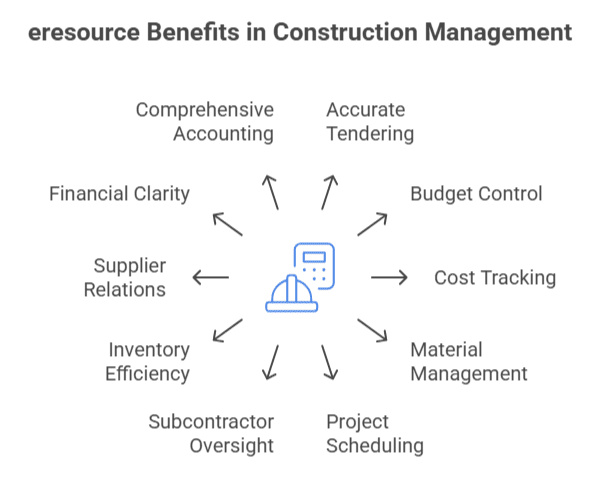
Here are 11 key benefits of ERP in construction industry.
1. Centralized Construction Project Management
Construction companies manage information from multiple departments and project sites.
An ERP system stores project information in one centralized platform.
Teams can access information related to:
Project budgets
BOQ
Project schedules
Purchase orders
Material stock
Site activities
Subcontractors
Labour
Client billing
Project expenses
Project profitability
This reduces dependency on disconnected spreadsheets and manual records.
Construction ERP platforms can connect project planning, BOQ, procurement, subcontractors, site operations, billing, and financial management in one system.
2. Better Project Cost Control
Project cost control is one of the most important benefits of ERP in construction industry.
Construction companies need to monitor costs throughout the project lifecycle.
ERP software can track:
Material costs
Labour costs
Equipment costs
Subcontractor costs
Site expenses
Procurement costs
Overheads
Project revenue
Management can compare the approved budget with actual costs.
This helps teams identify cost variations earlier.
Construction ERP systems can also provide budget-versus-actual tracking and variance reporting for materials, labour, and subcontractors.
3. Improved BOQ and Estimation Management
The Bill of Quantities is a critical part of construction projects.
ERP software can connect BOQ with estimation, procurement, project execution, and billing.
A construction ERP system can help manage:
BOQ preparation
Quantity estimation
Rate analysis
Material requirements
Labour requirements
Project budgets
BOQ revisions
Variation orders
This creates better continuity between tendering and project execution.
Current construction ERP workflows from eresource support multi-level BOQs, rate analysis, version control, and BOQ-based project budgeting.
4. Better Material and Inventory Management
Materials are a major cost component in construction.
Poor material control can lead to shortages, excess stock, wastage, and unplanned purchases.
Construction ERP software can track materials from procurement to site consumption.
It can manage:
Purchase orders
Material receipts
Site inventory
Material issues
Inter-site transfers
Material consumption
Material returns
Stock balances
Material wastage
Site-level inventory features can provide visibility into inward and outward material movements and site stock.
Better material visibility helps project teams plan purchases according to actual requirements.
5. Efficient Procurement Management
Construction projects require timely procurement.
A delay in purchasing critical material can affect project schedules.
ERP software connects project requirements with procurement activities.
The system can manage:
Material indents
Purchase requisitions
RFQs
Supplier quotations
Purchase orders
Material receipts
Vendor invoices
Supplier information
This creates a connected procurement workflow.
For example:
Site Requirement → Material Indent → Approval → Purchase Order → Material Receipt → Site Stock
This reduces manual coordination between site, purchase, stores, and accounts teams.
6. Improved Subcontractor Management
Subcontractors play an important role in many construction projects.
Companies need to track their work, quantities, contracts, bills, deductions, and payments.
Construction ERP software can manage:
Subcontractor work orders
Contract rates
BOQ quantities
Work completion
Joint measurements
Progress certification
Subcontractor bills
Retention
Advances
Deductions
Payment status
Modern construction ERP workflows can connect subcontractor work orders with measurements and RA billing.
This gives project managers better visibility into subcontractor performance and costs.
7. Faster Progress Billing and Invoicing
Construction billing often depends on completed work and measured quantities.
Manual billing can take considerable time.
ERP software can connect project progress with client billing.
It can support:
Progress measurement
BOQ-based billing
Milestone billing
Running Account bills
Retention
Advance recovery
Deductions
Variation orders
Invoice generation
When site measurements connect directly with billing, teams can reduce repeated data entry.
Current eresource construction workflows support progressive or RA billing linked with BOQ quantities and project progress.
8. Better Site and Labour Management
Construction activities take place across different sites.
Head-office teams need timely information from project locations.
ERP software can help capture:
Daily site progress
Labour attendance
Manpower deployment
Work completed
Material usage
Site expenses
Equipment usage
Site issues
Mobile-enabled ERP workflows can allow site teams to record progress and raise material requirements from the project location.
This improves communication between site teams and project management.
9. Improved Project Accounting and Profitability Tracking
Construction companies need project-level financial visibility.
Traditional accounting systems may show overall business figures without providing enough project detail.
Construction ERP software can connect financial transactions with individual projects.
It can track:
Project revenue
Material expenses
Labour expenses
Subcontractor costs
Equipment costs
Site expenses
Accounts receivable
Accounts payable
Project profit
Project loss
This allows management to review project profitability more frequently.
Project accounting systems can provide project-wise P&L and visibility into costs, revenue, and margins.
10. Real-Time Reporting and Decision Support
Construction managers need accurate information to make timely decisions.
ERP software provides centralized data for reporting and analysis.
Management can monitor:
Project progress
Budget versus actual cost
Material consumption
Procurement status
Outstanding payments
Subcontractor bills
Project revenue
Project profitability
Pending activities
Dashboards can help management identify issues without waiting for separate reports from every department.
This is particularly useful for companies managing multiple projects and locations.
11. Improved Operational Efficiency and Scalability
An integrated ERP system can reduce repetitive manual work.
Instead of maintaining separate records, teams can work with connected information.
For example:
Project → BOQ → Procurement → Material → Site Execution → Measurement → Billing → Accounting
When these processes share the same data, departments can coordinate more efficiently.
ERP also provides a structured platform for companies that are expanding their project portfolio.
A construction business can manage additional sites, users, projects, contractors, materials, and transactions within the same ERP environment.
Additional Benefits of Construction ERP Software
The 11 benefits above cover the major operational advantages. Construction companies can also gain value from other ERP capabilities.
Better Document Management
Construction projects generate many documents.
These may include:
Contracts
Drawings
BOQs
Purchase documents
Work orders
Invoices
Inspection records
Project reports
Digital document management makes information easier to organize and retrieve.
Improved Data Accuracy
Integrated ERP systems reduce the need to enter the same information into multiple applications.
This can reduce duplication and improve data consistency.
Better Multi-Project Visibility
Management can monitor several projects through a centralized system.
This helps compare project performance and identify areas that need attention.
Improved Compliance Management
Construction companies may need to manage tax, labour, contract, and project-specific compliance requirements.
A suitable ERP can integrate relevant compliance workflows into financial and project processes.
How Construction ERP Improves the Project Lifecycle
A construction ERP system can connect the complete project lifecycle.
Stage 1: Tendering
Teams register tenders and manage bid documents.
Stage 2: Estimation
The company prepares BOQs, rate analysis, and project estimates.
Stage 3: Project Planning
Managers define schedules, resources, budgets, and project milestones.
Stage 4: Procurement
Purchase teams procure materials according to project requirements.
Stage 5: Site Execution
Site teams record work progress, material usage, labour, and activities.
Stage 6: Subcontracting
Subcontractor work orders and completed quantities are tracked.
Stage 7: Billing
Measured work is used for client and subcontractor billing.
Stage 8: Project Accounting
Financial transactions are connected with project costs and revenue.
Stage 9: Project Monitoring
Management reviews progress, costs, billing, and profitability.
This integrated workflow provides better visibility from tender to project completion.
Construction Industries That Can Benefit From ERP
Construction ERP software can support different types of project-based businesses.
These include:
Civil contractors
Building contractors
Infrastructure companies
EPC companies
General contractors
MEP contractors
HVAC contractors
Interior fit-out companies
Road and bridge contractors
Metro and railway contractors
Government contractors
Real estate developers
Solar and renewable EPC companies
eresource currently provides construction-specific ERP workflows for civil contractors, fit-out firms, metro and railway projects, MEP and HVAC services, roads and bridges, EPC projects, infrastructure development, and other project-based businesses.
What to Consider Before Choosing Construction ERP Software
Not every ERP system provides the same construction capabilities.
Before selecting a solution, evaluate the following areas.
BOQ and Estimation
Check whether the system supports BOQ management, rate analysis, estimation, revisions, and variation orders.
Project Costing
Check whether you can compare project budgets with actual costs.
Material Management
Evaluate site inventory, material issues, transfers, consumption, and reconciliation.
Subcontractor Management
Check work orders, measurements, billing, retention, advances, and deductions.
Billing
Evaluate progress billing, milestone billing, RA billing, retention, and advance recovery.
Site Management
Check whether site teams can record progress and requirements easily.
Project Accounting
Make sure project revenue and costs can connect with financial accounting.
Reporting
Review project dashboards, cost reports, progress reports, and profitability reports.
Why eresource Nfra for Construction ERP?
eresource Nfra is a construction-focused ERP platform designed around project-based and contracting workflows.
Its current construction ERP offering covers tendering, estimation and BOQ, project planning, budgeting, material indents, site stores, subcontractor management, labour and contractor billing, and project monitoring.
The platform also supports construction-specific workflows such as progressive billing, retention, subcontractor certification, material reconciliation, and project-wise financial control.
This makes the platform relevant for businesses that need to connect project execution with procurement, materials, subcontractors, billing, and accounting.
Conclusion
The construction industry requires coordination between project planning, procurement, materials, labour, subcontractors, site execution, billing, and finance.
The benefits of ERP in construction industry come from connecting these processes through one integrated system.
From better project cost control to improved material management and faster billing, construction ERP can provide greater operational visibility.
A suitable construction ERP system can also connect BOQ, project planning, procurement, site activities, subcontractors, billing, and project accounting.
For construction and contracting businesses, eresource Nfra provides construction-focused ERP capabilities across tendering, BOQ, budgeting, site operations, subcontracting, billing, materials, labour, and project monitoring.
Businesses should evaluate their project workflows and select an ERP system that supports their current operations while providing room for future growth.
Frequently Asked Questions
Common questions about ERP for the construction industry
What are the benefits of ERP in construction industry?
The major benefits include centralized project management, better cost control, improved BOQ management, material tracking, procurement management, subcontractor control, faster billing, better site management, project accounting, reporting, and operational efficiency.
How does ERP reduce construction project costs?
ERP connects project budgets with actual expenses. It can track materials, labour, subcontractors, equipment, procurement, and other project costs. This helps teams identify cost variations earlier.
Can construction ERP manage multiple projects?
Yes. A suitable construction ERP can manage multiple projects, sites, contractors, budgets, materials, and financial transactions through a centralized system.
Does construction ERP support BOQ?
Yes. Construction ERP can manage BOQs, quantities, rates, estimates, revisions, variation orders, project budgets, and billing.
Can ERP manage subcontractors?
Yes. Construction ERP can manage subcontractor work orders, measurements, progress, bills, retention, advances, deductions, and payments.
How does ERP improve construction billing?
ERP can connect measured project progress with client billing. It can support progress billing, milestone billing, RA bills, retention, deductions, and advance recovery.
Can ERP manage construction materials?
Yes. ERP can track material procurement, receipts, site stock, issues, transfers, consumption, returns, and wastage.
Can ERP improve project profitability?
ERP provides project-level visibility into revenue and costs. This helps management monitor project profitability and identify cost variations.
Is construction ERP useful for small contractors?
Yes. Small contractors can use ERP to organize project, procurement, material, billing, and accounting processes. The system should match their current requirements and growth plans.