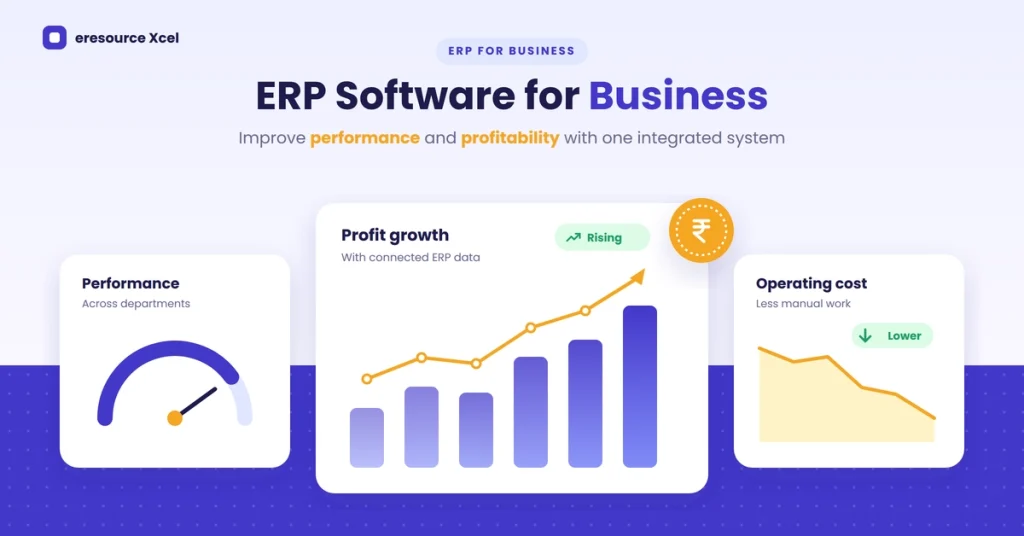
ERP Software for Business: Improve Performance and Profitability
Every business aims to improve performance and achieve its goals.
However, managing different departments can become difficult as a company grows.
Businesses need clear planning, strong communication, and efficient processes.
They also need accurate data to make better decisions.
ERP software brings these business functions together. It helps organizations manage daily operations from one integrated system.
With the right ERP software for business, companies can improve efficiency, control costs, and support profitable growth.
How ERP Software Improves Business Performance
ERP software helps businesses manage their key operations in one place.
It connects departments and gives teams access to shared business information.
Good planning also plays an important role in business performance.
A dedicated management team can use ERP data to monitor daily activities.
The system can also help managers track department performance.
As a result, they can identify areas that need improvement.
For example, managers can review operational data and find process gaps.
They can then provide the right training to employees.
Therefore, ERP software can support better productivity across different business functions.
Better Performance and Productivity
Business performance depends on several important factors.
These factors include planning, leadership, skilled employees, and effective technology.
An ERP system supports these areas by connecting business processes.
Employees can access relevant information without relying on multiple systems.
Managers can also monitor business activities more efficiently.
This makes it easier to identify delays and process issues.
In addition, employees can spend less time searching for information.
They can focus more on their core responsibilities.
As a result, ERP software can help improve overall business productivity.
Better Control Over Accounting
ERP software gives businesses better visibility into financial information.
For example, managers can review revenue, expenses, and profit data.
They can also monitor financial activities across different departments.
Business analytics can provide additional insights into company performance.
These insights help management understand financial trends.
Furthermore, accurate financial data supports better planning and control.
Managers can use this information when making important business decisions.
Therefore, ERP software can improve accounting visibility and financial management.
Cost-Effective Business Operations
Every organization looks for ways to control operating costs.
At the same time, businesses need to maintain service and product quality.
An ERP solution can help reduce unnecessary operating costs.
The system can track inventory and organize stock information.
It can also reduce errors caused by manual data entry.
Moreover, ERP software connects information across different departments.
This helps reduce communication gaps and duplicate work.
Employees can access current business information from one system.
Therefore, they can complete tasks with less manual effort.
An integrated ERP system can also reduce the need for multiple disconnected software systems.
This approach can simplify business management and improve operational efficiency.
ERP Software That Supports Business Requirements
Every business has different operational requirements.
Therefore, companies need software that can support their specific processes.
An ERP system can connect essential business activities through one platform.
This helps employees manage their daily responsibilities more efficiently.
Managers can also monitor important business information from different departments.
As a result, they can respond to business needs more quickly.
ERP software can become even more valuable as a company expands.
It can help businesses manage increasing data, employees, customers, and processes.
Furthermore, better process control can help companies improve their customer service.
It can also support consistent operations across different business locations.
Key Benefits of ERP Software for Business
A well-planned ERP system can provide several business benefits:
Better business performance
Improved accounting control
Lower operating costs
Better inventory management
Improved communication between departments
Faster access to business information
Reduced manual errors
Better employee productivity
Improved business visibility
More efficient decision-making
These benefits can help businesses manage their operations more effectively.
They can also support long-term business growth and profitability.
Conclusion
ERP software for business can connect people, processes, and information in one system.
It helps organizations improve operational efficiency and gain better business visibility.
In addition, ERP software can support accounting control and cost management.
It can also improve communication between departments and reduce manual work.
As a result, businesses can use ERP technology to manage daily operations more effectively.
The right ERP solution can also provide a strong foundation for future business growth.